
Practice Free AZ-400 Exam Online Questions
HOTSPOT
You use Azure DevOps to manage the build and deployment of an app named App1.
You have a release pipeline that deploys a virtual machine named VM1.
You plan to monitor the release pipeline by using Azure Monitor
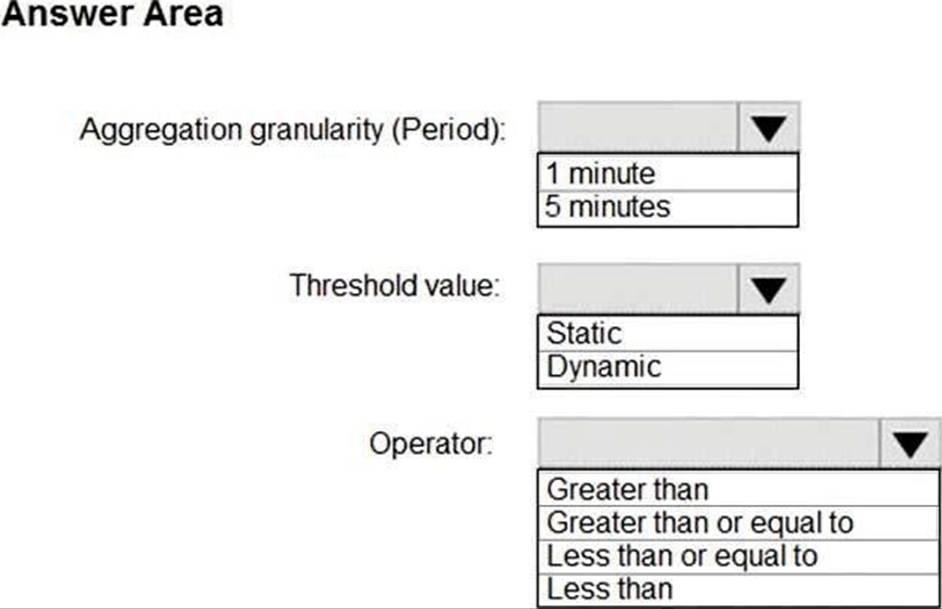
You need to create an alert to monitor the performance of VM1. The alert must be triggered when the average CPU usage exceeds 70 percent for five minutes. The alert must calculate the average once every minute.
How should you configure the alert rule? To answer, select the appropriate options in the answer area.
Explanation:
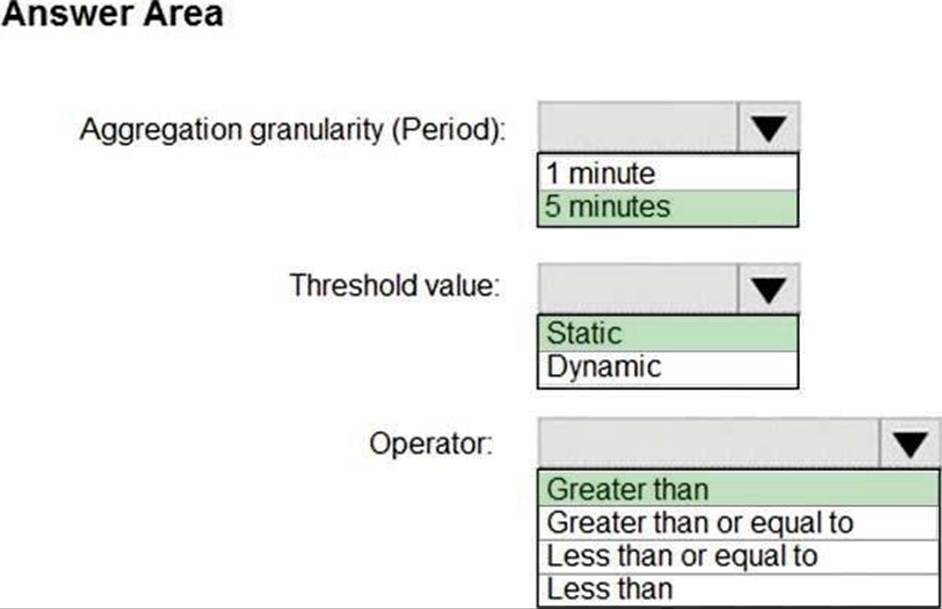
Box 1: 5 minutes
The alert must calculate the average once every minute.
Note: We [Microsoft] recommend choosing an Aggregation granularity (Period) that is larger than the Frequency of evaluation, to reduce the likelihood of missing the first evaluation of added time series
Box 2: Static
Box 3: Greater than
Example, say you have an App Service plan for your website. You want to monitor CPU usage on multiple instances running your web site/app.
You can do that using a metric alert rule as follows:
Target resource: myAppServicePlan
Metric: Percentage CPU
Condition Type: Static
Dimensions
Instance = InstanceName1, InstanceName2
Time Aggregation: Average
Period: Over the last 5 mins
Frequency: 1 min
Operator: GreaterThan
Threshold: 70
Like before, this rule monitors if the average CPU usage for the last 5 minutes exceeds 70%. Aggregation granularity
Reference: https://docs.microsoft.com/en-us/azure/azure-monitor/platform/alerts-metric-overview
DRAG DROP
You use an Azure pipeline to build a .NET app that has NuGet dependencies.
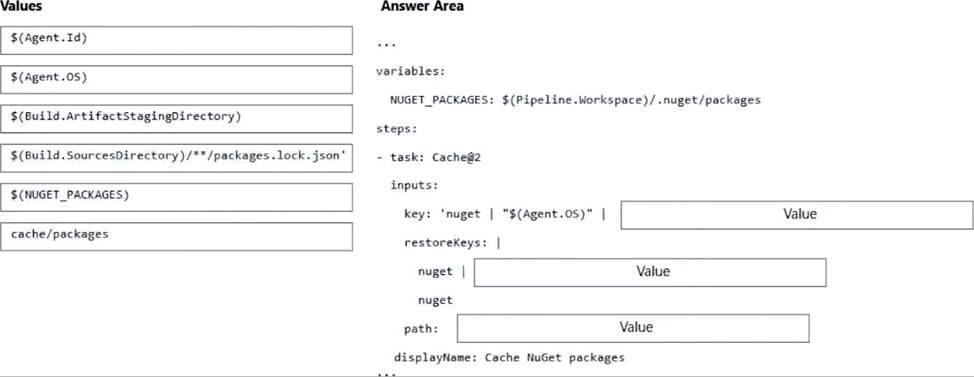
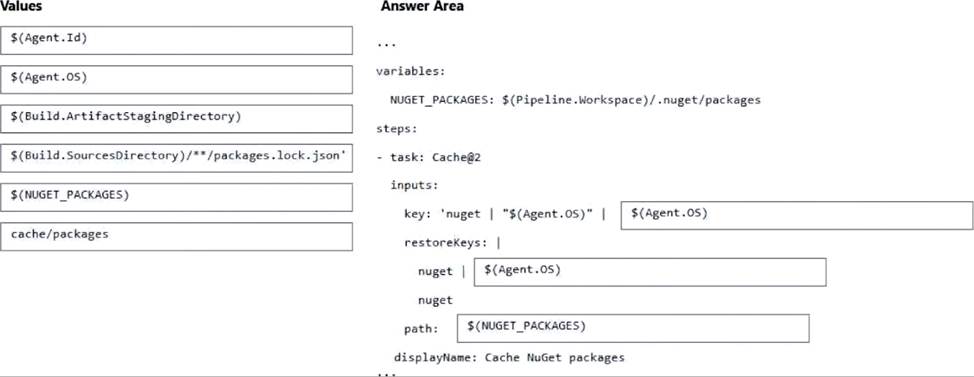
You need to ensure that the pipeline caches required NuGet packages.
How should you configure the pipeline? To answer, drag the appropriate values to the correct targets. Each value may be used once, more than once, or not at all. You may need to drag the split bar between panes or scroll to view content. NOTE: Each correct selection is worth one point.
DRAG DROP
You use an Azure pipeline to build a .NET app that has NuGet dependencies.
You need to ensure that the pipeline caches required NuGet packages.
How should you configure the pipeline? To answer, drag the appropriate values to the correct targets. Each value may be used once, more than once, or not at all. You may need to drag the split bar between panes or scroll to view content. NOTE: Each correct selection is worth one point.
Note: This question is part of a series of questions that present the same scenario. Each question in the series contains a unique solution that might meet the stated goals. Some question sets might have more than one correct solution, while others might not have a correct solution.
After you answer a question in this section, you will NOT be able to return to it. As a result, these questions will not appear in the review screen.
The lead developer at your company reports that adding new application features takes longer than expected due to a large accumulated technical debt.
You need to recommend changes to reduce the accumulated technical debt.
Solution: You recommend increasing the code duplication.
Does this meet the goal?
- A . Yes
- B . No
B
Explanation:
Instead reduce the code complexity.
Reference: https://dzone.com/articles/fight-through-the-pain-how-to-deal-with-technical
You use Azure Pipelines to build and release application code, The pipelines include validation tests that must be completed successfully before deployment proceeds from the test stage to production.
You discover inconsistent test outcomes for the same source code.
You need to validate the test logic.
What should you do?
- A . Decrease the test pass rate.
- B . Configure a parallel test runner.
- C . Enable flaky test detection.
- D . Install the Analytics extension.