
Practice Free AZ-400 Exam Online Questions
SIMULATION
You plan to implement a CI/CD strategy for an Azure Web App named az400-11566895-main.
You need to configure a staging environment for az400-11566895-main.
To complete this task, sign in to the Microsoft Azure portal.
SIMULATION
Task 11
You need to write a KQL query that will count the number of inbound requests for each source IP address, for any connection made during the last three months of 2021.
Open Azure Data Explorer by using the following link:
https//dataexploter azure.com/clusters/help/databases/Securiitylogs
The requests are contained in a table named InboundBrowsing in the Securitylogs connection.
The query must return two columns named NumberOfRequests and SourcelP.
Export the query result to C:Samples
Open Azure Data Explorer:
Navigate to Azure Data Explorer and sign in with your credentials.
Access the Securitylogs Database:
Open the Securitylogs database.
Write the Query:
Use the following KQL query tocount the number of inbound requests for each source IP address:
InboundBrowsing
| where Timestamp between (datetime(2021-10-01) .. datetime(2021-12-31))
| summarize NumberOfRequests = count() by SourceIP
| project SourceIP, NumberOfRequests
Step 2: Export the Query Results
Run the Query:
Execute the query in Azure Data Explorer.
Export the Results:
Once the query results are displayed, click on the Export button.
Choose the export format (e.g., CSV) and specify the export path as C:Samples.
By following these steps, you will have successfully written a KQL query to count the number of inbound requests for each source IP address during the last three months of 2021 and exported the results to C:Samples
SIMULATION
You need to ensure that Microsoft Visual Studio 2017 can remotely attach to an Azure Function named fa-11566895.
To complete this task, sign in to the Microsoft Azure portal.
Before we start a debugging session to our Azure Function app we need to enable the functionality.
Navigate in the Azure portal to your function app fa-11566895 Go to the “Application settings”
Under “Debugging” set Remote Debugging to On and set Remote Visual Studio version to 2017.
Reference: https://www.locktar.nl/uncategorized/azure-remote-debugging-manually-in-visual-studio-2017/
SIMULATION
You need to ensure that Microsoft Visual Studio 2017 can remotely attach to an Azure Function named fa-11566895.
To complete this task, sign in to the Microsoft Azure portal.
Before we start a debugging session to our Azure Function app we need to enable the functionality.
Navigate in the Azure portal to your function app fa-11566895 Go to the “Application settings”
Under “Debugging” set Remote Debugging to On and set Remote Visual Studio version to 2017.
Reference: https://www.locktar.nl/uncategorized/azure-remote-debugging-manually-in-visual-studio-2017/
SIMULATION
You need to ensure that Microsoft Visual Studio 2017 can remotely attach to an Azure Function named fa-11566895.
To complete this task, sign in to the Microsoft Azure portal.
Before we start a debugging session to our Azure Function app we need to enable the functionality.
Navigate in the Azure portal to your function app fa-11566895 Go to the “Application settings”
Under “Debugging” set Remote Debugging to On and set Remote Visual Studio version to 2017.
Reference: https://www.locktar.nl/uncategorized/azure-remote-debugging-manually-in-visual-studio-2017/
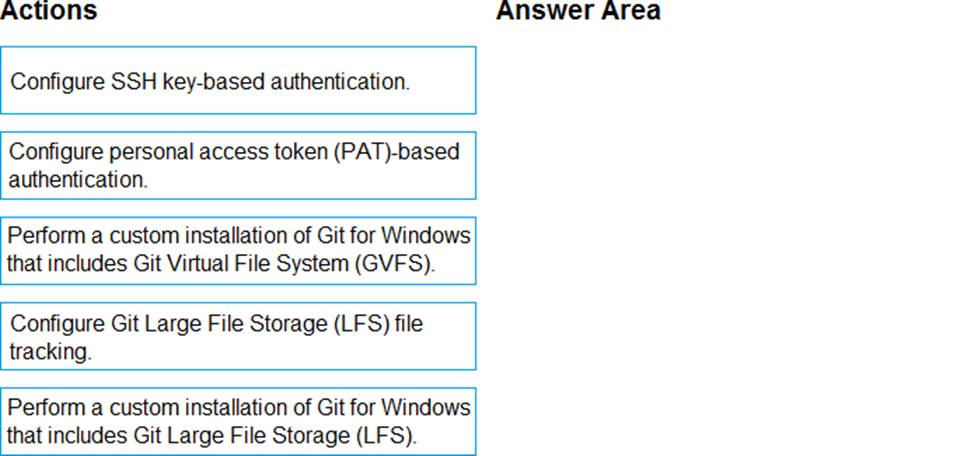
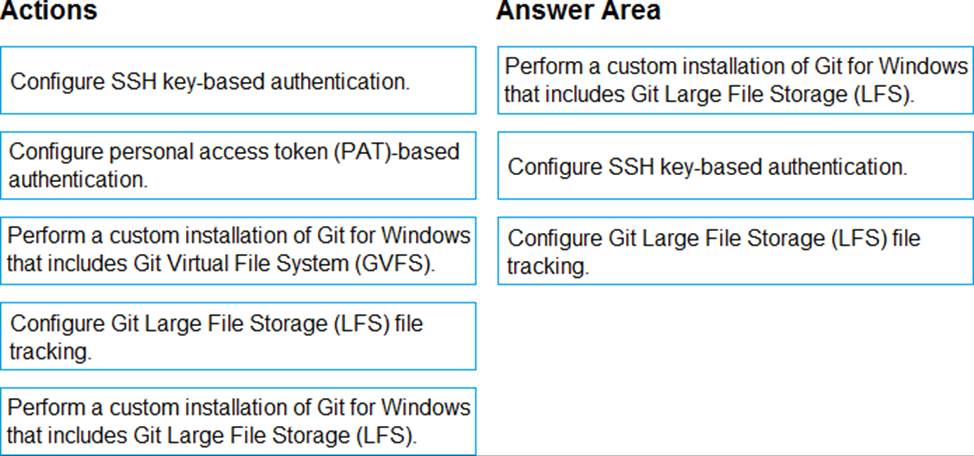
DRAG DROP
Your company has a project in Azure DevOps named Project1.
All the developers at the company have Windows 10 devices.
You need to create a Get repository for Project1.
The solution must meet the following requirements:
• Support large binary files.
• Store binary files outside of the repository.
• Use a standard Get workflow to maintain the metadata of the binary files by using commits to the repository.
Note: This question is part of a series of questions that present the same scenario. Each question in the series contains a unique solution that might meet the stated goals. Some question sets might have more than one correct solution, while others might not have a correct solution.
After you answer a question in this section, you will NOT be able to return to it. As a result, these questions will not appear in the review screen.
You have an Azure DevOps organization named Contoso and an Azure subscription. The subscription contains an Azure virtual machine scale set named VMSS1 that is configured for auto scaling.
You have a project in Azure DevOps named Project1. Project1 is used to build a web app named App1 and deploy App1 to VMSS1.
You need to ensure that an email alert is generated whenever VMSS1 scales in or out.
Solution: From Azure DevOps, configure the Service hooks settings for Project1.
Does this meet the goal?
- A . Yes
- B . No
Note: This question is part of a series of questions that present the same scenario. Each question in the series contains a unique solution that might meet the stated goals. Some question sets might have more than one correct solution, while others might not have a correct solution.
After you answer a question in this section, you will NOT be able to return to it. As a result, these questions will not appear in the review screen.
You plan to update the Azure DevOps strategy of your company.
You need to identify the following issues as they occur during the company’s development process:
✑ Licensing violations
✑ Prohibited libraries
Solution: You implement automated security testing.
Does this meet the goal?
- A . Yes
- B . No
B
Explanation:
Instead use implement continuous integration.
Note: WhiteSource is the leader in continuous open source software security and compliance management. WhiteSource integrates into your build process, irrespective of your programming languages, build tools, or development environments. It works automatically, continuously, and silently in the background, checking the security, licensing, and quality of your open source components against WhiteSource constantly-updated definitive database of open source repositories.
Reference: https://azuredevopslabs.com/labs/vstsextend/whitesource/
Note: This question is part of a series of questions that present the same scenario. Each question in the series contains a unique solution that might meet the stated goals. Some question sets might have more than one correct solution, while others might not have a correct solution.
After you answer a question in this section, you will NOT be able to return to it. As a result, these questions will not appear in the review screen.
You plan to update the Azure DevOps strategy of your company.
You need to identify the following issues as they occur during the company’s development process:
✑ Licensing violations
✑ Prohibited libraries
Solution: You implement automated security testing.
Does this meet the goal?
- A . Yes
- B . No
B
Explanation:
Instead use implement continuous integration.
Note: WhiteSource is the leader in continuous open source software security and compliance management. WhiteSource integrates into your build process, irrespective of your programming languages, build tools, or development environments. It works automatically, continuously, and silently in the background, checking the security, licensing, and quality of your open source components against WhiteSource constantly-updated definitive database of open source repositories.
Reference: https://azuredevopslabs.com/labs/vstsextend/whitesource/
You have an Azure Resource Manager (ARM) template that contains the following expression.
[if(parameters(‘isComplete’), ‘1a’, ‘2a’)]
You need to migrate the template to Bicep.
Which expression should you run?
- A . iif(isComplete, ‘1a’, ‘2a’)
- B . if(isComplete, ‘1a’, ‘2a’)
- C . if(‘isComplete’) ‘1a’ else ‘2a’
- D . isComplete ? ‘1a’ ‘2a’