Practice Free AZ-400 Exam Online Questions
Note: This section contains one or more sets of questions with the same scenario and problem. Each question presents a unique solution to the problem. You must determine whether the solution meets the stated goals. More than one solution in the set might solve the problem. It is also possible that none of the solutions in the set solve the problem.
After you answer a question in this section, you will NOT be able to return. As a result, these questions do not appear on the Review Screen.
You have an on-premises web server named Server1.
You need to ensure that you can build .NET apps and deploy the apps to Server1 by using Azure Pipelines.
Solution: You deploy a virtual machine scale set and select the [small disk] Windows Server 2019 Datacenter – x64 Gen 1 image.
Does this meet the goal?
- A . Yes
- B . No
HOTSPOT
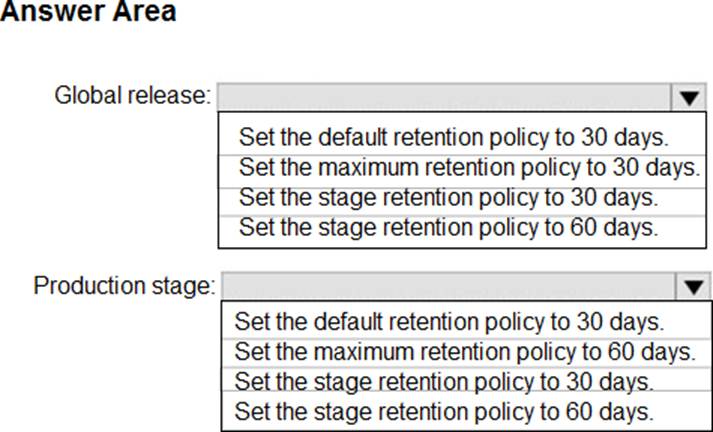
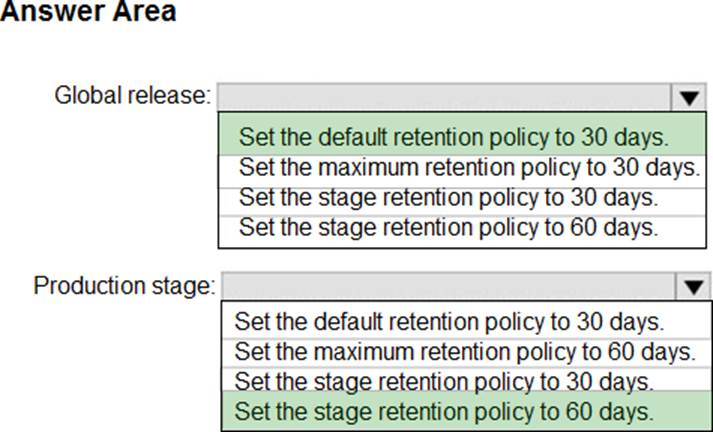
How should you configure the release retention policy for the investment planning applications suite? To answer, select the appropriate options in the answer area. NOTE: Each correct selection is worth one point.
Explanation:
Scenario: By default, all releases must remain available for 30 days, except for production releases, which must be kept for 60 days.
Box 1: Set the default retention policy to 30 days
The Global default retention policy sets the default retention values for all the build pipelines.
Authors of build pipelines can override these values.
Box 2: Set the stage retention policy to 60 days
You may want to retain more releases that have been deployed to specific stages.
Reference: https://docs.microsoft.com/en-us/azure/devops/pipelines/policies/retention
2You have a GitHub repository.
You need to ensure that all changes to code are validated by your company’s security department before the main branch is deployed.
Which two actions can you perform? Each correct answer presents a complete solution. NOTE: Each correct selection is worth one point.
- A . Create a branch protection rule for the feature branches.
- B . Create a branch protection rule for the main branch.
- C . Create a LICENSE file.
- D . Require signed commits.
- E . Create a CODEOWNERS file.
2You have a GitHub repository.
You need to ensure that all changes to code are validated by your company’s security department before the main branch is deployed.
Which two actions can you perform? Each correct answer presents a complete solution. NOTE: Each correct selection is worth one point.
- A . Create a branch protection rule for the feature branches.
- B . Create a branch protection rule for the main branch.
- C . Create a LICENSE file.
- D . Require signed commits.
- E . Create a CODEOWNERS file.
DRAG DROP
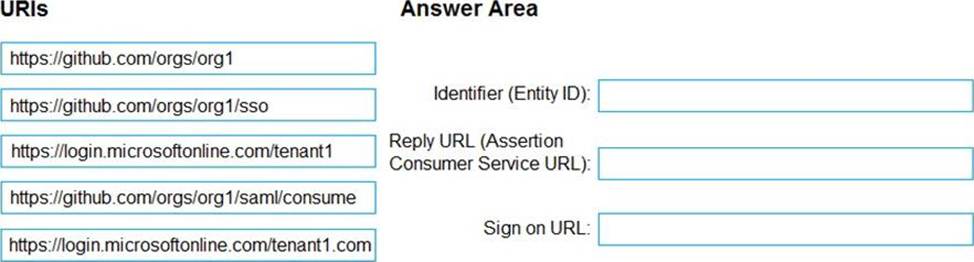
You have a GitHub organization named org1 and an Azure tenant named Tenant1.
You need to enable single sign-on (SSO) in Azure Active Directory (Azure AD) for the users in org1.
Which URIs should you use for the SAML configuration in Azure AD? To answer, drag the appropriate URIs to the correct settings. Each URI may be used once, more than once, or not at all. You may need to drag the split bar between panes or scroll to view content. NOTE: Each correct selection is worth one point.
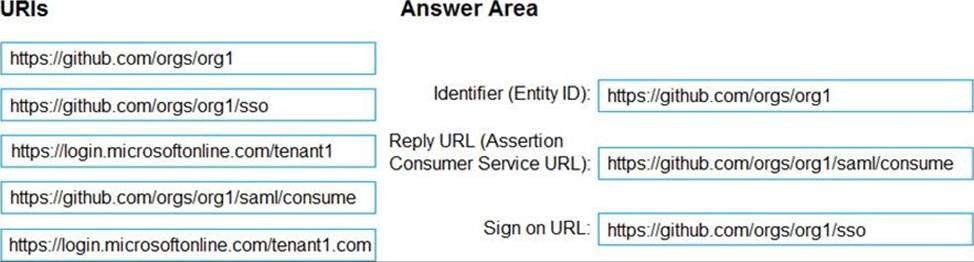
Explanation:
Reference: https://docs.microsoft.com/en-us/azure/active-directory/saas-apps/github-tutorial
HOTSPOT
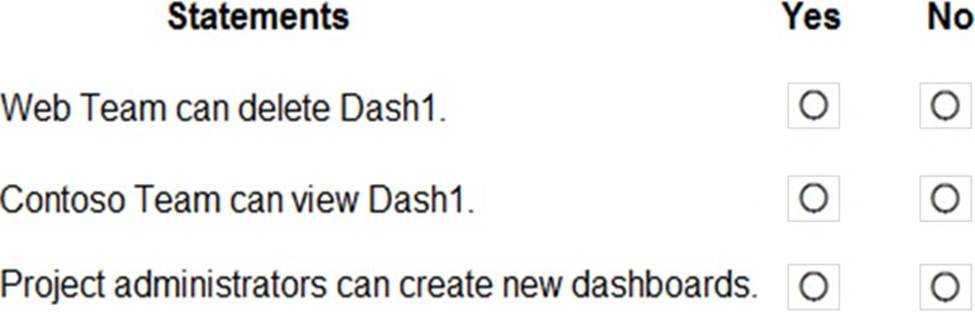
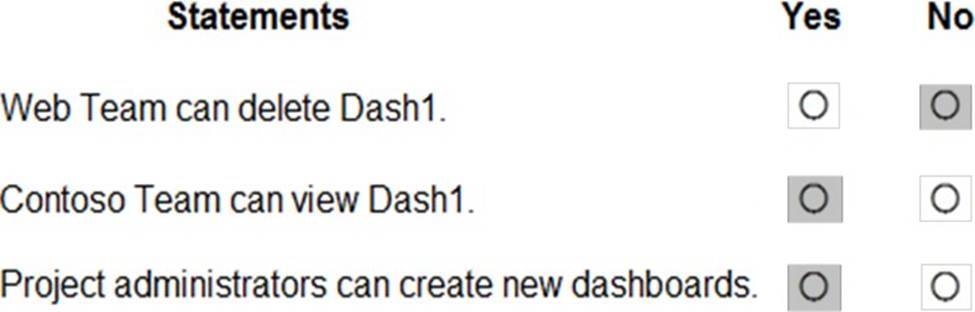
You have a project in Azure DevOps that has three teams as shown in the Teams exhibit. (Click the Teams tab.)
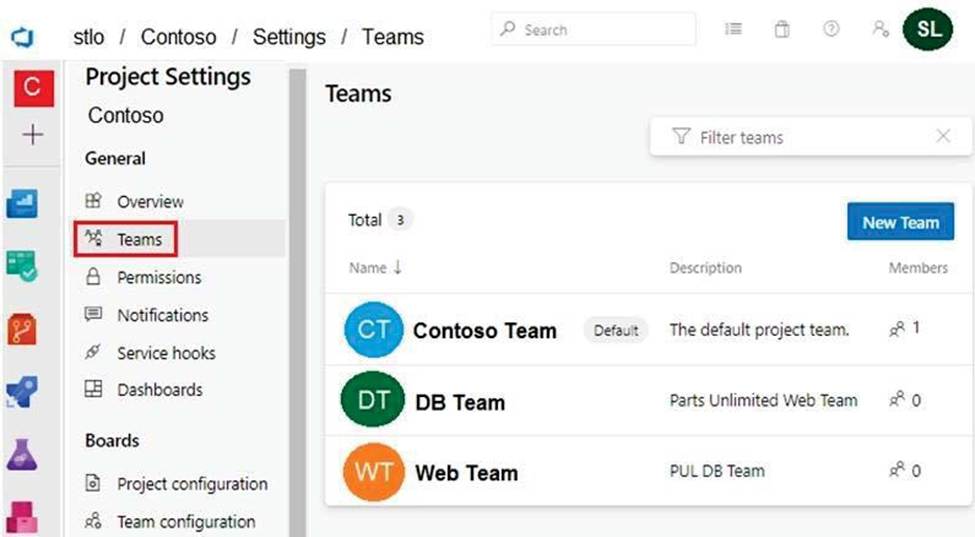
You create a new dashboard named Dash1.
You configure the dashboard permissions for the Contoso project as shown in the Permissions exhibit (Click the Permissions tab.)
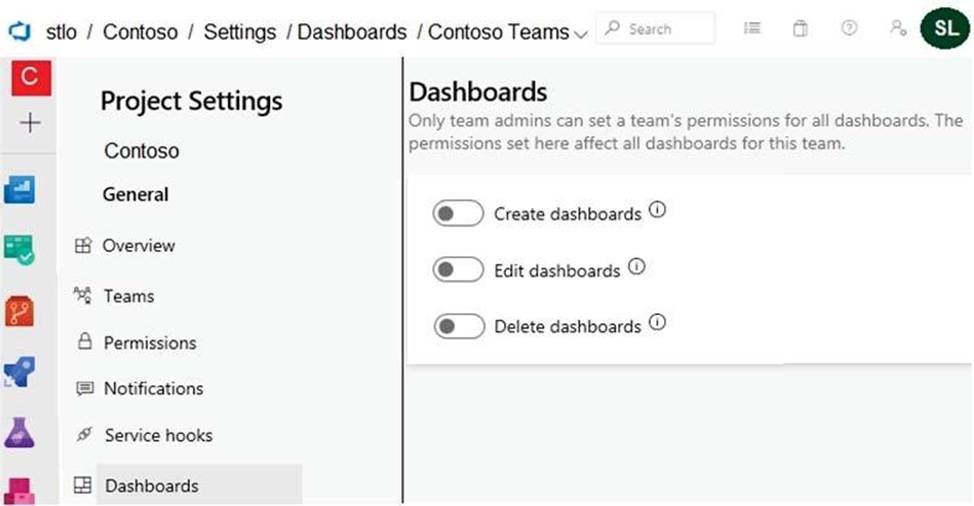
All other permissions have the default values set.
Note: This question is part of a series of questions that present the same scenario. Each question in the series contains a unique solution that might meet the stated goals. Some question sets might have more than one correct solution, while others might not have a correct solution.
After you answer a question in this section, you will NOT be able to return to it. As a result, these questions will not appear in the review screen.
You plan to create a release pipeline that will deploy Azure resources by using Azure Resource Manager templates.
The release pipeline will create the following resources:
✑ Two resource groups
✑ Four Azure virtual machines in one resource group
✑ Two Azure SQL databases in other resource group
You need to recommend a solution to deploy the resources.
Solution: Create a main template that has two linked templates, each of which will deploy the resource in its respective group.
Does this meet the goal?
- A . Yes
- B . No
A
Explanation:
To deploy your solution, you can use either a single template or a main template with many related templates. The related template can be either a separate file that is linked to from the main template, or a template that is nested within the main template.
Reference: https://docs.microsoft.com/en-us/azure/azure-resource-manager/resource-group-linked-templates
Note: This question is part of a series of questions that present the same scenario. Each question in the series contains a unique solution that might meet the stated goals. Some question sets might have more than one correct solution, while others might not have a correct solution.
After you answer a question in this section, you will NOT be able to return to it. As a result, these questions will not appear in the review screen.
You plan to create a release pipeline that will deploy Azure resources by using Azure Resource Manager templates.
The release pipeline will create the following resources:
✑ Two resource groups
✑ Four Azure virtual machines in one resource group
✑ Two Azure SQL databases in other resource group
You need to recommend a solution to deploy the resources.
Solution: Create a main template that has two linked templates, each of which will deploy the resource in its respective group.
Does this meet the goal?
- A . Yes
- B . No
A
Explanation:
To deploy your solution, you can use either a single template or a main template with many related templates. The related template can be either a separate file that is linked to from the main template, or a template that is nested within the main template.
Reference: https://docs.microsoft.com/en-us/azure/azure-resource-manager/resource-group-linked-templates
SIMULATION
Task 8
You need to ensure that the https://contoso.com/statushook webhook is called every time a repository named az40038443478acr 1 receives a new version of an image named dot netapp
Navigate to the Azure Container Registry:
Go to the Azure Portal.
Find and select your Azure Container Registry instanceaz40038443478acr1.
Create a New Webhook:
UnderServices, selectWebhooks.
Click on+ Addto create a new webhook.
Fill in the form with the following information:
Webhook name: Enter a unique name for your webhook.
ServiceURI: Enterhttps://contoso.com/statushook.
Custom headers: (Optional) Add any headers you want to pass along with the POST request.
Trigger actions: SelectPushto trigger the webhook on image push events.
Scope: Specify the scope asaz40038443478acr1: dotnetappto target the specific image.
Status: Set toEnabled.
Save the Webhook Configuration:
Review the information and clickCreateto save the webhook.
Once configured, the webhook will send a POST request tohttps://contoso.com/statushookwhenever a new version of thedotnetappimage is pushed to theaz40038443478acr1repository in your Azure Container Registry1.
This setup will automate the notification process, ensuring that the specified webhook is called with each new image version, thus fulfilling the task requirements.
DRAG DROP
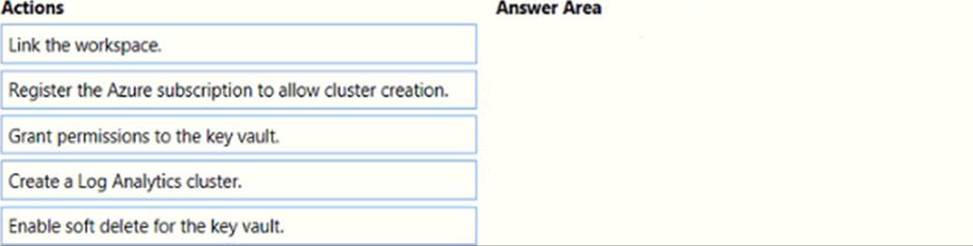
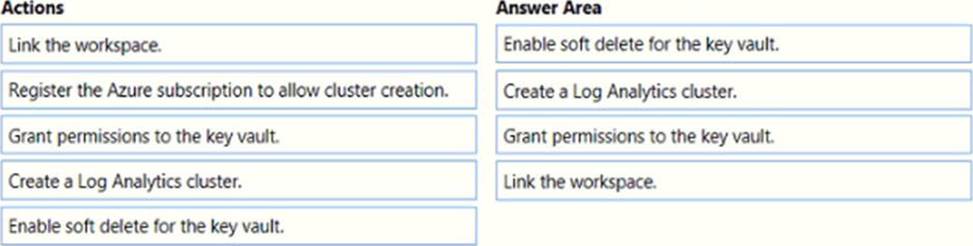
You have an Azure Key Vault that contains an encryption key named key1.
You plan to create a Log Analytics workspace that will store logging data.
You need to encrypt the workspace by using key1.
Which four actions should you perform in sequence? To answer, move the appropriate actions from the list of actions to the answer area and arrange them in the correct order.