
Practice Free AZ-400 Exam Online Questions
You have a GitHub repository.
You need to create a tag named v3.0.5 and ensure that the tag is available in the remote repository.
Which two commands should you run? Each correct answer presents part of the solution. NOTE: Each correct selection is worth one point.
- A . git coamit -m ‘tag v3.6.5’
- B . git push origin v3.0.5
- C . git tag V3.9.5
- D . git push -force
- E . git add ‘tag v3.6.5’
HOTSPOT
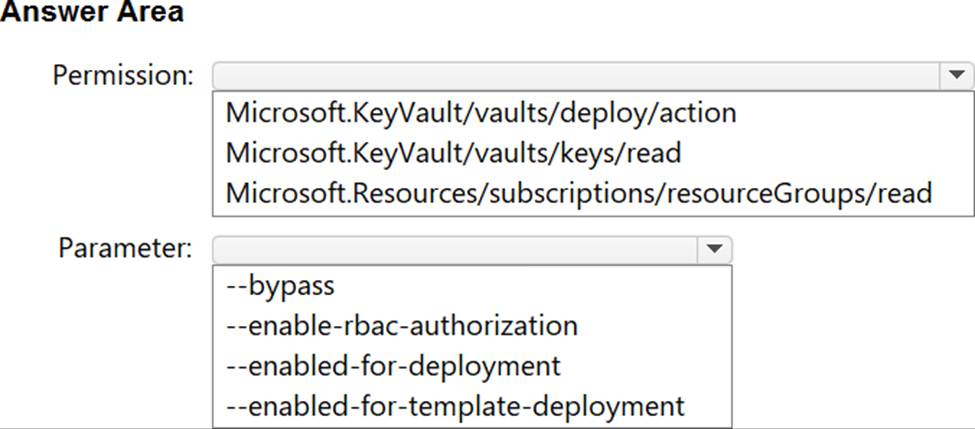
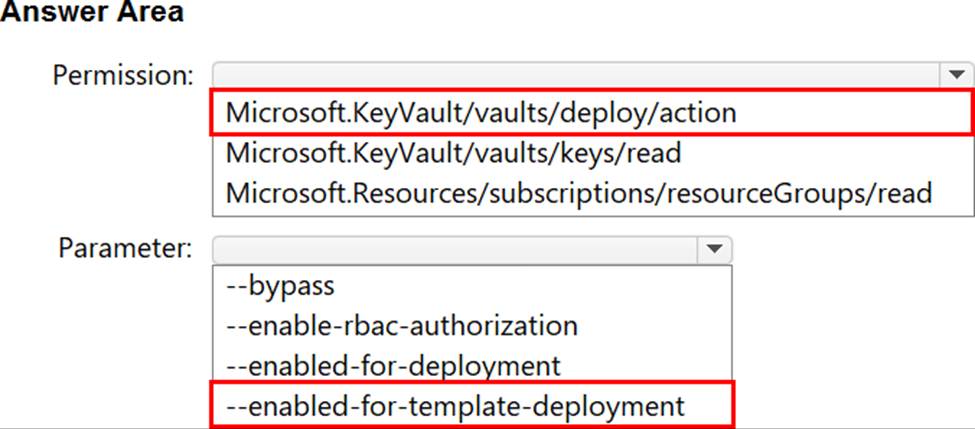
You have an Azure subscription that contains a user named User1.
You have an Azure Resource Manager (ARM) template named Template 1.
You plan to perform the following actions:
• Deploy an Azure key vault named KV1.
• Deploy Azure resources by using Template1 to retrieve secrets from KV1
You need to ensure that User1 can deploy Template1. The solution must follow the principle of least privilege.
Which permission should you grant to User1, and which parameter should be specified when you create KV1? To answer, select the appropriate options in the answer area. NOTE: Each correct selection is worth one point.
In Azure DevOps, you create Project3.
You need to meet the requirements of the project.
What should you do first?
- A . From Azure DevOps, create a service endpoint.
- B . From Sonar Qube, obtain an authentication token.
- C . From Azure DevOps, modify the build definition.
- D . From Sonar Qube , create a project.
A
Explanation:
The first thing to do is to declare your Sonar Qube server as a service endpoint in your VSTS/DevOps project settings.
Reference: https://docs.sonarqube.org/display/SCAN/Analyzing+with+SonarQube+Extension+for+vst s-TFS
Note: This question is part of a series of questions that present the same scenario. Each question in the series contains a unique solution that might meet the stated goals. Some question sets might have more than one correct solution, while others might not have a correct solution.
After you answer a question in this section, you will NOT be able to return to it. As a result, these questions will not appear in the review screen.
Your company has a project in Azure DevOps for a new web application.
You need to ensure that when code is checked in, a build runs automatically.
Solution: From the Pre-deployment conditions settings of the release pipeline, you select After stage.
Does this meet the goal?
- A . Yes
- B . No
B
Explanation:
Instead, In Visual Designer you enable continuous integration (CI) by:
Select the Triggers tab.
Enable Continuous integration.
Reference: https://docs.microsoft.com/en-us/azure/devops/pipelines/get-started-designer
Note: This section contains one or more sets of questions with the same scenario and problem. Each question presents a unique solution to the problem. You must determine whether the solution meets the stated goals. More than one solution in the set might solve the problem. It is also possible that none of the solutions in the set solve the problem.
After you answer a question in this section, you will NOT be able to return. As a result, these questions do not appear on the Review Screen.
You have an on-premises web server named Server1.
You need to ensure that you can build .NET apps and deploy the apps to Server1 by using Azure Pipelines.
Solution; You deploy Managed DevOps Pools and select the Azure Pipelines – Windows Server 2022 image.
Does this meet the goal?
- A . Yes
- B . No
Note: This question is part of a series of questions that present the same scenario. Each question in the series contains a unique solution that might meet the stated goals. Some question sets might have more than one correct solution, while others might not have a correct solution.
After you answer a question in this section, you will NOT be able to return to it. As a result, these questions will not appear in the review screen.
You need to recommend an integration strategy for the build process of a Java application.
The solution must meet the following requirements:
✑ The builds must access an on-premises dependency management system.
✑ The build outputs must be stored as Server artifacts in Azure DevOps.
✑ The source code must be stored in a Git repository in Azure DevOps.
Solution: Install and configure a self-hosted build agent on an on-premises machine. Configure the build pipeline to use the Default agent pool. Include the Java Tool Installer task in the build pipeline.
Does this meet the goal?
- A . Yes
- B . No
B
Explanation:
Instead use Octopus Tentacle.
Reference: https://explore.emtecinc.com/blog/octopus-for-automated-deployment-in-devops-models
You use Azure Pipelines to manage project builds and deployments.
You plan to use Azure Pipelines for Microsoft Teams to notify the legal team when a new build is ready for release. You need to configure the Organization Settings in Azure DevOps to support Azure Pipelines for Microsoft Teams.
What should you turn on?
- A . Azure Active Directory Conditional Access Policy Validation
- B . Alternate authentication credentials
- C . Third-party application access via OAuth
- D . SSH authentication
C
Explanation:
The Azure Pipelines app uses the OAuth authentication protocol, and requires Third-party application access via OAuthfor the organization to be enabled. To enable this setting, navigate to Organization Settings > Security > Policies, and set the Third-party application access via OAuth for the organization setting to On.
Reference: https://docs.microsoft.com/en-us/azure/devops/pipelines/integrations/microsoft-teams
DRAG DROP
You plan to use Azure DevOps in development processes.
You identify the following issues with the existing development processes:
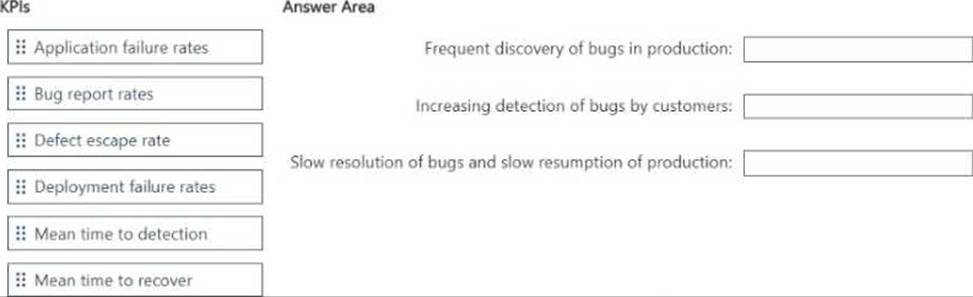
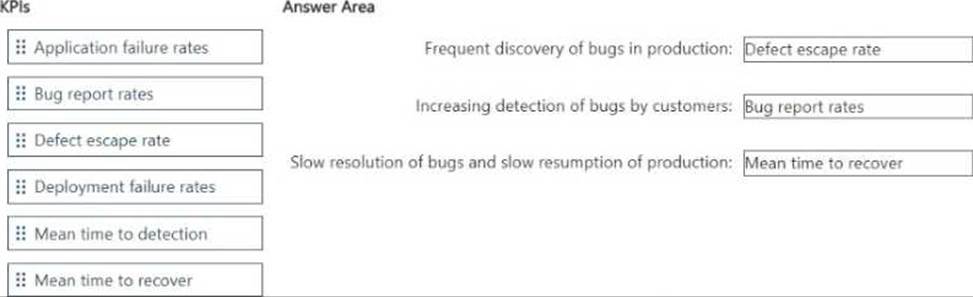
• Frequent discovery of bugs in production
• Increasing detection of bugs by customers
• Slow resolution of bugs and slow resumption of production
You need to implement Key Performance Indicators (KPIs) to track each issue.
Which KPI should you implement for each issue? To answer, drag the appropriate KPIs to the correct issues. Each KPI may be used once, more than once, or not at all. You may need to drag the split bar between panes or scroll to view content. NOTE: Each correct selection is worth one point.
DRAG DROP
You plan to use Azure DevOps in development processes.
You identify the following issues with the existing development processes:
• Frequent discovery of bugs in production
• Increasing detection of bugs by customers
• Slow resolution of bugs and slow resumption of production
You need to implement Key Performance Indicators (KPIs) to track each issue.
Which KPI should you implement for each issue? To answer, drag the appropriate KPIs to the correct issues. Each KPI may be used once, more than once, or not at all. You may need to drag the split bar between panes or scroll to view content. NOTE: Each correct selection is worth one point.
You have a project in Azure DevOps. You have an Azure Resource Group deployment project in Microsoft Visual Studio that is checked in to the Azure DevOps project.
You need to create a release pipeline that will deploy resources by using Azure Resource Manager templates.
The solution must minimize administrative effort.
Which task type should you include in the solution?
- A . Azure Cloud Service Deployment
- B . Azure RM Web App Deployment
- C . Azure PowerShell
- D . Azure App Service Manage
C
Explanation:
There are two different ways to deploy templates to Azure DevOps Services. Both methods provide the same
results, so choose the one that best fits your workflow.