
Practice Free AZ-400 Exam Online Questions
You have an Azure subscription that contains four Azure virtual machines
You need to configure the virtual machines to use a single identity.
The solution must meet the following requirements:
• Ensure that the credentials for the identity are managed automatically.
• Support granting privileges to the identity.
Which type of identity should you use?
- A . a service principal
- B . a user-assigned managed identity
- C . a system-assigned managed identity
- D . a user account
B
Explanation:
System-assigned managed identities enable Azure resources to authenticate to cloud services without storing credentials in code. They also support granting privileges to the identity, making them the ideal choice for this scenario. Source: Microsoft
DRAG DROP
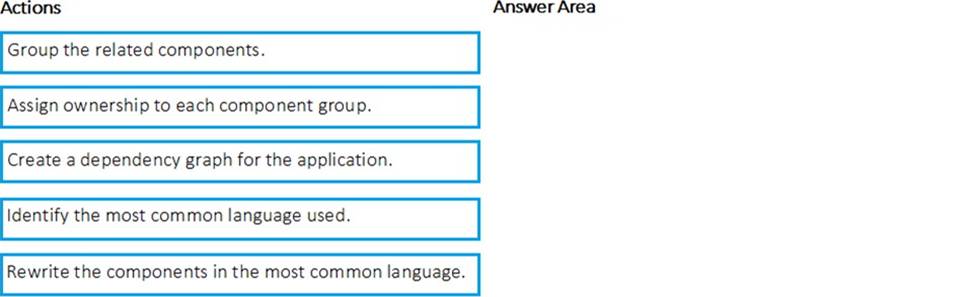
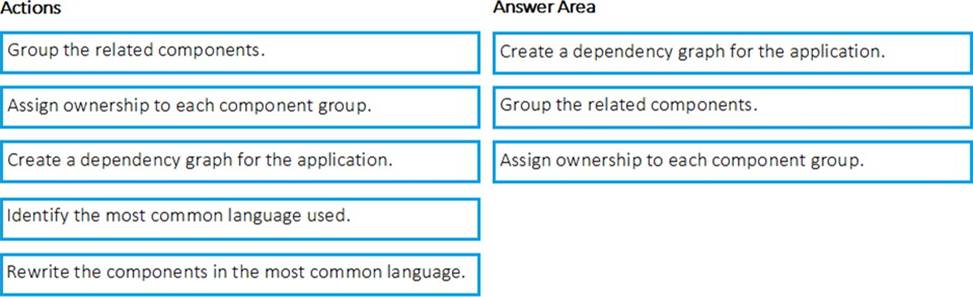
You need to find and isolate shared code. The shared code will be maintained in a series of packages.
Which three actions should you perform in sequence? To answer, move the appropriate actions from the list of actions to the answer area and arrange them in the correct order.
Explanation:
Step 1: Create a dependency graph for the application
By linking work items and other objects, you can track related work, dependencies, and changes made over time. All links are defined with a specific link type. For example, you can use Parent/Child links to link work items to support a hierarchical tree structure. Whereas, the Commit and Branch link types support links between work items and commits and branches, respectively.
Step 2: Group the related components.
Packages enable you to share code across your organization: you can compose a large product, develop multiple products based on a common shared framework, or create and share reusable components and libraries.
Step 3: Assign ownership to each component graph
Reference:
https://docs.microsoft.com/en-us/azure/devops/boards/queries/link-work-items-support-traceability?view=azure-devops&tabs=new-web-form
https://docs.microsoft.com/en-us/visualstudio/releasenotes/tfs2017-relnotes
You have a project in Azure DevOps named Project1 that contains two environments named environment1 andenvkonment2.
When a new version of Project1 is released, the latest version is deployed to environment2, and the previous version is redeployed to environments
You need to distribute users across the environments.
The solution must meet the following requirements:
• New releases must be available to only a subset of the users.
• You must gradually increase the number of users that can access environment2.
What should you use?
- A . web app deployment slots
- B . Azure Traffic Manager
- C . VIP swapping
- D . Azure Load Balancer
You have a project in Azure DevOps named Project1 that contains two environments named environment1 andenvkonment2.
When a new version of Project1 is released, the latest version is deployed to environment2, and the previous version is redeployed to environments
You need to distribute users across the environments.
The solution must meet the following requirements:
• New releases must be available to only a subset of the users.
• You must gradually increase the number of users that can access environment2.
What should you use?
- A . web app deployment slots
- B . Azure Traffic Manager
- C . VIP swapping
- D . Azure Load Balancer
You have an Azure subscription that contains the resources shown in the following table.
Project1 produces 9pm packages that are published to Feed1. Feed1 is consumed by multiple projects.
You need to ensure that only tested packages are available for consumption. The solution must
minimize development effort.
What should you do?
- A . Create a feed view named @default. After the 9pm packages test successfully, configure a release pipeline that tags the packages as release.
- B . Create a feed view named @release and set @release as the default view. After the 9pm packages test successfully, configure a release pipeline that tags the packages as release.
- C . Create a feed view named @release and set @release as the default view After the 9pm packages test successfully, configure a release pipeline that promotes a package to the @release view.
- D . Create a feed view named @default. After the 9pm packages test successfully, configure a release pipeline that promotes a package to the @default view.
C
Explanation:
By creating a feed view named "release" and setting it as the default view, packages that are published to the feed will not be immediately available for consumption. After the 9pm packages are tested successfully, you can configure a release pipeline that promotes a package to the @release view. This ensures that only tested packages are available for consumption and minimizes development effort as it doesn’t require any additional steps to be taken by the consumer of the feed.
Reference: Azure DevOps Docs: Create a feed and viewshttps://docs.microsoft.com/en-us/azure/devops/artifacts/feeds/create-feed?view=azure-devops
Azure DevOps Docs: Promote a packagehttps://docs.microsoft.com/en-us/azure/devops/artifacts/feeds/promote-package?view=azure-devops
SIMULATION
Task 8
You need to ensure that the https://contoso.com/statushook webhook is called every time a repository named az40038443478acr 1 receives a new version of an image named dotnetapp
Go to the Azure Portal.
Find and select yourAzure Container Registry instanceaz40038443478acr1.
Create a New Webhook:
UnderServices, selectWebhooks.
Click on+ Addto create a new webhook.
Fill in the form with the following information: Webhook name: Enter a unique name for your webhook. ServiceURI: Enterhttps://contoso.com/statushook.
Custom headers: (Optional) Add any headers you want to pass along with the POST request.
Trigger actions: SelectPushto trigger the webhook on image push events.
Scope: Specify the scope asaz40038443478acr1: dotnetappto target the specific image.
Status: Set toEnabled.
Save the Webhook Configuration:
Review the information and clickCreateto save the webhook.
Once configured, the webhook will send a POST request tohttps://contoso.com/statushookwhenever a new version of thedotnetappimage is pushed to theaz40038443478acr1repository in your Azure Container Registry1.
This setup will automate the notification process, ensuring that the specified webhook is called with each new image version, thus fulfilling the task requirements.
DRAG DROP
You have an app named App1. You have a Log Analytics workspace named Workspace 1 that contains two tables named Events and Logs. App1 manages events in multiple locations and writes togs to Workspace1.
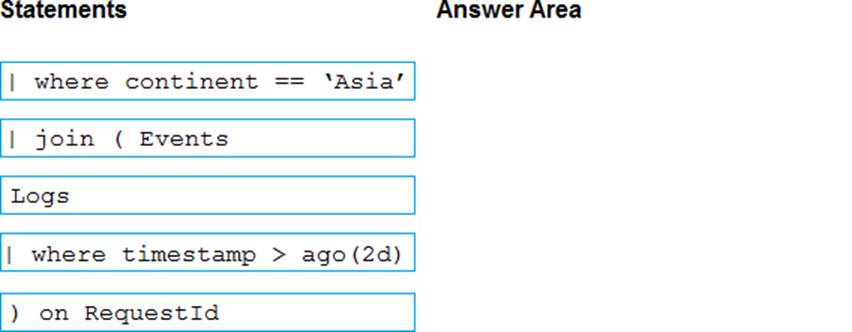
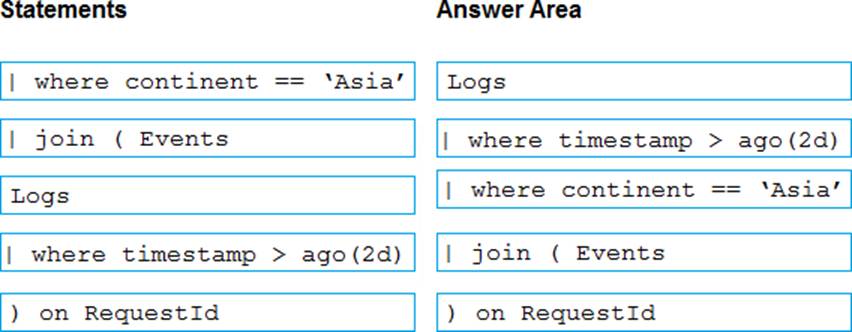
You need to query Workspace1 for all log entries related to Asia that occurred during the last two days.
In which order should you arrange the query statements? To answer, move all statements from the let of statements to the answer area and arrange them in the correct order.
Your company has 60 developers who are assigned to four teams. Each team has 15 members.
The company uses an agile development methodology.
You need to structure the work of the development teams so that each team owns their respective work while working together to reach a common goal.
Which parts of the taxonomy should you enable the team to perform autonomously?
- A . Features and Tasks
- B . Initiatives and Epics
- C . Epics and Features
- D . Stories and Tasks
A
Explanation:
A feature typically represents a shippable component of software.
Features, examples:
Add view options to the new work hub
Add mobile shopping cart
Support text alerts
Refresh the web portal with new look and feel
User Stories and Tasks are used to track work. Teams can choose how they track bugs, either as requirements or as tasks
Reference:
https://docs.microsoft.com/en-us/azure/devops/boards/backlogs/define-features-epics
https://docs.microsoft.com/en-us/azure/devops/boards/work-items/about-work-items
Your company has 60 developers who are assigned to four teams. Each team has 15 members.
The company uses an agile development methodology.
You need to structure the work of the development teams so that each team owns their respective work while working together to reach a common goal.
Which parts of the taxonomy should you enable the team to perform autonomously?
- A . Features and Tasks
- B . Initiatives and Epics
- C . Epics and Features
- D . Stories and Tasks
A
Explanation:
A feature typically represents a shippable component of software.
Features, examples:
Add view options to the new work hub
Add mobile shopping cart
Support text alerts
Refresh the web portal with new look and feel
User Stories and Tasks are used to track work. Teams can choose how they track bugs, either as requirements or as tasks
Reference:
https://docs.microsoft.com/en-us/azure/devops/boards/backlogs/define-features-epics
https://docs.microsoft.com/en-us/azure/devops/boards/work-items/about-work-items
You have several Azure Active Directory (Azure AD) accounts.
You need to ensure that users use multi-factor authentication (MFA) to access Azure apps from untrusted networks.
What should you configure in Azure AD?
- A . access reviews
- B . managed identities
- C . entitlement management
- D . conditional access
D
Explanation:
You can configure a Conditional Access policy that requires MFA for access from untrusted networks.
Reference: https://docs.microsoft.com/en-us/azure/active-directory/conditional-access/howto-conditional-access-policy-all-users-mfa