
Practice Free AZ-400 Exam Online Questions
You manage an Azure web app that supports an e-commerce website.
You need to increase the logging level when the web app exceeds normal usage patterns. The solution must minimize administrative overhead.
Which two resources should you include in the solution? Each correct answer presents part of the solution. NOTE: Each correct selection is worth one point.
- A . an Azure Automation run book
- B . an Azure Monitor alert that has a dynamic threshold
- C . an Azure Monitor alert that has a static threshold
- D . the Azure Monitor auto scale settings
- E . an Azure Monitor alert that uses an action group that has an email action
A,B
Explanation:
A: You can use Azure Monitor to monitor base-level metrics and logs for most services in Azure. You can call Azure Automation run books by using action groups or by using classic alerts to automate tasks based on alerts.
B: Metric Alert with Dynamic Thresholds detection leverages advanced machine learning (ML) to learn metrics’ historical behavior, identify patterns and anomalies that indicate possible service issues. It provides support of both a simple UI and operations at scale by allowing users to configure alert rules through the Azure Resource Manager API, in a fully automated manner.
Reference:
https://docs.microsoft.com/en-us/azure/azure-monitor/platform/alerts-dynamic-thresholds
https://docs.microsoft.com/en-us/azure/automation/automation-create-alert-triggered-runbook
You configure an Azure Application Insights availability test.
You need to notify the customer services department at your company by email when availability is degraded.
You create an Azure logic app that will handle the email and follow up actions.
Which type of trigger should you use to invoke the logic app?
- A . an ApiConnectiontrigger
- B . a Request trigger
- C . an HTTP Webhook trigger
- D . an HTTP trigger
C
Explanation:
You can use webhooks to route an Azure alert notification to other systems for post-processing or custom actions. You can use a webhook on an alert to route it to services that send SMS messages, to log bugs, to notify a team via chat or messaging services, or for various other actions.
Reference: https://docs.microsoft.com/en-us/azure/azure-monitor/platform/alerts-webhooks
You have an Azure subscription that contains multiple Azure pipelines.
You need to deploy a monitoring solution for the pipelines.
The solution must meet the following requirements:
• Parse togs from multiple sources
• Identify the root cause of issues.
What advanced feature of a monitoring tool should you include in the solution?
- A . synthetic monitoring
- B . Alert Management
- C . analytics
- D . directed monitoring
C
Explanation:
An analytics feature in a monitoring solution would allow you to parse logs from multiple sources and analyze them to identify the root cause of issues in your Azure pipelines. This feature would typically provide tools for searching, filtering, and visualizing log data, as well as for identifying patterns and anomalies. With analytics, you can also create custom dashboards and alerts to monitor your pipelines and quickly identify and troubleshoot any issues.
Note: This question is part of a series of questions that present the same scenario. Each question in the series contains a unit solution that might meet the stated goals. Some question sets might have more than one correct solution, while others might not have a correct solution.
After you answer a question in this section, you will NOT be able to return to it. As a result, these questions will not appear if the review screen.
You use an Azure Pipelines pipeline to build and release web apps.
You need to configure the pipeline to meet the following requirements:
• Only run when there is a change in the/webapp folder.
• Only run when a pr is created.
Solution: You configure the pipeline definition by using the following elements.
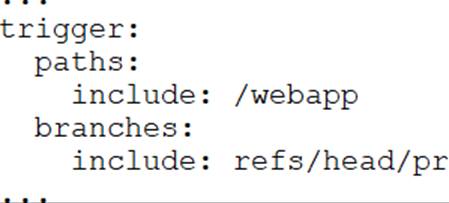
Does this meet the goal?
- A . Yes
- B . No
Note: This question is part of a series of questions that present the same scenario. Each question in the series contains a unit solution that might meet the stated goals. Some question sets might have more than one correct solution, while others might not have a correct solution.
After you answer a question in this section, you will NOT be able to return to it. As a result, these questions will not appear if the review screen.
You use an Azure Pipelines pipeline to build and release web apps.
You need to configure the pipeline to meet the following requirements:
• Only run when there is a change in the/webapp folder.
• Only run when a pr is created.
Solution: You configure the pipeline definition by using the following elements.
Does this meet the goal?
- A . Yes
- B . No
Your company is concerned that when developers introduce open source libraries, it creates licensing compliance issues.
You need to add an automated process to the build pipeline to detect when common open source libraries are added to the code base.
What should you use?
- A . Microsoft Visual SourceSafe
- B . PDM
- C . WhiteSource
- D . OWASP ZAP
C
Explanation:
WhiteSource is the leader in continuous open source software security and compliance management. WhiteSource integrates into your build process, irrespective of your programming languages, build tools, or development environments. It works automatically, continuously, and silently in the background, checking the security, licensing, and quality of your open source components against WhiteSource constantly-updated denitive database of open source repositories.
Azure DevOps integration with WhiteSource Bolt will enable you to:
✑ Detect and remedy vulnerable open source components.
✑ Generate comprehensive open source inventory reports per project or build.
✑ Enforce open source license compliance, including dependencies’ licenses.
✑ Identify outdated open source libraries with recommendations to update.
References: https://www.azuredevopslabs.com/labs/vstsextend/WhiteSource/
DRAG DROP
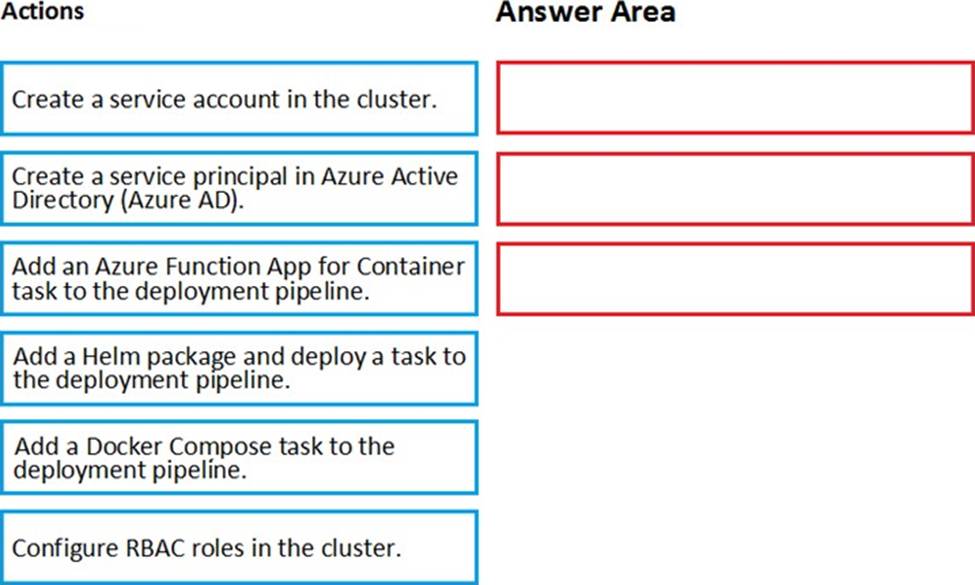
You have an Azure Kubernetes Service (AKS) cluster.
You need to deploy an application to the cluster by using Azure DevOps.
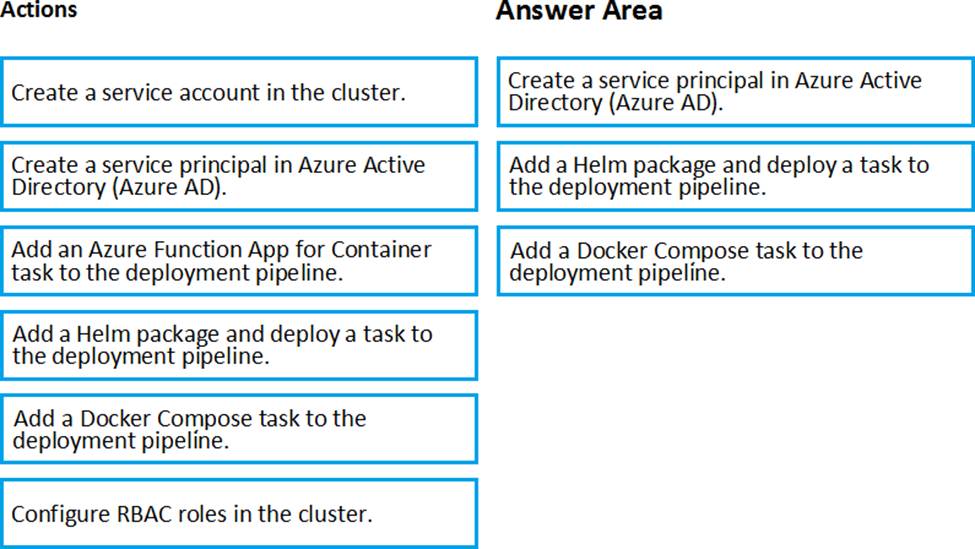
Which three actions should you perform in sequence? To answer, move the appropriate actions from the list of actions to the answer area and arrange them in the correct order.
Explanation:
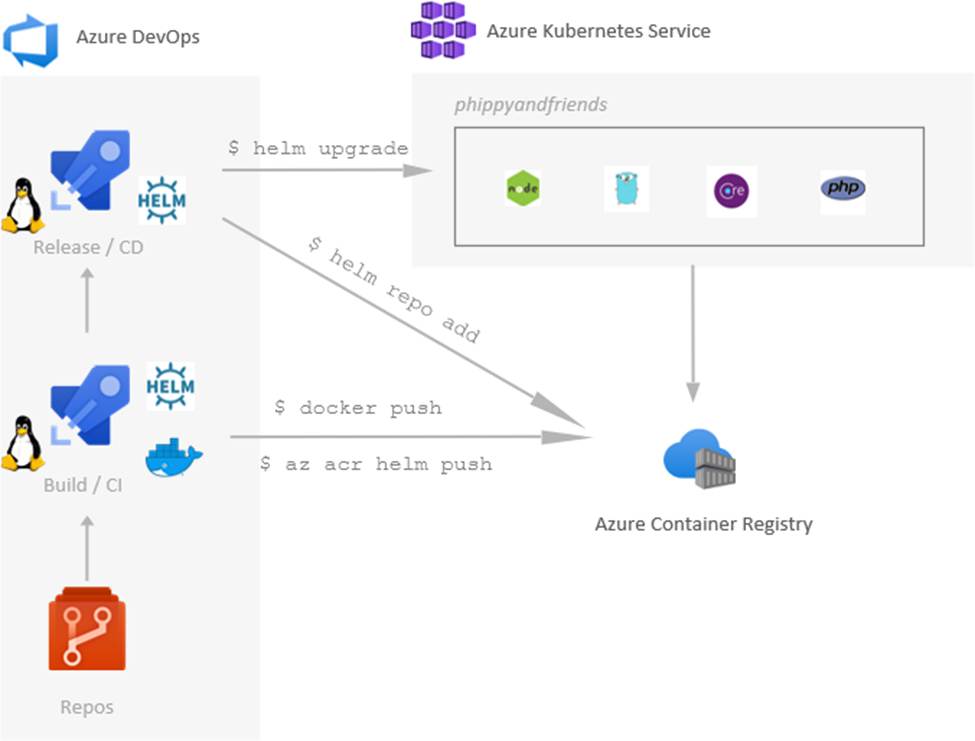
You can set up a CI/CD pipeline to deploy your apps on a Kubernetes cluster with Azure DevOps by leveraging a Linux agent, Docker, and Helm.
Step 1: Create a service principle in Azure Active Directory (Azure AD)
We need to assign 3 specific service principals with specific Azure Roles that need to interact with our ACR and our AKS.
Create a specific Service Principal for our Azure DevOps pipelines to be able to push and pull images and charts of our ACR.
Create a specific Service Principal for our Azure DevOps pipelines to be able to deploy our application in our AKS.
Step 2: Add a Helm package and deploy a task to the deployment pipeline
This is the DevOps workflow with containers:
Step 3: Add a Docker Compose task to the deployment pipeline.
Docker file file is a script leveraged by Docker, composed of various commands (instructions) and arguments listed successively to automatically perform actions on a base image in order to create a new Docker image by packaging the app.
Reference: https://cloudblogs.microsoft.com/opensource/2018/11/27/tutorial-azure-devops-setup-cicd-pipeline-kubernetes-docker-helm/
DRAG DROP
You have an Azure Kubernetes Service (AKS) cluster.
You need to deploy an application to the cluster by using Azure DevOps.
Which three actions should you perform in sequence? To answer, move the appropriate actions from the list of actions to the answer area and arrange them in the correct order.
Explanation:
You can set up a CI/CD pipeline to deploy your apps on a Kubernetes cluster with Azure DevOps by leveraging a Linux agent, Docker, and Helm.
Step 1: Create a service principle in Azure Active Directory (Azure AD)
We need to assign 3 specific service principals with specific Azure Roles that need to interact with our ACR and our AKS.
Create a specific Service Principal for our Azure DevOps pipelines to be able to push and pull images and charts of our ACR.
Create a specific Service Principal for our Azure DevOps pipelines to be able to deploy our application in our AKS.
Step 2: Add a Helm package and deploy a task to the deployment pipeline
This is the DevOps workflow with containers:
Step 3: Add a Docker Compose task to the deployment pipeline.
Docker file file is a script leveraged by Docker, composed of various commands (instructions) and arguments listed successively to automatically perform actions on a base image in order to create a new Docker image by packaging the app.
Reference: https://cloudblogs.microsoft.com/opensource/2018/11/27/tutorial-azure-devops-setup-cicd-pipeline-kubernetes-docker-helm/
You have an Azure subscription linked to a tenant in Microsoft Azure Active Directory (Azure AD), part of Entrap. The tenant is licensed for Azure AD Premium Plan 1.
A security review indicates that too many users have privileged access to resources.
You need to deploy a privileged access management solution that meets the following requirements:
• Enforces time limits on the use of privileged access
• Requires approval to activate privileged access
• Minimizes costs
What should you do first?
- A . Configure alerts for the activation of privileged roles.
- B . Enforce Azure Multi-Factor Authentication (MFA) for role activation.
- C . Configure notifications when privileged roles are activated.
- D . Upgrade the license of the Azure AD tenant.
You have an Azure subscription linked to a tenant in Microsoft Azure Active Directory (Azure AD), part of Entrap. The tenant is licensed for Azure AD Premium Plan 1.
A security review indicates that too many users have privileged access to resources.
You need to deploy a privileged access management solution that meets the following requirements:
• Enforces time limits on the use of privileged access
• Requires approval to activate privileged access
• Minimizes costs
What should you do first?
- A . Configure alerts for the activation of privileged roles.
- B . Enforce Azure Multi-Factor Authentication (MFA) for role activation.
- C . Configure notifications when privileged roles are activated.
- D . Upgrade the license of the Azure AD tenant.