
Practice Free AZ-400 Exam Online Questions
You use Azure SQL Database Intelligent Insights and Azure Application Insights foe monitoring.
You need to write ad-hoc Queries against the monitoring data.
Which Query language should you use?
- A . PL/pgSQL
- B . Transact-SQL
- C . Azure Log Analytics
- D . PL/SQL
C
Explanation:
Data analysis in Azure SQL Analytics is based on Log Analytics language for your custom querying and reporting.
Reference: https://docs.microsoft.com/en-us/azure/azure-monitor/insights/azure-sql
You use Calendar Versioning (CalVer) for code assets.
You need to store an optional tag of beta as part of the version.
Which part of the version should you use for the tag?
- A . micro
- B . minor
- C . major
- D . modifier
DRAG DROP
You are developing a full Microsoft .NET Framework solution that includes unit tests.
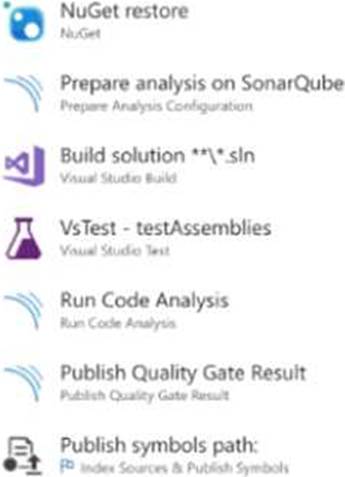
You need to configure SonarQube to perform a code quality validation of the C# code as part of the build pipelines.
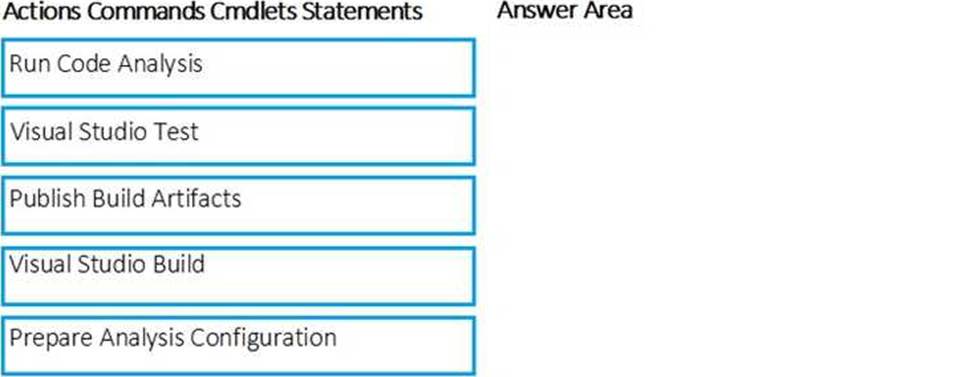
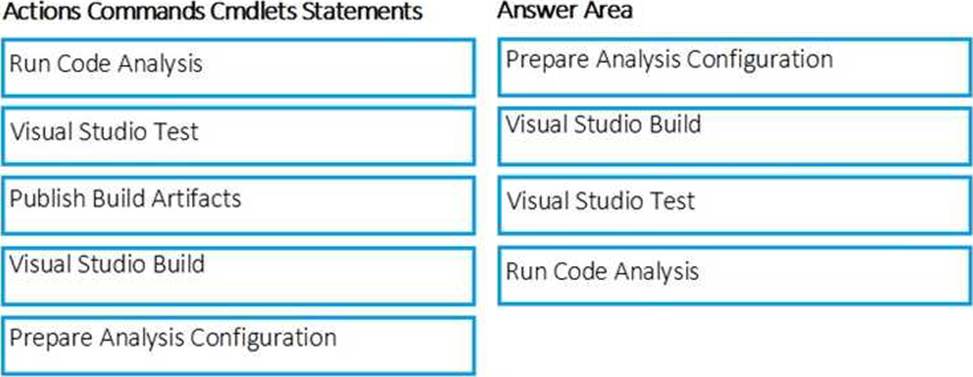
Which four tasks should you perform in sequence? To answer, move the appropriate tasks from the list of tasks to the answer area and arrange them in the correct order.
Explanation:
Step 1: Prepare Analysis Configuration
Prepare Analysis Configuration task, to configure all the required settings before executing the build.
This task is mandatory.
In case of .NET solutions or Java projects, it helps to integrate seamlessly with MSBuild, Maven and Gradle tasks.
Step 2: Visual Studio Build
Reorder the tasks to respect the following order:
Prepare Analysis Configuration task before any MSBuild or Visual Studio Build task.
Step 3: Visual Studio Test
Reorder the tasks to respect the following order:
Run Code Analysis task after the Visual Studio Test task.
Step 4: Run Code Analysis
Run Code Analysis task, to actually execute the analysis of the source code.
This task is not required for Maven or Gradle projects, because scanner will be run as part of the Maven/Gradle build.
Note:
s: https://docs.sonarqube.org/display/SCAN/Analyzing+with+SonarQube+Extension+for+VSTS-TFS
HOTSPOT
You ate using Agile process methodologies in Azure DevOps.
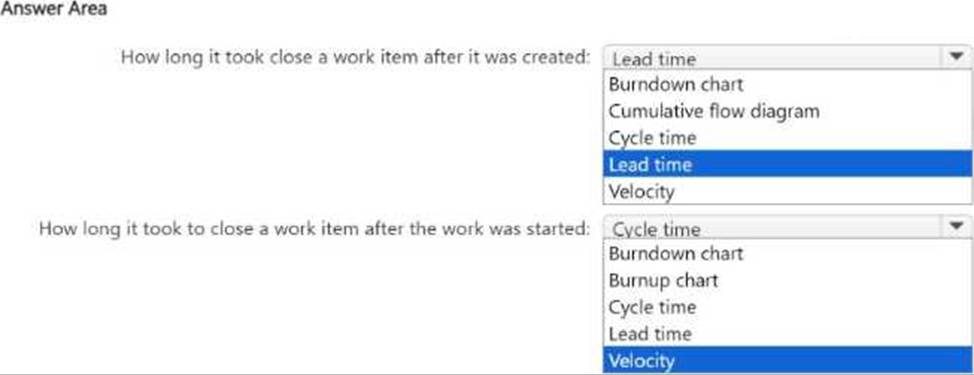
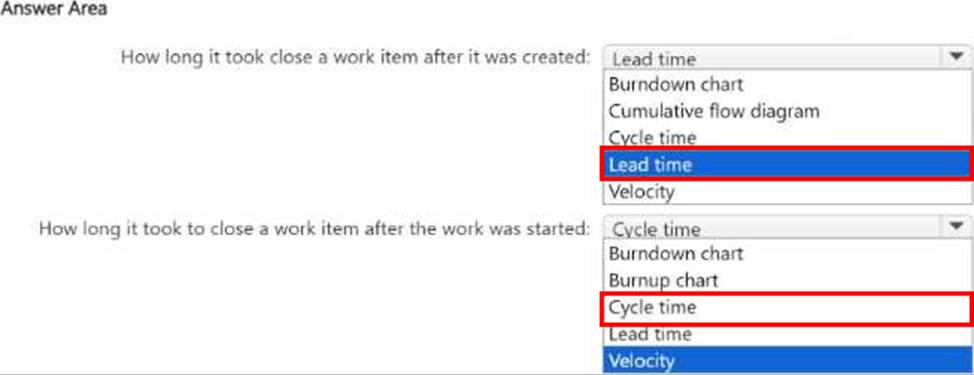
You need to deploy a dashboard that will provide progress reports for the following work items:
• How long it took to close a work item after it was created.
• How long it took to close a work item after the work was started.
Which type of widget should you use for each work item? To answer, select the appropriate options in the answer area. NOTE: Each correct selection is worth one point.
You have an Azure Automation account that contains a webbook. The webbook is used to configure the application infrastructure of an Azure subscription.
You have a project in Azure DevOps named Project). Project1 contains a repository that stores code for the webbook.
You need to ensure that every committed change to the code will update automatically and publish
the webbook to Azure Automation.
What should you configure?
- A . the Connections settings for the Automation account
- B . the Service hooks settings for Project1
- C . the Source control settings for the Automation account
- D . the Service connections settings for Project1
Your company is concerned that when developers introduce open source libraries, it creates licensing compliance issues.
You need to add an automated process to the build pipeline to detect when common open source libraries are added to the code base.
What should you use?
- A . PDM
- B . OWASPZAP
- C . WhiteSource
- D . Jenkins
Note: This question is part of a series of questions that present the same scenario. Each question in
the series contains a unique solution that might meet the stated goals. Some question sets might have more than one correct solution, while others might not have a correct solution.
After you answer a question in this section, you win NOT be able to return to it. As a result, these questions win not appear in the review screen.
You integrate a cloud- hosted Jenkins server and a new Azure DevOps deployment
You need Azure DevOps to send a notification to Jenkins when a developer commits changes to a branch in Azure Repos.
Solution: You create a service hook subscription that uses the code pushed event.
Does this meet the goal?
- A . Yes
- B . B. NO
A
Explanation:
You can create a service hook for Azure DevOps Services and TFS with Jenkins.
Reference: https://docs.microsoft.com/en-us/azure/devops/service-hooks/services/jenkins
Note: This question is part of a series of questions that present the same scenario. Each question in
the series contains a unique solution that might meet the stated goals. Some question sets might have more than one correct solution, while others might not have a correct solution.
After you answer a question in this section, you win NOT be able to return to it. As a result, these questions win not appear in the review screen.
You integrate a cloud- hosted Jenkins server and a new Azure DevOps deployment
You need Azure DevOps to send a notification to Jenkins when a developer commits changes to a branch in Azure Repos.
Solution: You create a service hook subscription that uses the code pushed event.
Does this meet the goal?
- A . Yes
- B . B. NO
A
Explanation:
You can create a service hook for Azure DevOps Services and TFS with Jenkins.
Reference: https://docs.microsoft.com/en-us/azure/devops/service-hooks/services/jenkins
You are creating a dashboard in Azure Boards.
You need to visualize the time from when work starts on a work item until the work item is closed.
Which type of widget should you use?
- A . cycle time
- B . velocity
- C . cumulative flow
- D . lead time
This question is part of a series of questions that present the same scenario. Each question in the series contains a unique solution that might meet the stated goals. Some question sets might have more than one correct solution, while others might not have a correct solution.
After you answer a question in this section, you will NOT be able to return to it. As a result, these questions will not appear in the review screen.
You have an Azure DevOps project.
Your build process creates several artifacts.
You need to deploy the artifacts to on-premises servers.
Solution: You deploy an Azure self-hosted agent to an on-premises server. You add a Copy and Publish Build Artifacts task to the deployment pipeline.
Does this meet the goal?
- A . Yes
- B . No
A
Explanation:
To build your code or deploy your software using Azure Pipelines, you need at least one agent.
If your on-premises environments do not have connectivity to a Microsoft-hosted agent pool (which is typically the case due to intermediate firewalls), you’ll need to manually configure a self-hosted agent on on-premises computer(s). The agents must have connectivity to the target on-premises
environments, and access to the Internet to connect to Azure Pipelines or Team Foundation Server.
Reference: https://docs.microsoft.com/en-us/azure/devops/pipelines/agents/agents?view=azure-devops