Practice Free AZ-400 Exam Online Questions
Your development team is building a new web solution by using the Microsoft Visual Studio integrated
development environment (IDE).
You need to make a custom package available to all the developers. The package must be managed centrally, and the latest version must be available for consumption in Visual Studio automatically.
Which three actions should you perform? Each correct answer presents part of the solution. NOTE: Each correct selection is worth one point.
- A . Publish the package to a feed.
- B . Create a new feed in AzureArtifacts.
- C . Upload a package to a Git repository.
- D . Add the package URL to the Environment settings in Visual Studio.
- E . Add the package URL to the NuGet Package Manager settings in Visual Studio.
- F . Create a Git repository in Azure Repos.
A,B,E
Explanation:
B: By using your custom NuGet package feed within your Azure DevOps (previously VSTS) instance, you’ll be able to distribute your packages within your organization with ease. Start by creating a new feed.
A: We can publish, pack and push the built project to our NuGet feed.
E: Consume your private NuGet Feed
Go back to the Packages area in Azure DevOps, select your feed and hit “Connect to feed”. You’ll see some instructions for your feed, but it’s fairly simple to set up.
Just copy your package source URL, go to Visual Studio, open the NuGet Package Manager, go to its settings and add a new source. Choose a fancy name, insert the source URL. Done.
Search for your package in the NuGet Package Manager and it should appear there, ready for installation.
Make sure to select the appropriate feed (or just all feeds) from the top right select box.
Reference: https://medium.com/medialesson/get-started-with-private-nuget-feeds-in-azure-devops-8c7b5f022a68
DRAG DROP
You need to deploy a new project in Azure DevOps that has the following requirements:
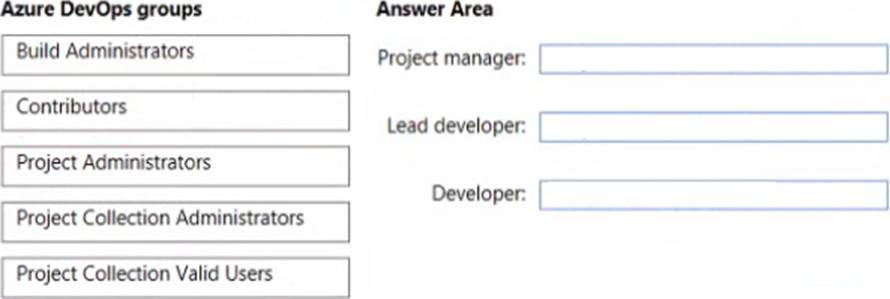
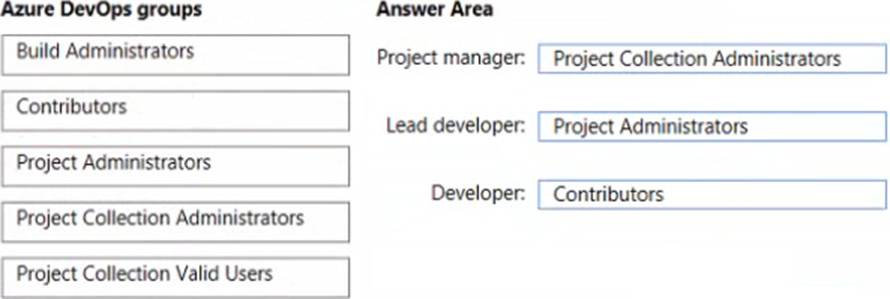
• The lead developer must be able to create repositories, manage permissions, manage policies, and contribute to the repository.
• Developers must be able to contribute to the repository and create branches, but NOT bypass policies when pushing builds.
• Project managers must only be able to view the repository.
• The principle of least privilege must be used.
You create a new Azure DevOps project team for each role.
To which Azure DevOps groups should you add each team? To answer, drag the appropriate groups to the correct teams. Each group may be used once, more than once, or not at all. You may need to drag the split bar between panes or scroll to view content. NOTE: Each correct selection is worth one point.
DRAG DROP
You are implementing a package management solution for a Node.js application by using Azure Artifacts.
You need to configure the development environment to connect to the package repository. The solution must minimize the likelihood that credentials will be leaked.
Which file should you use to configure each connection? To answer, drag the appropriate files to the correct connections. Each file may be used once, more than once, or not at all. You may need to drag the split bar between panes or scroll to view content. NOTE: Each correct selection is worth one point.
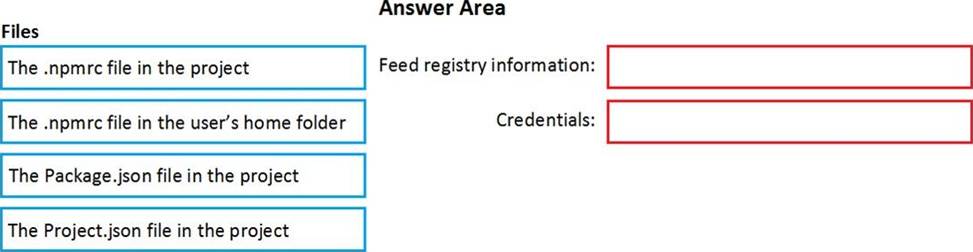
Explanation:
All Azure Artifacts feeds require authentication, so you’ll need to store credentials for the feed before you can install or publish packages. npm uses .npmrc configuration files to store feed URLs and credentials. Azure DevOps Services recommends using two .npmrc files.
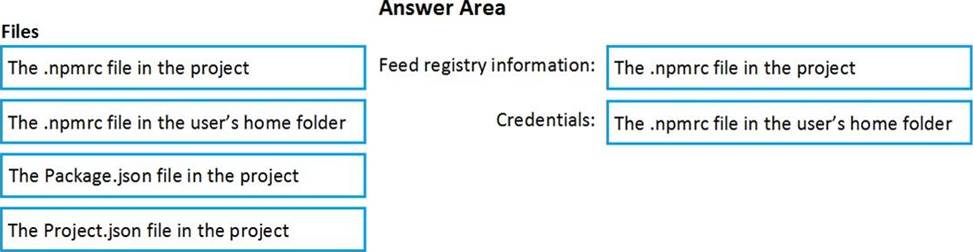
Feed registry information: The .npmrc file in the project
One .npmrc should live at the root of your git repo adjacent to your project’s package.json. It should contain a "registry" line for your feed and it should not contain credentials since it will be checked into git.
Credentials: The .npmrc file in the user’s home folder
On your development machine, you will also have a .npmrc in $home for Linux or Mac systems or $env.HOME for win systems. This .npmrc should contain credentials for all of the registries that you need to connect to. The NPM client will look at your project’s .npmrc, discover the registry, and fetch matching credentials from $home/.npmrc or $env.HOME/.npmrc.
References: https://docs.microsoft.com/en-us/azure/devops/artifacts/npm/npmrc?view=azure-devops&tabs=windows
: 213
You have an Azure subscription that contains an Azure Active Directory (Azure AD) tenant.
You are configuring a build pipeline in Azure Pipelines that will include a task named Task1. Task1 will authenticate by using an Azure AD service principal.
Which three values should you configure for Task1? Each correct answer presents part of the solution. NOTE: Each correct selection is worth one point.
- A . the object ID
- B . the tenant ID
- C . the app ID
- D . the client secret
- E . the subscription ID
B,C,D
Explanation:
Reference: https://docs.microsoft.com/en-us/azure/devops/pipelines/library/connect-to-azure
After you answer a question in this section, you will NOT be able to return to it. As a result, these questions will not appear in the review screen.
You have an Azure DevOps organization named Contoso and an Azure subscription. The subscription contains an Azure virtual machine scale set named VMSS1 that is configured for autoscaling.
You have a project in Azure DevOps named Project1. Project1 is used to build a web app named App1 and deploy App1 to VMSS1.
You need to ensure that an email alert is generated whenever VMSS1 scales in or out.
Solution: From Azure Monitor, create an action group.
Does this meet the goal?
- A . Yes
- B . No
A
Explanation:
An action group is a collection of notification preferences defined by the owner of an Azure subscription. Azure Monitor, Service Health and Azure Advisor alerts use action groups to notify users that an alert has been triggered.
Reference: https://docs.microsoft.com/en-us/azure/azure-monitor/alerts/action-groups
You have a containerized solution that runs in Azure Container Instances. The solution contains a frontend container named App1 and a backend container named DB1. DB1 loads a large amount of data during startup.
You need to verify that DB1 can handle incoming requests before users can submit requests to Appl.
What should you configure?
- A . a Iiveness probe
- B . an Azure Load Balancer health probe
- C . a readiness probe
- D . a performance log
C
Explanation:
For containerized applications that serve traffic, you might want to verify that your container is ready to handle incoming requests. Azure Container Instances supports readiness probes to include configurations so that your container can’t be accessed under certain conditions.
Reference: https://docs.microsoft.com/en-us/azure/container-instances/container-instances-readiness-probe
SIMULATION
You need to ensure that Microsoft Visual Studio 2017 can remotely attach to an Azure Function named fa-11566895.
To complete this task, sign in to the Microsoft Azure portal.
Before we start a debugging session to our Azure Function app we need to enable the functionality.
Navigate in the Azure portal to your function app fa-11566895 Go to the “Application settings”
Under “Debugging” set Remote Debugging to On and set Remote Visual Studio version to 2017.
Reference: https://www.locktar.nl/uncategorized/azure-remote-debugging-manually-in-visual-studio-2017/
You use Azure Pipelines to build and test code projects.
You notice an increase in cycle times.
You need to identify whether agent pool exhaustion is causing the issue.
What are two possible ways to achieve this goal? Each correct answer presents a complete solution. NOTE: Each correct selection is worth one point.
- A . View the Pipeline duration report.
- B . Query the PipelineRun/PipelineRuns endpoint.
- C . View the pool consumption report at the organization level.
- D . Query the TaskAgentPoolSizeSnapshots endpoint
You use Azure Pipelines to build and test code projects.
You notice an increase in cycle times.
You need to identify whether agent pool exhaustion is causing the issue.
What are two possible ways to achieve this goal? Each correct answer presents a complete solution. NOTE: Each correct selection is worth one point.
- A . View the Pipeline duration report.
- B . Query the PipelineRun/PipelineRuns endpoint.
- C . View the pool consumption report at the organization level.
- D . Query the TaskAgentPoolSizeSnapshots endpoint
HOTSPOT
You are using an Azure Pipelines pipeline to build and deploy a web app.
You need to implement a testing strategy that meets the following requirements:
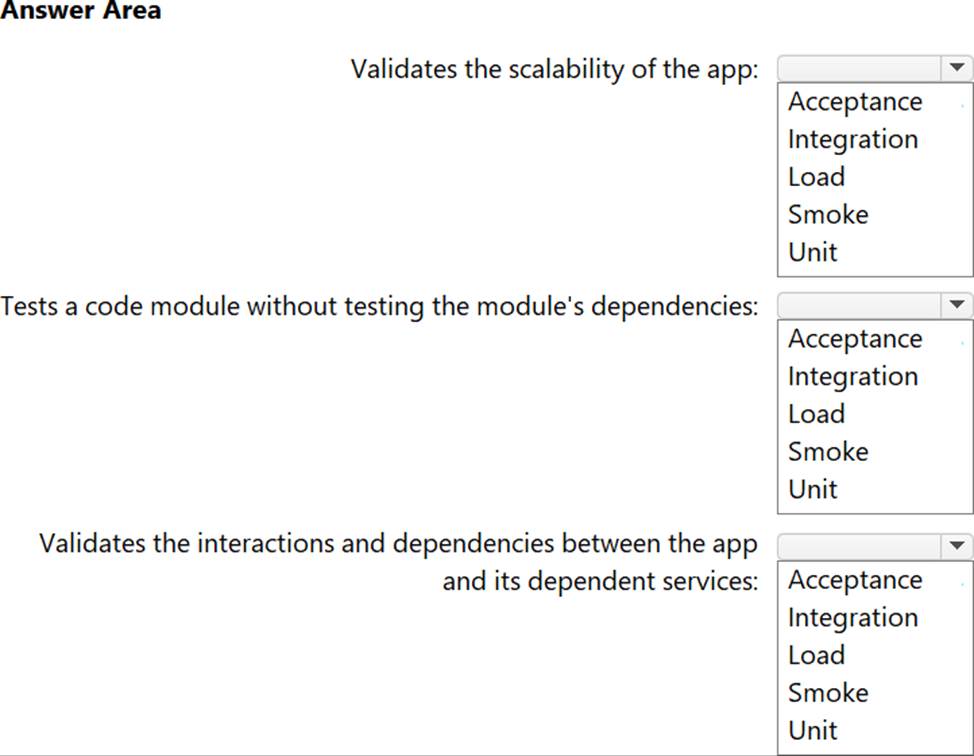
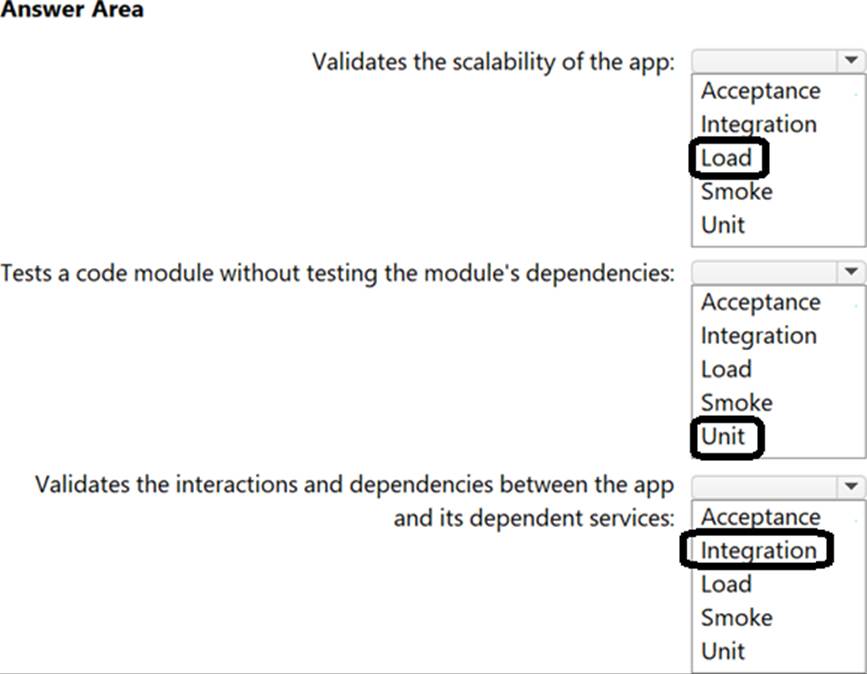
• Validates the scalability of the app
• Tests a code module without testing the module’s dependencies
• Validates the interactions and dependencies between the app and its dependent services.
Which type of test should you implement for each requirement? To answer, select the appropriate options in the answer area.