
Practice Free AZ-400 Exam Online Questions
You have a project in Azure DevOps named Project1. Project1 contains a build pipeline named Pipe1 that builds an application namedAppl.
You have an agent pool named Pool1 that contains a Windows Server 2019-based self-hosted agent.
Pipe1 uses Pool1.
You plan to implement another project named Project2. Project2 will have a build pipeline named
Pipe2 that builds an application namedApp2.
App1 and App2 have conflicting dependencies.
You need to minimize the possibility that the two build pipelines will conflict with each other. The
solution must minimize infrastructure costs.
What should you do?
- A . Create two container jobs.
- B . Change the self-hosted agent to use Red Hat Enterprise Linux (RHEL) 9.
- C . Add another self-hosted agent
- D . Add a Docker Compose task to the build pipelines.
Note: This question is part of a series of questions that present the same scenario. Each question in the series contains a unique solution that might meet the stated goals. Some question sets might have more than one correct solution, while others might not have a correct solution.
After you answer a question in this section, you will NOT be able to return to it. As a result, these questions will not appear in the review screen.
You use Azure Pipelines to build and test a React.js application.
You have a pipeline that has a single job.
You discover that installing JavaScript packages from 9pm takes approximately five minutes each time you run the pipeline.
You need to recommend a solution to reduce the pipeline execution time.
Solution: You recommend using pipeline artifacts.
Does this meet the goal?
- A . Yes
- B . No
B
Explanation:
Pipeline artifacts are a way to persist build outputs, test results, and other files generated during a pipeline run. They allow you to share data between stages, jobs, and pipelines, and to persist data for longer than the lifetime of a pipeline run. While artifacts can be useful for sharing data between pipeline runs and reducing the time required to download dependencies, they are not a solution for reducing the time required to install JavaScript packages from 9pm during a pipeline run.
The solution of reducing the pipeline execution time could be achieved by using package caching, which allows you to store and reuse 9pm packages from previous pipeline runs. There are several package caching options available for Azure Pipelines, including the 9pm task, the 9pm cache task, and the 9pm ci task. All of these options allow you to configure caching for your 9pm packages, which can significantly reduce the time required to install packages during subsequent pipeline runs. Another solution could be using a dedicated agent that has those packages already installed, this way the pipeline doesn’t have to install them again.
You can find more information on package caching by following this linkhttps://docs.microsoft.com/en-us/azure/devops/pipelines/tasks/package/npm-cache?view=azure-devops
You plan to use Terraform to deploy an Azure resource group.
You need to install the required frameworks to support the planned deployment.
Which two frameworks should you install? Each correct answer presents part of the solution. NOTE: Each correct selection is worth one point.
- A . Vault
- B . Terratest
- C . Node.js
- D . Yeoman
- E . Tiller
B,D
Explanation:
You can use the combination of Terraform and Yeoman. Terraform is a tool for creating infrastructure
on Azure. Yeoman makes it easy to create Terraform modules.
Terratest provides a collection of helper functions and patterns for common infrastructure testing tasks, like making HTTP requests and using SSH to access a specific virtual machine. The following list describes some of the major advantages of using Terratest:
Convenient helpers to check infrastructure – This feature is useful when you want to verify your real infrastructure in the real environment.
Organized folder structure – Your test cases are organized clearly and follow the standard Terraform module folder structure.
Test cases are written in Go – Many developers who use Terraform are Go developers. If you’re a Go developer, you don’t have to learn another programming language to use Terratest.
Extensible infrastructure – You can extend additional functions on top of Terratest, including Azure-specific features.
Reference:
https://docs.microsoft.com/en-us/azure/developer/terraform/create-base-template-using-yeoman
https://docs.microsoft.com/en-us/azure/developer/terraform/test-modules-using-terratest
You have a GitHub Enterprise account.
You need to enable push protection for secret scanning of the account repositories.
What should you do first?
- A . Purchase Premium Plus support.
- B . Enforce multi-factor authentication (MFA).
- C . Purchase a GitHub Advanced Security license.
- D . Create an access policy for secrets.
SIMULATION
You plan to implement a CI/CD strategy for an Azure Web App named az400-11566895-main.
You need to configure a staging environment foraz400-11566895-main.
To complete this task, sign in to the Microsoft Azure portal.
SIMULATION
Your company plans to implement a new compliance strategy that will require all Azure web apps to be backed up every five hours.
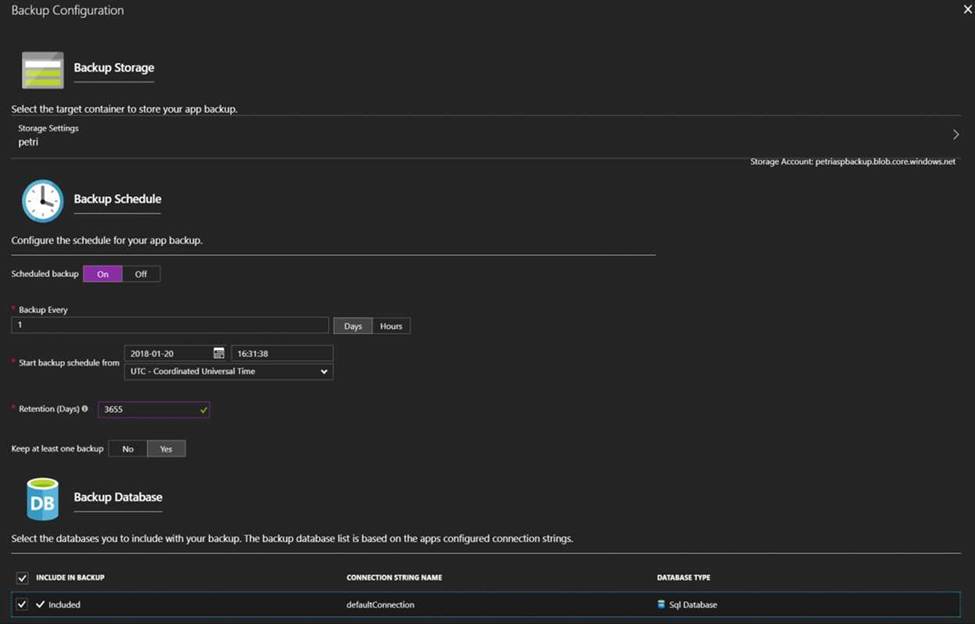
You need to back up an Azure web app named az400-11566895-main every five hours to an Azure Storage account in your resource group.
To complete this task, sign in to the Microsoft Azure portal.
Open the App Serviceaz400-11566895-main, which you want to protect, in the Azure Portal and
browse to Settings > Backups. Click Configure and a Backup Configuration blade should appear.
Select the storage account.
Click + to create a private container. You could name this container after the web app or App Service.
Select the container.
If you want to schedule backups, then set Scheduled Backup to On and configure a schedule: every five hours
Select your retention. Note that 0 means never delete backups.
Decide if at least one backup should always be retained.
Choose if any connected databases should be included in the web app backup.
Click Save to finalize the backup configuration.
Reference: https://petri.com/backing-azure-app-service
SIMULATION
Your company plans to implement a new compliance strategy that will require all Azure web apps to be backed up every five hours.
You need to back up an Azure web app named az400-11566895-main every five hours to an Azure Storage account in your resource group.
To complete this task, sign in to the Microsoft Azure portal.
Open the App Serviceaz400-11566895-main, which you want to protect, in the Azure Portal and
browse to Settings > Backups. Click Configure and a Backup Configuration blade should appear.
Select the storage account.
Click + to create a private container. You could name this container after the web app or App Service.
Select the container.
If you want to schedule backups, then set Scheduled Backup to On and configure a schedule: every five hours
Select your retention. Note that 0 means never delete backups.
Decide if at least one backup should always be retained.
Choose if any connected databases should be included in the web app backup.
Click Save to finalize the backup configuration.
Reference: https://petri.com/backing-azure-app-service
You have an Azure subscription that contains multiple Azure pipelines.
You need to deploy a monitoring solution for the pi*lines.
The solution must meet the following requirements:
✑ Parse logs from multiple sources.
✑ Identify the root cause of issues.
What advanced feature of a monitoring tool should include in the solution?
- A . directed monitoring
- B . synthetic monitoring
- C . analytics
- D . Alert Management
Your company uses the following resources:
Windows Server 2019 container images hosted in an Azure Container Registry Azure virtual machines that run the latest version of Ubuntu An Azure Log Analytics workspace Azure Active Directory (Azure AD)
An Azure key vault
For which two resources can you receive vulnerability assessments in Azure Security Center? Each correct answer presents part of the solution.
- A . the Azure Log Analytics workspace
- B . the Azure key vault
- C . the Azure virtual machines that run the latest version of Ubuntu
- D . Azure Active Directory (Azure AD)
- E . the Windows Server 2019 container images hosted in the Azure Container Registry
C,E
Explanation:
https://docs.microsoft.com/en-us/azure/security-center/features-paas
https://docs.microsoft.com/en-us/azure/security-center/container-security
Your company uses the following resources:
Windows Server 2019 container images hosted in an Azure Container Registry Azure virtual machines that run the latest version of Ubuntu An Azure Log Analytics workspace Azure Active Directory (Azure AD)
An Azure key vault
For which two resources can you receive vulnerability assessments in Azure Security Center? Each correct answer presents part of the solution.
- A . the Azure Log Analytics workspace
- B . the Azure key vault
- C . the Azure virtual machines that run the latest version of Ubuntu
- D . Azure Active Directory (Azure AD)
- E . the Windows Server 2019 container images hosted in the Azure Container Registry
C,E
Explanation:
https://docs.microsoft.com/en-us/azure/security-center/features-paas
https://docs.microsoft.com/en-us/azure/security-center/container-security