
Practice Free N10-009 Exam Online Questions
A network security administrator needs to monitor the contents of data sent between a secure network and the rest of the company.
Which of the following monitoring methods will accomplish this task?
- A . Port mirroring
- B . Flow data
- C . Syslog entries
- D . SNMP traps
A
Explanation:
To monitor the contents of data (i.e., inspect the actual packets/frames and their payloads) moving between networks, the administrator should use port mirroring (also called SPAN on some platforms). Port mirroring copies traffic from one or more switch ports (or VLANs) to a designated monitoring port where a packet analyzer/IDS sensor can capture and inspect the traffic in detail. This aligns with Network+ (N10-009) security and monitoring concepts that distinguish between packet-level visibility and higher-level summaries or logs. If the requirement is explicitly to monitor “contents,” you need a method that provides full packet capture capability, not just metadata.
Flow data (e.g., NetFlow) provides summarized metadata―who talked to whom, how much, ports, and timestamps―but not full payload contents. Syslog entries are device/application-generated logs and only show events a device chooses to report; they don’t provide full data content visibility. SNMP traps are alerts about status changes (interfaces, thresholds, etc.) and similarly do not include traffic contents. Therefore, port mirroring is the correct monitoring method for inspecting data contents in transit.
A company is migrating a data center from on premises to the cloud.
Which of the following tools will help maintain consistency, reliability, and efficiency of provisioning and management?
- A . IaC
- B . CDN
- C . SASE
- D . ZTA
A
Explanation:
The correct answer is A. IaC. Infrastructure as Code is used to define and deploy infrastructure through templates, configuration files, or code rather than building everything manually. During a cloud migration, that approach helps keep deployments consistent across environments and reduces the chance of human error.
This fits the question especially well because it mentions consistency, reliability, and efficiency in both provisioning and management. Those are exactly the kinds of benefits IaC is meant to provide. Instead of configuring servers, networks, and services one by one, administrators can reuse tested deployment definitions and apply the same settings repeatedly. That makes rollouts faster and easier to audit.
The other options do not match the task. A CDN improves content delivery performance. SASE is a networking and security architecture. ZTA focuses on access control and trust decisions. All of those are important in the right context, but none is primarily a provisioning and management automation tool.
In a cloud migration, the organization usually wants repeatable builds, standardization, and faster recovery if something has to be recreated. That is why IaC is the strongest answer here. It directly supports automated, dependable, and scalable infrastructure deployment.
A newly opened retail shop uses a combination of new tablets, PCs, printers, and legacy card readers.
Which of the following wireless encryption types is the most secure and compatible?
- A . WPA3
- B . WPA2
- C . WPA2/WPA3 mixed mode
- D . WPA/WPA2 mixed mode
C
Explanation:
WPA2/WPA3 mixed mode provides compatibility for older devices (that only support WPA2) while allowing newer devices to take advantage of stronger WPA3 encryption. This ensures maximum compatibility and security in a mixed-device environment.
An organization is struggling to get effective coverage using the wireless network. The organization wants to implement a solution that allows for continuous connectivity anywhere in the facility.
Which of the following should the network administrator suggest to ensure the best coverage?
- A . Implementing additional ad hoc access points
- B . Providing more Ethernet drops for user connections
- C . Deploying a mesh network in the building
- D . Changing the current frequency of the Wi-Fi
C
Explanation:
The correct answer is deploying a mesh network. A mesh wireless network uses multiple interconnected access points that automatically route traffic through the best available path. This ensures seamless coverage throughout a facility, even when users move between APs. Mesh APs can extend coverage without requiring each AP to be directly wired, making them ideal for large or hard-to-wire environments.
A company is upgrading its wireless network. Currently, each AP broadcasts a wireless LAN name depending on the location in the building.
Which of the following configurations allows a single wireless LAN name to be broadcast across the entire building?
- A . ESSID
- B . Wireless mesh
- C . Band steering
- D . WPA3
A
Explanation:
The correct answer is A. ESSID. An ESSID (Extended Service Set Identifier) is used when multiple wireless access points are configured to present the same wireless network name (SSID) across a larger coverage area, such as an entire building or campus floor. This allows users to move from one location to another while remaining connected to what appears to be a single wireless network. In practice, this supports seamless roaming between APs when they are properly configured with the same SSID, compatible security settings, and coordinated channel planning.
The other options do not fit the requirement. Wireless mesh is a topology that allows APs to connect to one another wirelessly, but it does not by itself describe using one common WLAN name across all APs. Band steering pushes dual-band clients toward the 5 GHz or 6 GHz band for better performance; it is not about creating one building-wide WLAN name. WPA3 is a wireless security standard and relates to encryption and authentication, not SSID design.
The key phrase in the question is “a single wireless LAN name across the entire building”, which points directly to an ESSID deployment.
Which of the following is used to store and deliver content to clients in a geographically distributed manner using edge servers?
- A . Load balancer
- B . CDN
- C . DNS server
- D . SAN
B
Explanation:
A Content Delivery Network (CDN) stores cached versions of content in edge locations to deliver data faster and more reliably to users based on geographical proximity.
From Andrew Ramdayal’s guide:
“CDNs distribute content to multiple, geographically dispersed servers. This enhances performance and reliability for end-users by reducing latency and load times.”
SIMULATION
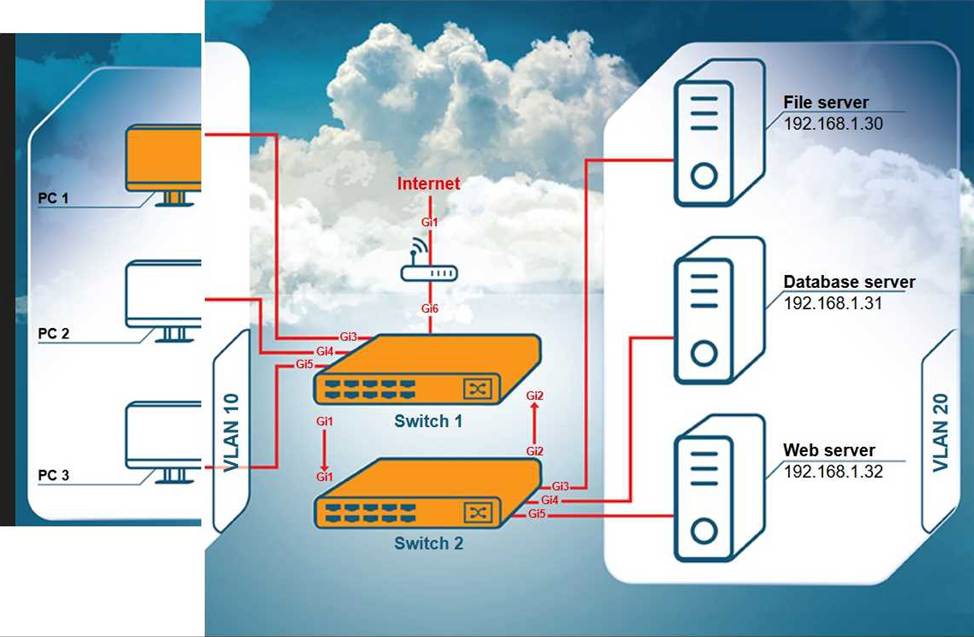
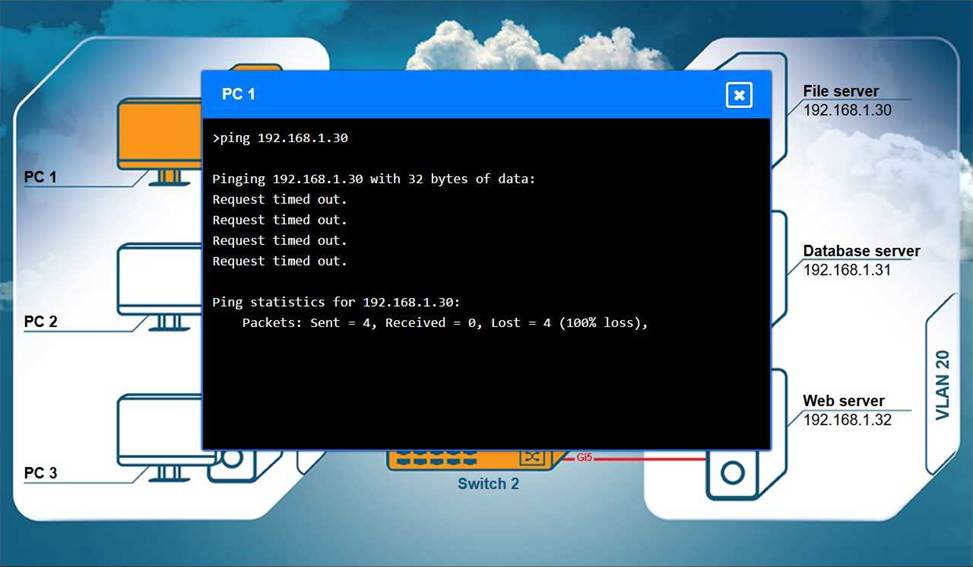
A network technician receives a ticket from an employee who is working on PC 1 but is unable to connect to the database server. The technician pings the database server from PC 1, but the request times out. After reviewing the utilization of Switch 1 and Switch 2, the technician finds high CPU utilization and sees that the MAC table is continuously changing.
INSTRUCTIONS
Configure Switch 1 and Switch 2 to remediate the employee’s issue. Then, validate connectivity between PC 1 and the database server.
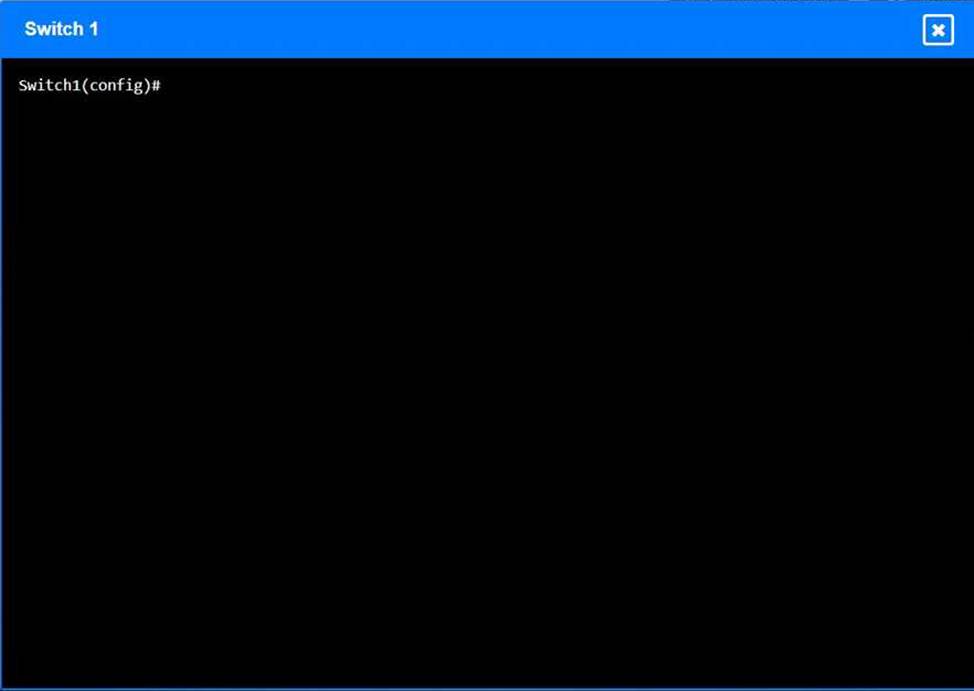
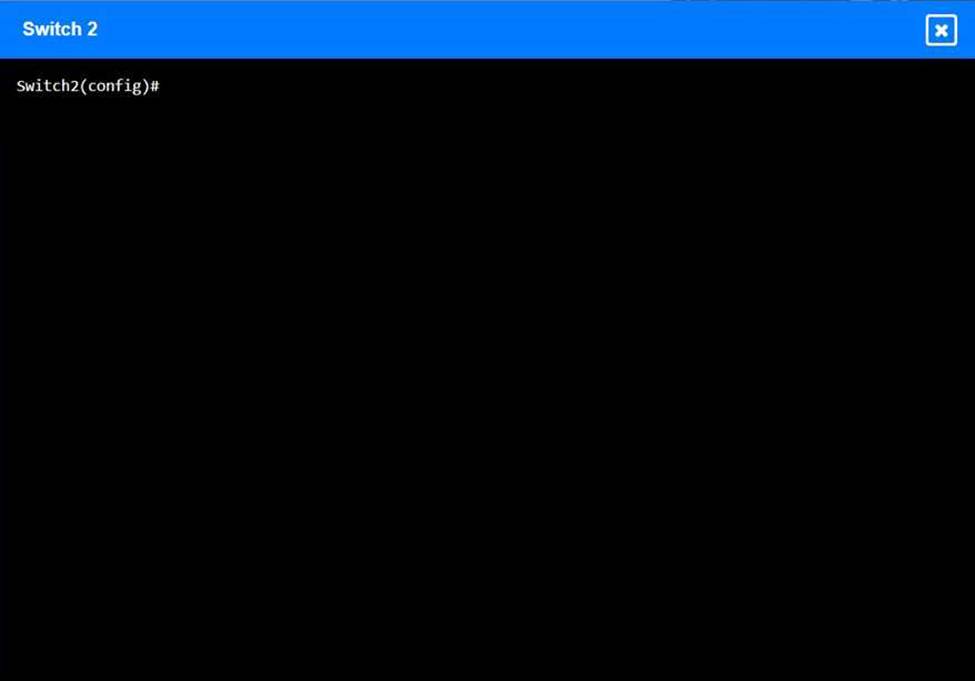
Switch 1 and Switch 2 are already in configuration mode. Type help to view a list of available commands.
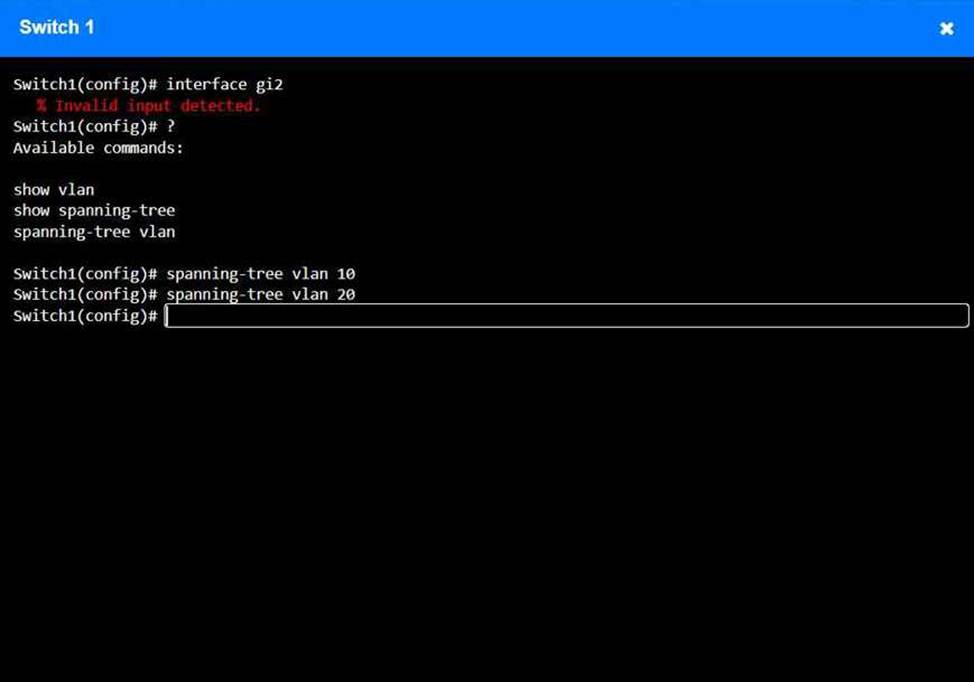
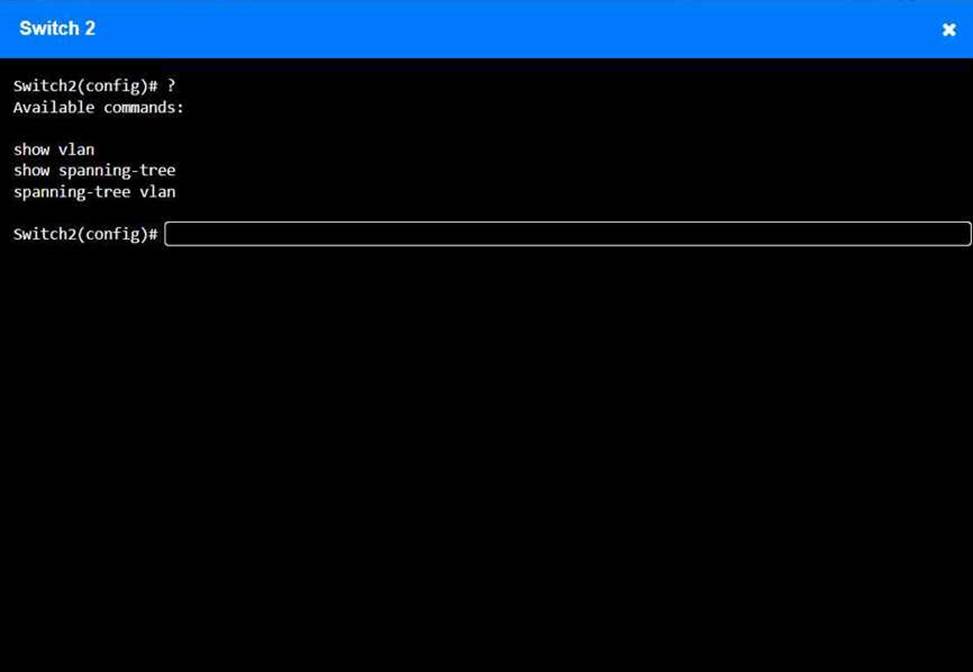
spanning-tree vlan 10 root primary
spanning-tree vlan 20 root secondary
Switch 2
spanning-tree vlan 20 root primary
spanning-tree vlan 10 root secondary
This PBQ is pointing to a switching loop / MAC flapping problem. The biggest clues are the high CPU utilization and the fact that the MAC table is continuously changing. That behavior is classic for a Layer 2 loop when redundant links exist between switches and no proper spanning-tree root role has been established.
The available commands shown in the screenshots are limited to spanning-tree vlan, so this is not an interface shutdown question. The fix is to use STP per VLAN and make one switch the preferred root for one VLAN and the other switch the preferred root for the other VLAN. That prevents both uplinks from forwarding in an uncontrolled loop while still giving redundancy.
A clean design is:
Switch 1 root primary for VLAN 10
Switch 2 root primary for VLAN 20
Make each opposite switch root secondary for failover
That stabilizes Layer 2 forwarding, stops MAC address flapping, reduces CPU load, and restores normal connectivity. After applying the STP root settings, the user should be able to ping 192.168.1.31 from PC 1 successfully. If your simulator asks for validation, run the ping again from PC 1 to the database server.
A user’s VoIP phone and workstation are connected through an inline cable. The user reports that the VoIP phone intermittently reboots, but the workstation is not having any network-related issues.
Which of the following is the most likely cause?
- A . The PoE power budget is exceeded.
- B . Port security is violated.
- C . The signal is degraded
- D . The Ethernet cable is not working
A
Explanation:
Power over Ethernet (PoE) delivers power to devices such as VoIP phones over the same cables used for data. If the total power requirement of connected devices exceeds the PoE power budget of the switch or injector, some devices may not receive adequate power and could intermittently reboot. This issue would not affect the workstation, which is likely receiving power separately.
Reference: CompTIA Network+ Exam Objectives and official study guides.
A user’s VoIP phone and workstation are connected through an inline cable. The user reports that the VoIP phone intermittently reboots, but the workstation is not having any network-related issues.
Which of the following is the most likely cause?
- A . The PoE power budget is exceeded.
- B . Port security is violated.
- C . The signal is degraded
- D . The Ethernet cable is not working
A
Explanation:
Power over Ethernet (PoE) delivers power to devices such as VoIP phones over the same cables used for data. If the total power requirement of connected devices exceeds the PoE power budget of the switch or injector, some devices may not receive adequate power and could intermittently reboot. This issue would not affect the workstation, which is likely receiving power separately.
Reference: CompTIA Network+ Exam Objectives and official study guides.
Which of the following cable types allows the use of QSFP ports without requiring transceivers?
- A . Multimode
- B . Twinaxial
- C . RG11
- D . Category 6
B
Explanation:
Twinaxial (Direct Attach Copper / DAC) cables can plug directly into QSFP ports without needing separate optical transceivers. They are cost-effective for short-distance, high-speed connections (commonly in data centers).