
Practice Free N10-009 Exam Online Questions
A network technician is troubleshooting network latency and has determined the issue to be occurring two network switches (Switch10 and Switch11). Symptoms reported included poor video performance and slow file copying. Given the following informtion:
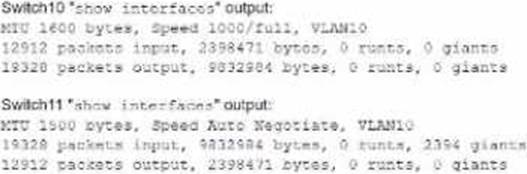
Which of the following should the technician most likely do to resolve the issue?
- A . Disable automatic negotiation on Switch11.
- B . Modify Switch10 MTU value to 1500.
- C . Configure STP on both switches.
- D . Change the native VLAN on the ports.
Which of the following is most commonly associated with many systems sharing one IP address in the public IP-addressing space?
- A . PAT
- B . NAT
- C . VIP
- D . NAT64
A
Explanation:
Port Address Translation (PAT) allows multiple internal devices to share a single public IP address by assigning each device a unique port number. This is the most common method used in environments where many systems need internet access but there are limited public IP addresses.
A network administrator needs to ensure all network ports use a security method that only permits authenticated devices.
The solution must meet the following requirements:
• Reduced chance of spoofing
• Centrally managed solution
• Auditable logs
Which of the following technologies provides this functionality?
- A . MAC filtering
- B . Port security
- C . ACLs
- D . 802.1X
D
Explanation:
A user’s desk has a workstation and an IP phone. The user is unable to browse the internet on the workstation, but the phone works.
Which of the following configurations is required?
- A . Voice VLAN
- B . Native VLAN
- C . Data VLAN
- D . Trunk port
C
Explanation:
If the IP phone works but the workstation doesn’t, it indicates that the Voice VLAN is functioning correctly, but the Data VLAN (C) is either misconfigured or missing. The workstation typically connects through the phone, which tags voice and data traffic separately using VLANs.
A network administrator wants to implement security zones in the corporate network to control access to only individuals inside of the corporation.
Which of the following security zones is the best solution?
- A . Extranet
- B . Trusted
- C . VPN
- D . Public
B
Explanation:
Introduction to Security Zones:
Security zones are logical segments within a network designed to enforce security policies and control access. They help in segregating and securing different parts of the network.
Types of Security Zones:
Trusted Zone: This is the most secure zone, typically used for internal corporate networks where only trusted users have access.
Extranet: This zone allows controlled access to external partners, vendors, or customers.
VPN (Virtual Private Network): While VPNs are used to create secure connections over the internet, they are not a security zone themselves.
Public Zone: This zone is the least secure and is typically used for public-facing services accessible by anyone.
Trusted Zone Implementation:
The trusted zone is configured to include internal corporate users and resources. Access controls, firewalls, and other security measures ensure that only authorized personnel can access this zone.
Internal network segments, such as the finance department, HR, and other critical functions, are usually placed in the trusted zone.
Example Configuration:
Firewall Rules: Set up rules to allow traffic only from internal IP addresses.
Access Control Lists (ACLs): Implement ACLs on routers and switches to restrict access based on IP addresses and other criteria.
Segmentation: Use VLANs and subnetting to segment and isolate the trusted zone from other zones.
Explanation of the Options:
A network administrator recently upgraded a wireless infrastructure with new APs. Users report that when stationary, the wireless connection drops and reconnects every 20 to 30 seconds. While reviewing logs, the administrator notices the APs are changing channels.
Which of the following is the most likely reason for the service interruptions?
- A . Channel interference
- B . Roaming misconfiguration
- C . Network congestion
- D . Insufficient wireless coverage
A
Explanation:
If APs are changing channels frequently, it indicates automatic channel selection due to interference.
This can cause temporary disconnections as the APs switch frequencies.
Breakdown of Options:
A server administrator needs to add a record to the company’s DNS server to verify ownership of a web domain. The administrator has the record’s name and value.
Which of the following record types should the administrator use to add the record to the DNS server?
- A . TXT
- B . A
- C . PTR
- D . CNAME
A
Explanation:
To verify ownership of a domain, providers commonly require adding a TXT record to DNS containing a specific validation token (a name/value pair). A TXT (text) record is designed to store arbitrary text data associated with a domain or hostname, which makes it ideal for domain verification workflows used by certificate authorities, email security (SPF/DKIM/DMARC-related entries), and third-party services that need proof of administrative control over DNS. This fits Network+ DNS objectives that cover common record types and their practical purposes in real deployments.
An A record maps a hostname to an IPv4 address and is used for name-to-address resolution, not ownership verification. A PTR record provides reverse DNS mapping (IP address to hostname) and is stored in reverse lookup zones, not typically used for validating web domain ownership. A CNAME record creates an alias from one hostname to another canonical hostname; while sometimes used in service integrations, the classic “record name + token value” ownership verification is most directly and universally satisfied by a TXT record. Therefore, TXT is the correct choice given the requirement and the provided record name and value.
A junior network administrator is auditing the company network and notices incrementing input errors on a long-range microwave interface.
Which of the following is the most likely reason for the errors?
- A . The parabolic signal is misaligned.
- B . The omnidirectional signal is being jammed.
- C . The omnidirectional signal is not strong enough to receive properly.
- D . The parabolic signal uses improper routing protocols.
A
Explanation:
A misaligned parabolic antenna can cause a significant increase in input errors because the signal is not properly focused or directed towards the receiving antenna, resulting in poor reception and data corruption.
The document confirms:
“Misalignment of parabolic microwave antennas can lead to weak or incorrect signal reception, causing an increase in input errors and connectivity issues on the link.”
A network administrator upgraded the wireless access points and wants to implement a configuration that will give users higher speed and less channel overlap based on device compatibility.
Which of the following will accomplish this goal?
- A . 802.1X
- B . MIMO
- C . ESSID
- D . Band steering
D
Explanation:
Band steering allows wireless access points to automatically direct capable devices to the 5GHz band, which typically has higher throughput and less interference than the 2.4GHz band, improving performance.
The document confirms:
“Band steering helps balance wireless client loads by steering dual-band capable devices to the 5GHz band, which offers higher speeds and less channel congestion than 2.4GHz.”
Which of the following can support a jumbo frame?
- A . Access point
- B . Bridge
- C . Hub
- D . Switch
D
Explanation:
Definition of Jumbo Frames:
Jumbo frames are Ethernet frames with more than 1500 bytes of payload, typically up to 9000 bytes.
They are used to improve network performance by reducing the overhead caused by smaller frames.
Why Switches Support Jumbo Frames:
Switches are network devices designed to manage data packets and can be configured to support jumbo frames. This capability enhances throughput and efficiency, particularly in high-performance networks and data centers.
Incompatibility of Other Devices:
Access Point: Primarily handles wireless communications and does not typically support jumbo frames.
Bridge: Connects different network segments but usually operates at standard Ethernet frame sizes.
Hub: A simple network device that transmits packets to all ports without distinguishing between devices, incapable of handling jumbo frames.
Practical Application:
Enabling jumbo frames on switches helps in environments where large data transfers are common, such as in storage area networks (SANs) or large-scale virtualized environments.
Reference: CompTIA Network+ course materials and networking hardware documentation.