Practice Free AZ-120 Exam Online Questions
HOTSPOT
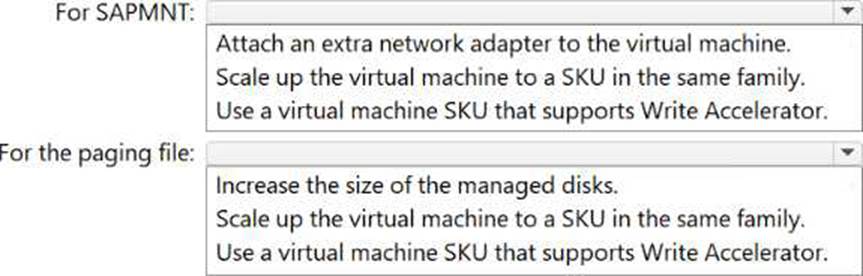
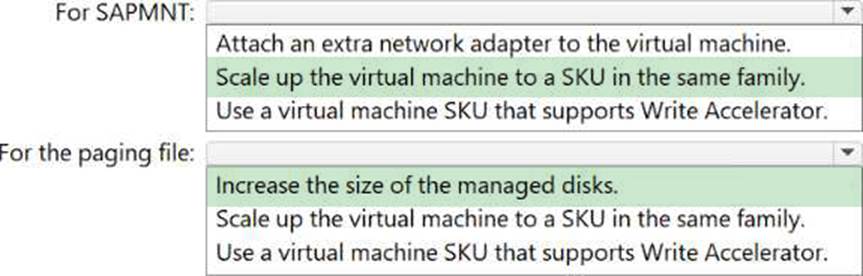
You plan to deploy an SAP workload to an Azure virtual machine that has the following types of storage:
• An SAPMNT file share hosted in Azure premium files
• Application files stored on Azure Premium managed disks
During testing, you use the E20ds v4 virtual machine SKU.
You discover that the bandwidth of the connection to the SAPMNT share is too low, and the disk space available for the paging file is insufficient.
You need to increase the available bandwidth and disk space.
The solution must minimize costs.
What should you do? To answer, select the appropriate options in the answer area. NOTE: Each correct selection is worth one point.
You have an Azure subscription that contains an SAP HANA on Azure (Large Instances) deployment.
The deployment is forecasted to require an additional 256 GB of storage.
What is the minimum amount of additional storage you can allocate?
- A . 256 GB
- B . 512 GB
- C . 1TB
- D . 2 TB
Litware is evaluating whether to add high availability after the migration?
What should you recommend to meet the technical requirements?
- A . SAP HANA system replication and Azure Availability Sets
- B . Azure virtual machine auto-restart with SAP HANA service auto-restart.
- C . Azure Site Recovery
You have an Azure subscription.
You deploy Active Directory domain controllers to Azure virtual machines.
You plan to deploy Azure for SAP workloads.
You plan to segregate the domain controllers from the SAP systems by using different virtual networks.
You need to recommend a solution to connect the virtual networks. The solution must minimize costs.
What should you recommend?
- A . a site-to-site VPN
- B . virtual network peering
- C . user-defined routing
- D . ExpressRoute
B
Explanation:
https://github.com/MicrosoftDocs/azure-docs/issues/32537
https://azure.microsoft.com/en-us/blog/vnet-peering-and-vpn-gateways/
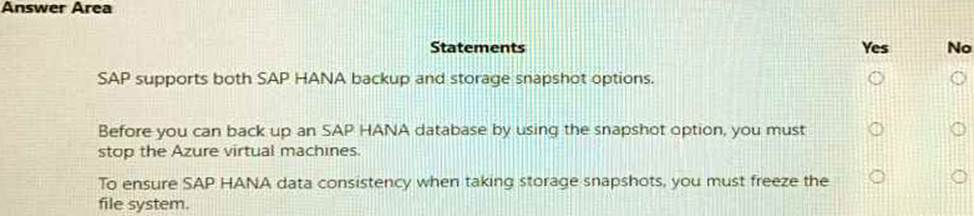
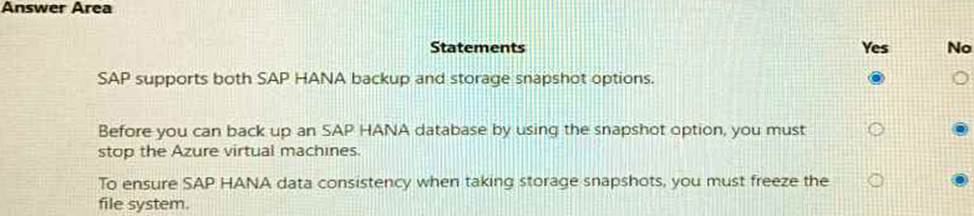
HOTSPOT
For each of the following statements, select Yes if the statement is true. Otherwise, select No. NOTE Each correct selection is worth one point.
You need direct connectivity from an on-premises network to SAP HANA (Large Instances).
The solution must meet the following requirements:
Minimize administrative effort.
Provide the highest level of resiliency.
What should you use?
- A . ExpressRoute Global Reach
- B . Linux IPTables
- C . ExpressRoute
- D . NGINX as a reverse proxy
C
Explanation:
https://docs.microsoft.com/en-us/azure/virtual-machines/workloads/sap/hana-network-architecture
Express Route Global Reach Microsoft introduced a new functionality called ExpressRoute Global Reach. Global Reach can be used for HANA Large Instances in two scenarios: Enable direct access from on-premises to your HANA Large Instance units deployed in different regions Enable direct communication between your HANA Large Instance units deployed in different regions Direct Access from on-premises In the Azure regions where Global Reach is offered, you can request enabling the Global Reach functionality for your ExpressRoute circuit that connects your on-premises network to the Azure virtual network that connects to your HANA Large Instance units as well.
You deploy on SAP environment on Azure.
You need to monitor the performance of the SAP NetWeaver environment by using the Azure Enhanced Monitoring Extension for SAP.
What should you do first?
- A . From Azure CLI, install the Linux Diagnostic Extension.
- B . From the Azure portal, enable the Azure Network Watcher Agent.
- C . From the Azure portal, enable the Custom Script Extension.
- D . From Azure CLI. run the az v aem m set command.
B
Explanation:
This solution requires the VM Agent to be installed in the Azure Virtual Machines you want to run SAP systems.
Reference: https://docs.microsoft.com/en-us/azure/virtual-machines/workloads/sap/vm-extension-for-sap
You plan to deploy an SAP production landscape on Azure.
You need to estimate how many SAP operations will be processed by the landscape per hour. The solution must minimize administrative effort.
What should you use?
- A . SAP Quick Sizer
- B . SAP HANA hardware and cloud measurement tools
- C . SAP S/4HANA Migration Cockpit
- D . SAP GUI
You have an on-premises SAP NetWeaver application server and SAP HANA database deployment.
You plan to migrate the on-premises deployment to Azure.
You provision new Azure virtual machines to host the application server and database roles.
You need to initiate SAP Database Migration Option (DMO) with System Move.
On which server should you start Software Update Manager (SUM)?
- A . the virtual machine that will host the application server
- B . the on-premises application server
- C . the on-premises database server
- D . the virtual machine that will host the database
HOTSPOT
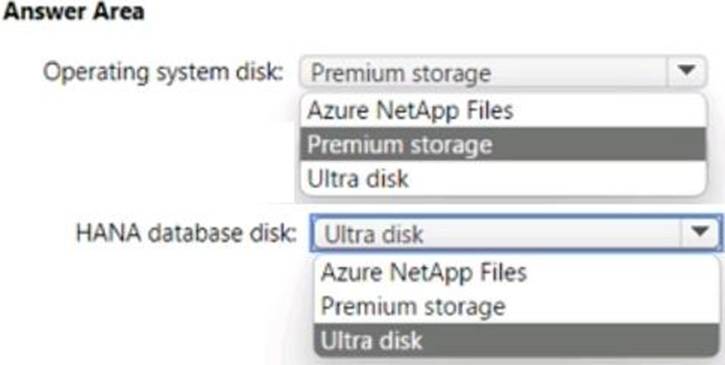
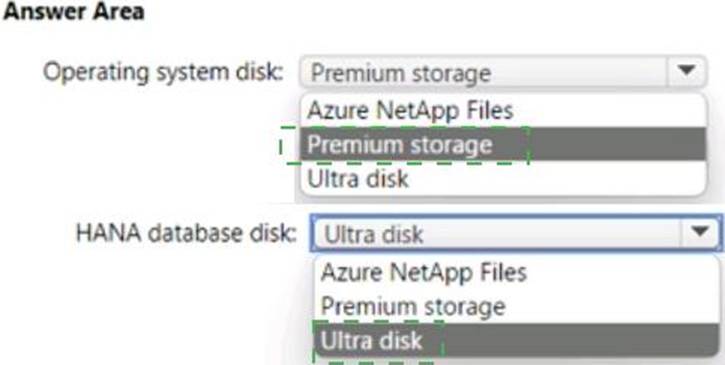
You plan to deploy two Azure virtual machines that will host an SAP HANA database for an SAP landscape. The virtual machines will be deployed to the same availability set.
You need to meet the following requirements:
• Ensure that the virtual machines support disk snapshots.
• Ensure that the virtual machine disks provide sub millisecond latency for writes.
• Ensure that each virtual machine can be allocated disks from a different storage cluster.
Which type of operating system disk and HANA database disk should you use? To answer, select the appropriate options in the answer area. NOTE Each correct selection is worth one point.