Practice Free AZ-120 Exam Online Questions
Note: This question is part of a series of questions that present the same scenario. Each question in the series contains a unique solution that might meet the stated goals. Some question sets might have more than one correct solution, while others might not have a correct solution.
After you answer a question in this section, you will NOT be able to return to it. As a result, these questions will not appear in the review screen.
You deploy SAP HANA on Azure (Large Instances).
You need to back up the SAP HANA database to Azure.
Solution: Back up directly to disk, copy the backups to an Azure virtual machine, and then copy the backup to an Azure Storage account
Does this meet the goal?
- A . Yes
- B . No
B
Explanation:
Instead you should create a Recovery Services vault and a backup policy.
Reference:
https://docs.microsoft.com/en-us/azure/backup/sap-hana-db-about
https://docs.microsoft.com/en-us/azure/backup/backup-azure-sap-hana-database#configure-backup
You plan to deploy an SAP environment on Azure that will use Azure Availability Zones.
Which load balancing solution supports the deployment?
- A . Azure Basic Load Balancer
- B . Azure Standard Load Balancer
- C . Azure Application Gateway v1 SKU
B
Explanation:
When you deploy Azure VMs across Availability Zones and establish failover solutions within the same Azure region, some restrictions apply:
You can’t use an Azure Basic Load Balancer to create failover cluster solutions based on Windows Server Failover Clustering or Linux Pacemaker. Instead, you need to use the Azure Standard Load Balancer SKU.
Reference: https://docs.microsoft.com/en-us/azure/virtual-machines/workloads/sap/sap-ha-availability-zones
You plan to migrate an on-premises SAP development system to Azure.
Before the migration, you need to check the usage of the source system hardware, such as CPU, memory, network, etc.
Which transaction should you run from SAP GUI?
- A . SM51
- B . DB01
- C . DB12
- D . ST06
D
Explanation:
ST06 is a transaction code used for Operating System Monitor in SAP.
SAP transaction ST06 (Operating System Monitor) is classified in the Basis Component module under application component Operating System Monitors and runs Monitoring Operating System program RSHOST05 upon execution.
Reference: https://saptransactions.com/codes/ST06/
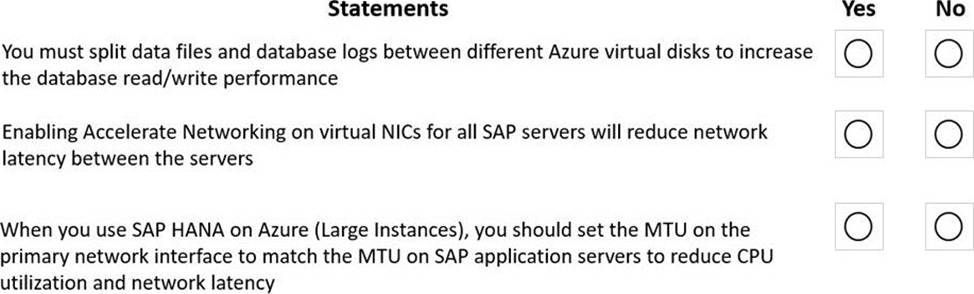
HOTSPOT
For each of the following statements, select Yes if the statement is true. Otherwise, select No. NOTE: Each correct selection is worth one point.
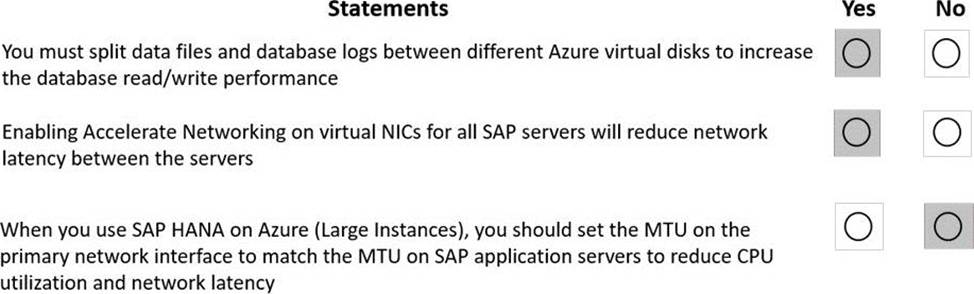
Explanation:
Box 1: Yes
The following is a quick checklist of storage configuration best practices for running your SQL Server on Azure VM:
Place data, log, and tempdb files on separate drives.
Box 2: Yes
Accelerated networking enables single root I/O virtualization (SR-IOV) to a VM, greatly improving its networking performance. This high-performance path bypasses the host from the data path, which reduces latency, jitter, and CPU utilization for the most demanding network workloads on supported VM types.
Box 3: No
Note: The maximum transmission unit (MTU) is the largest size frame (packet), specified in bytes, that can be sent over a network interface. The MTU is a configurable setting. The default MTU used on Azure VMs, and the default setting on most network devices globally, is 1,500 bytes.
Reference:
https://docs.microsoft.com/en-us/azure/virtual-network/create-vm-accelerated-networking-powershell
https://docs.microsoft.com/en-us/azure/azure-sql/virtual-machines/windows/performance-guidelines-best-practices-checklist
You have an SAP production landscape in Azure.
Users access the landscape from the internet by using Azure Application Gateway.
You need to analyze the network traffic of the landscape by using Azure Network Watcher traffic analytics.
What should you configure?
- A . network security group (NSG) flow logs
- B . Network Manager
- C . Connection Monitor
- D . Diagnostic settings in Application Gateway
DRAG DROP
You have an Azure subscription that contains a highly available SAP NetWeaver deployment. The deployment contains four virtual machines.
You need to monitor the NetWeaver deployment by using Azure Monitor for SAP Solutions. During the implementation of Azure Monitor for SAP Solutions, downtime of the deployment must be minimized.
Which three actions should you perform in sequence? To answer, move the appropriate actions from the list of actions to the answer area and arrange them in the correct order.


You are planning a deployment of SAP on Azure that will use SAP HANA.
You need to ensure that the SAP application servers are in the same datacenter as the HANA nodes.
What should you use?
- A . a resource group
- B . a virtual machine scale set
- C . an application group
- D . a proximity placement group
You need to recommend a solution to reduce the cost of the SAP non-production landscapes after the migration.
What should you include in the recommendation?
- A . Deallocate virtual machines when not In use.
- B . Migrate the SQL Server databases to Azure SQL Data Warehouse.
- C . Configure scaling of Azure App Service.
- D . Deploy non-production landscapes to Azure Devlest Labs.
You plan to implement a highly available SAP HANA deployment by using two Azure virtual machines that run SUSE Linux Enterprise Server (SLES). You need to create an Azure Fence agent STONITH block device (SBD).
What should you do first?
- A . Create a system-assigned managed identity.
- B . Create a storage account
- C . Create an application registration in Azure AD.
- D . Create a user-assigned managed identity
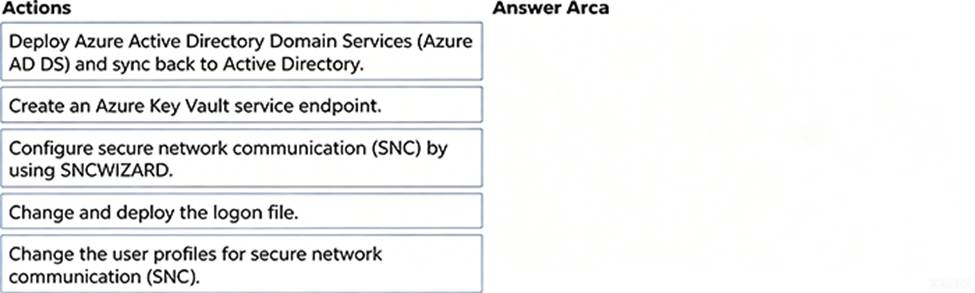
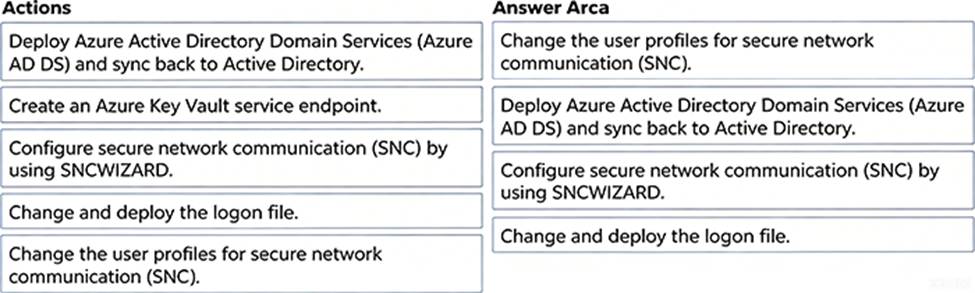
DRAG DROP
Your on-premises network contains an Active Directory domain.
You are deploying a new SAP environment on Azure.
You need to configure SAP Single Sign-On to ensure that users can authenticate lo SAP GUI and SAP WebGUI.
Which four actions should you perform in sequence? To answer, move the appropriate actions from the list of actions to the answer area and arrange them in the correct order.