
Practice Free AZ-120 Exam Online Questions
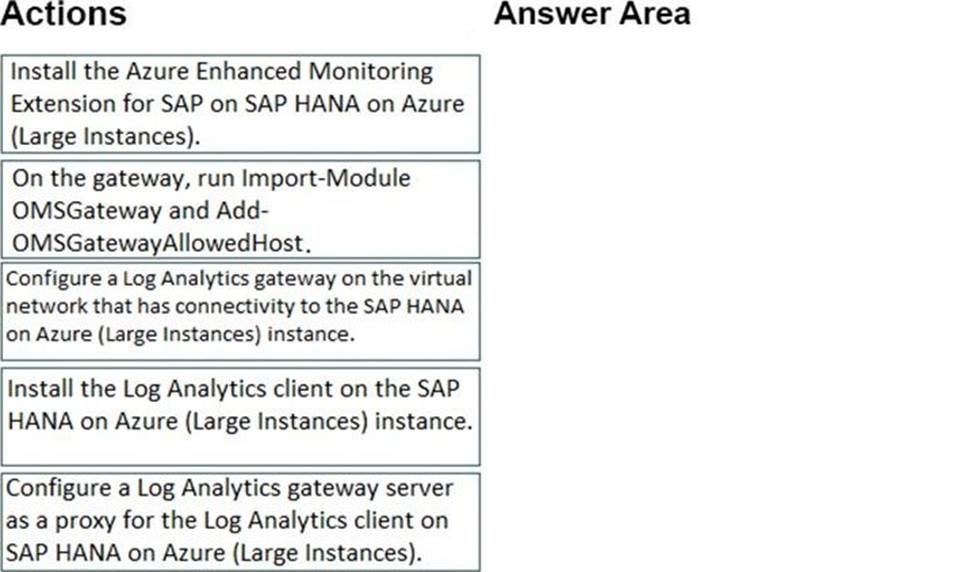
DRAG DROP
You need to connect SAP HANA on Azure (Large Instances) to an Azure Log Analytics workspace.
Which four actions should you perform in sequence? To answer, move the appropriate actions from the list of actions to the answer area and arrange them in the correct order.
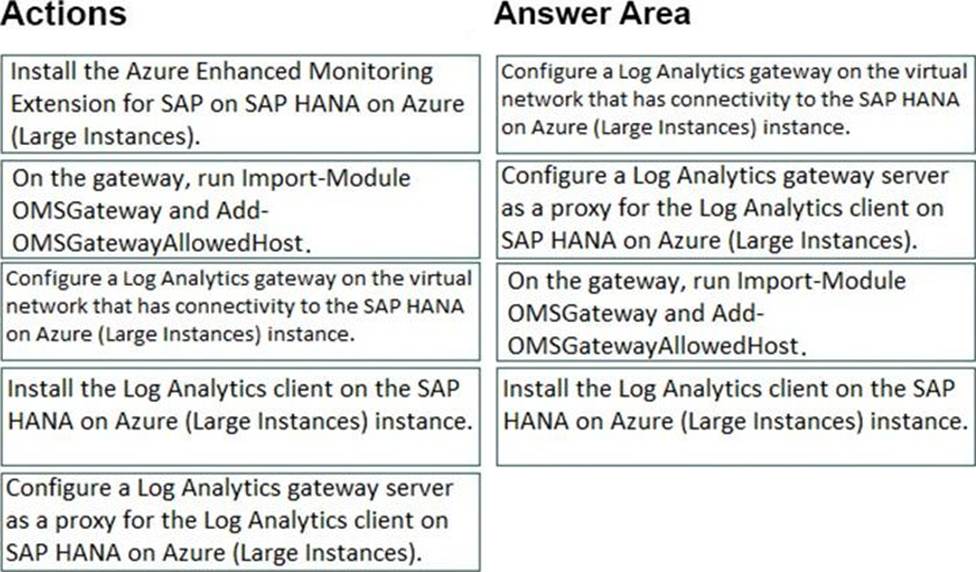
Explanation:
3524
Reference:
http://www.deployazure.com/compute/virtual-machines/sap-azure-enhanced-monitoring-extension/
https://docs.microsoft.com/en-us/azure/azure-monitor/platform/gateway
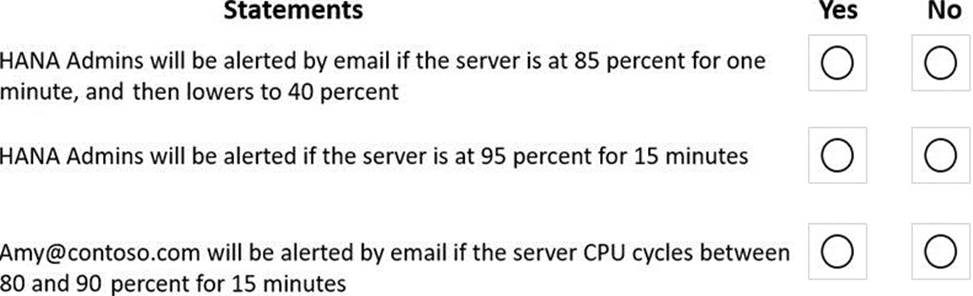
HOTSPOT
You have an SAP production landscape that uses SAP HANA databases.
You configure a metric alert for the primary HANA server as shown in the following exhibit.

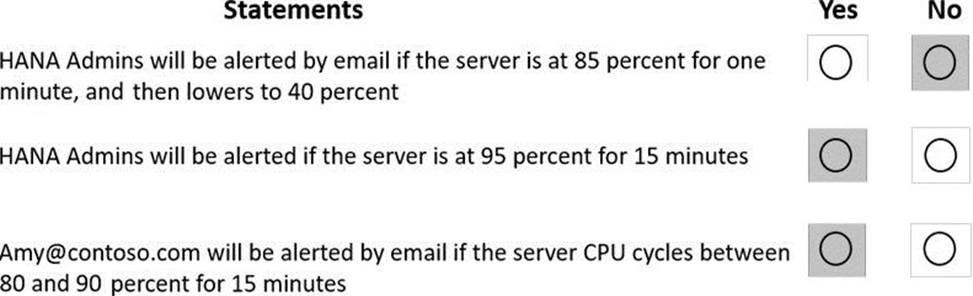
Explanation:
Box 1: No
The period is 15 minutes. Only alerts or emails will be sent.
Box 2: Yes
Box 3: Yes
You have an SAP HANA on Azure (Large Instances) deployment. You need to generate hearth check log files for the Deployment.
What should you do?
- A . From a SSH session on the HANA Large instance node. Run/var/waagent/Microsoft.AzureCAT.AzureEnhancedMonitoring.MonitorX64Linux-1.0.082/AzuredMonitoring Cmonitoring.
- B . From the Azure portal, select New support request.
- C . From A SSH session on the HANA large instances node, run/opt/sgi/health_check/microsoft_tdi-sh.
- D . From the Azure portal, select Diagnose and solve problems.
You have an SAP production landscape on-premises and an SAP development landscape on Azure. You deploy a network virtual appliance to act as a firewall between the Azure subnet and the on-premises network.
Solution: You deploy an Azure Standard Load balancer.
Does this meet the goal?
- A . Yes
- B . No
HOTSPOT
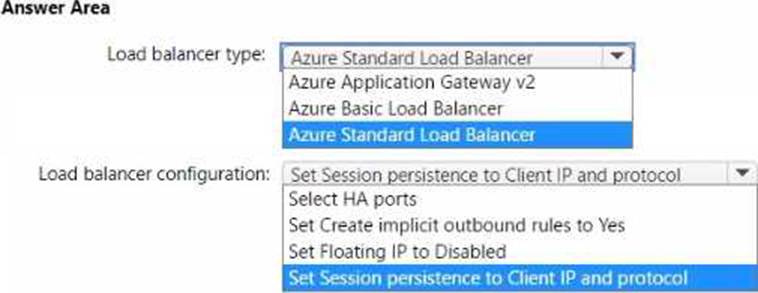
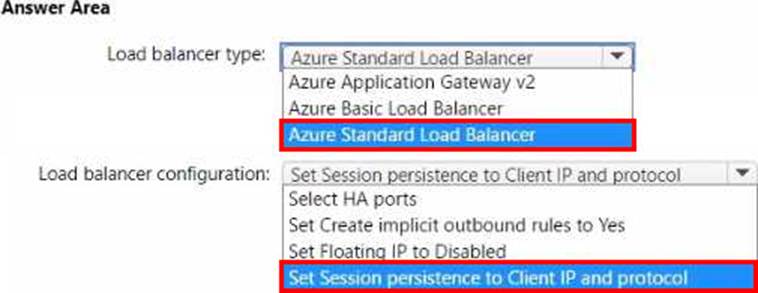
You plan to deploy a highly available SAP NetWeaver system to Azure virtual machines on SUSE Linux Enterprise Server (SLES) for SAP Applications.
You need to configure a load balancer that will be deployed in front of the ABAP Central Services (ASCS) tier. The solution must minimize the number of required load balancing rules.
What should you configure? To answer, select the appropriate options in the answer area. NOTE: Each correct selection is worth one point.
HOTSPOT
You plan to deploy a highly available SAP NetWeaver system to Azure virtual machines on SUSE Linux Enterprise Server (SLES) for SAP Applications.
You need to configure a load balancer that will be deployed in front of the ABAP Central Services (ASCS) tier. The solution must minimize the number of required load balancing rules.
What should you configure? To answer, select the appropriate options in the answer area. NOTE: Each correct selection is worth one point.
You have an Azure subscription and an Enterprise Agreement (EA).
You plan to deploy an SAP on Azure production landscape that will contain the following virtual machines:
• One M-series virtual machine with 128 cores
• 15 E-series virtual machines with a total of 300 cores
• 10 D-series virtual machines with a total of 160 cores
During the deployment of the E-series virtual machines, you receive the following error message.
Operation results in exceeding quota limits of Core.
You need to ensure you can complete the E-series virtual machine deployment.
The solution must meet the following requirements:
• Maintain the performance of the SAP landscape.
• Minimize administrative effort.
• Minimize costs.
What should you do?
- A . Convert the subscription to Pay-As-You-Go (PAYG).
- B . Create a second subscription and split the virtual machines evenly between both subscriptions.
- C . Resize the D-series and E-series virtual machines.
- D . Request a quota increase for the Azure region.
DRAG DROP
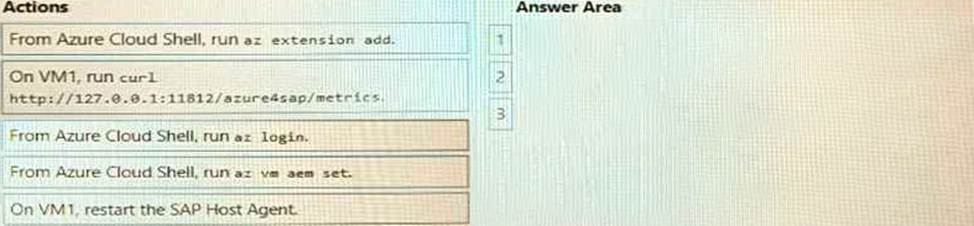
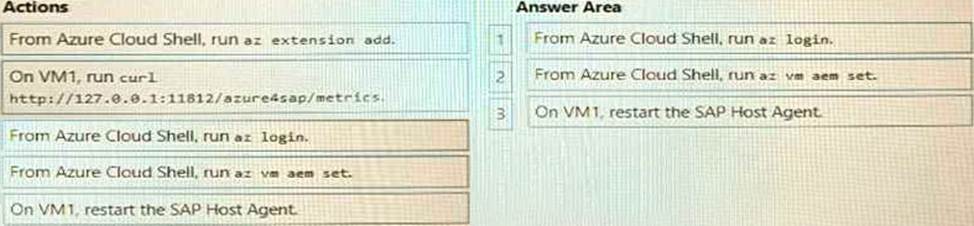
You have an Azure virtual machine named VM1 that runs SUSE Linux Enterprise Server (SLE5) and hosts an SAP NetWeaver application server.
You need to install the Azure VM extension for SAP solutions on VM1.
Which three actions should you perform in sequence? To answer, move all actions from the list of actions to the answer area and arrange them in the correct order.
You plan to migrate an SAP ERP Central Component (SAP ECC) production system to Azure.
You are reviewing the SAP EarlyWatch Alert report for the system.
You need to recommend sizes for the Azure virtual machines that will host the system.
Which two sections of the report should you review? Each correct answer presents a complete solution. NOTE: Each correct selection is worth one point.
- A . Hardware Capacity
- B . Patch Levels under SAP Software Configuration
- C . Hardware Configuration under Landscape
- D . Database and ABAP Load Optimization
- E . Data Volume Management
A, D
Explanation:
Reference: https://wiki.scn.sap.com/wiki/display/SM/Hardware+Capacity+Checks+in+EWA
You have an SAP production landscape in Azure and an Azure Firewall instance named FW1.
You are migrating the landscape to an SAP RISE managed workload.
You need to configure FW1 to allow traffic between the landscape and the managed workload. The solution must minimize the number of open ports on FW1.
Which protocols should you allow?
- A . HTTPS, RFC, and OBDC only
- B . HTTPS only
- C . NFS, RFC, and SSH only
- D . NFS and RPC only