
Practice Free AZ-120 Exam Online Questions
You have an Azure subscription. The subscription contains a virtual machine named Server1 that runs Windows Server and hosts SAP Central Services (SCS). To Server1. you deploy the new version of the Azure VM Extension for SAP solutions. You need to validate whether the extension is collecting performance metrics.
What should you do on Server1?
- A . From Microsoft Edge, navigate to http://127.0.0.1:11812/azure4sap/metrics.
- B . Run the Get-AzMetric cmdlet.
- C . Run the Get-AzVMDiagnosticsExtension cmdlet.
- D . From Microsoft Edge, navigate to http://169.254.169.254/metadata/instance?api-version=2021-02-01.
You have a n SAP environment on Azure.
Your on-premises network uses a 1-Gbps ExpresRoute circuit to connect to Azure Private peering is enabled on the circuit. The default route (0.0.0.0/0) from the on-premises network is advertised You need to resolve the issue without modifying the ExpresRoute circuit. The solution must minimize administrative effort.
What should you do?
- A . Create a user-defined route tint redirects traffic to the Blob storage.
- B . Create an application security group.
- C . Change the backup solution to use a third-party software that can write to the Blob storage.
- D . Enable virtual network service endpoints.
D
Explanation:
Private endpoint enables connectivity between the consumers from the same ExpressRoute.
Note: Consult with SAP HANA on Microsoft Service Management. If they advise you to increase the bandwidth of the SAP HANA on Azure (Large Instances) ExpressRoute circuit, create an Azure support request. (You can request an increase for a single circuit bandwidth up to a maximum of 10 Gbps.)
Reference:
https://docs.microsoft.com/en-us/azure/private-link/private-endpoint-overview
https://docs.microsoft.com/bs-cyrl-ba/azure/virtual-machines/workloads/sap/hana-additional-network-requirements#increase-expressroute-circuit-bandwidth
You have an existing SAP production landscape on Azure. The SAP application virtual machines have static IP addresses.
You need to replicate the virtual machines to another Azure region by using Azure Site Recovery. The source and target subnets have different address ranges.
Which three actions should you perform? Each correct answer presents part of the solution. NOTE: Each correct selection is worth one point.
- A . Stop the virtual machines.
- B . Create a backup policy.
- C . Create a recovery plan.
- D . Modify the networking configuration.
- E . Replicate the virtual machines.
Your on-premises network is connected to an SAP HANA deployment in the East US Azure region.
The deployment uses the Standard SKU of an ExpressRoute gateway.
You need to implement ExpressRoute FastPath.
The solution must meet the following requirements:
• Hybrid connectivity must be maintained if a single datacenter fails in the East US region.
• Hybnd connectivity costs must be minimized.
Which ExpressRoute gateway SKU should you use?
- A . ErGwIAz
- B . High Performance
- C . Ultra Performance
- D . ErGw3Az
You plan to migrate an on-premises SAP development system to Azure.
Before the migration, you need to check the usage of the source system hardware, such as CPU, memory, network, etc.
Which transaction should you run from SAP GUI?
- A . SM51
- B . DB01
- C . DB12
- D . OS07N
D
Explanation:
SAP transaction OS07N (Remote Operating System Activity) is classified in the Basis Component module under application component Operating System Monitors and runs Monitoring Operating System program RSHOST1N upon execution.
Incorrect Answers:
A: Transaction code SM51 is to display list of active application servers that have registered in the SAP message server.
B: DB01 is a transaction code used for Analyze Exclusive Lockwaits in SAP.
C: Transaction code DB12 is to collects and presents information that is necessary to monitor database backups.
Reference: http://www.saptransactions.com/codes/OS07N/
You have an SAP HANA on Azure (Large Instances) deployment that has two Type II SKU nodes. Each node is provisioned in a separate Azure region. You need to monitor storage replication for the deployment.
What should you use?
- A . xfsdump
- B . azacsnap
- C . rear
- D . tar
You have an SAP landscape on Azure that contains the virtual machines shown in the following table.

You need to ensure that the Application Server role is available if a single Azure datacenter fails.
What should you include in the solution?
- A . Azure Private Link
- B . Azure Load Balancer Standard
- C . a local network gateway
- D . Azure Application Gateway v1
You have an SAP production landscape in Azure.
You plan to migrate the landscape to an SAP RISE managed workload.
Which task will be the sole responsibility of the SAP vendor after the migration?
- A . configuring security monitoring in Microsoft Sentinel
- B . sizing the Azure resources that host the landscape
- C . implementing single sign-on (SSO)
- D . configuring virtual network peering
You have an SAP landscape on Azure that contains the virtual machines shown in the following table.

You need to ensure that the Application Server role is available if a single Azure datacenter fails.
What should you include in the solution?
- A . a local network gateway
- B . Azure Virtual WAN
- C . Azure Load Balancer Standard
- D . Azure Private Link
C
Explanation:
For the load balancers of the failover clusters of SAP Central Services and the DBMS layer, you need to use the Standard SKU Azure Load Balancer. The Basic Load Balancer won’t work across zones.
Reference: https://docs.microsoft.com/en-us/azure/virtual-machines/workloads/sap/sap-high-availability-architecture-scenarios
HOTSPOT
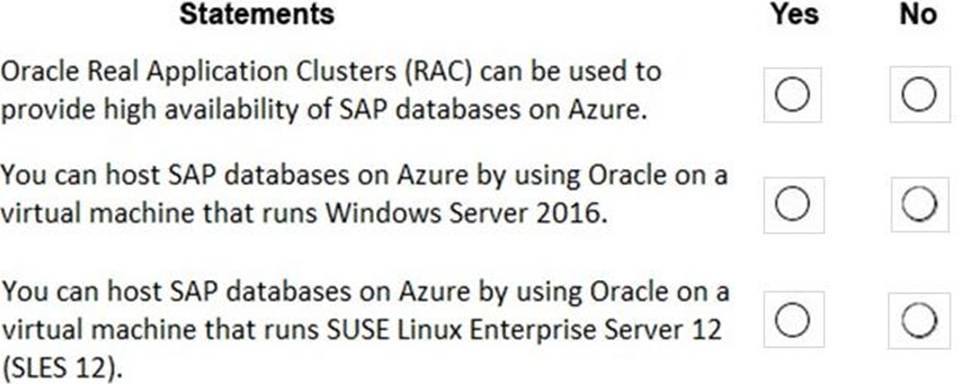
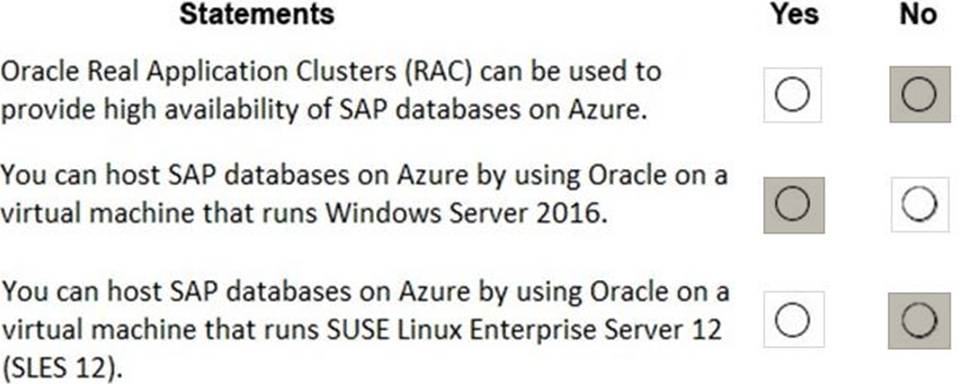
For each of the following statements, select Yes if the statement is true. Otherwise, select No. NOTE: Each correct selection is worth one point.
Explanation: