
Practice Free 300-410 Exam Online Questions
Refer to the exhibit.
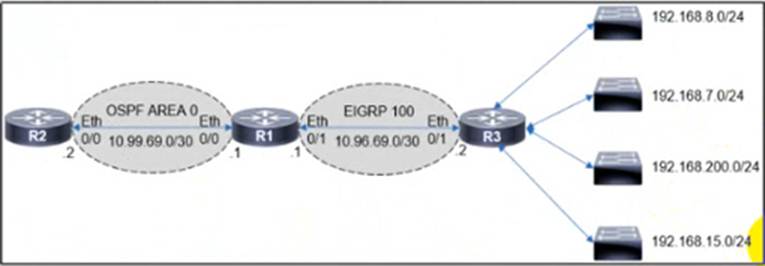
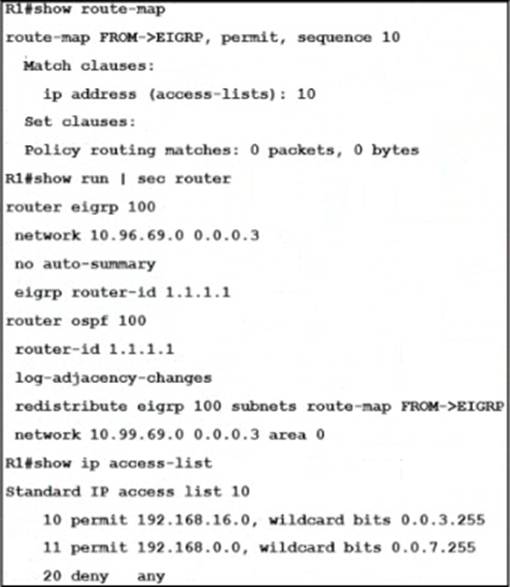
The engineer configured route redistribution in the network but soon received reports that R2 cannot access 192 168 7 0/24 and 192 168 15 0/24 subnets.
Which configuration resolves the issue?
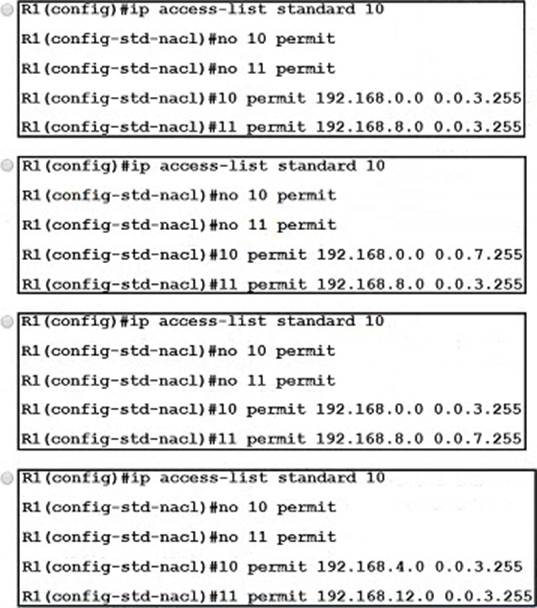
- A . Option A
- B . Option B
- C . Option C
- D . Option D
Refer to the exhibit.
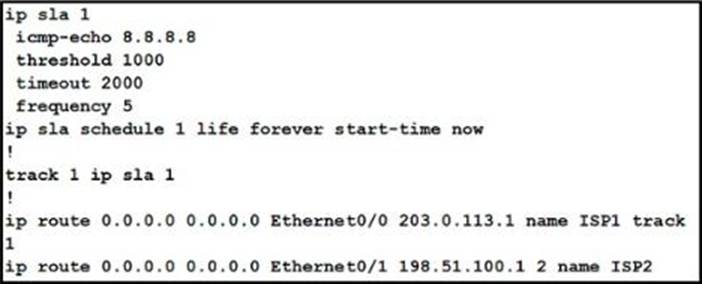
After recovering from a power failure. Ethernet0/1 stayed down while Ethernet0/0 returned to the up/up state. The default route through ISP1 was not reinstated m the routing table until Ethernet0/1 also came up.
Which action resolves the issue?
- A . Reference the track object 1 in both static default routes
- B . Remove the references to the interface names from both static default routes
- C . Configure the default route through ISP1 with a higher administrative distance than 2.
- D . Add a static route to the 8 8.8 8/32 destination through the next hop 203.0.113.1
Refer to the exhibit.
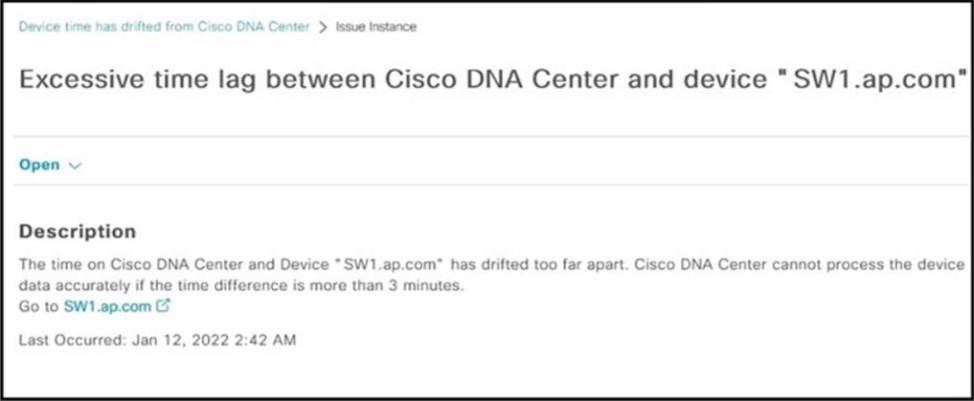
Which action resolves the issue?
- A . Establish connectivity between the NTP server and the switch.
- B . Configure the local time on Cisco DNA Center
- C . Configure the local time on the SW1 device
- D . Establish connectivity between the NTP server and Cisco DNA Center.
A customer reports to the support desk that they cannot print from their PC to the local printer id:401987778.
Which tool must be used to diagnose the issue using Cisco DNA Center Assurance?
- A . application trace
- B . path trace
- C . ACL trace
- D . device trace
Refer to the exhibit.
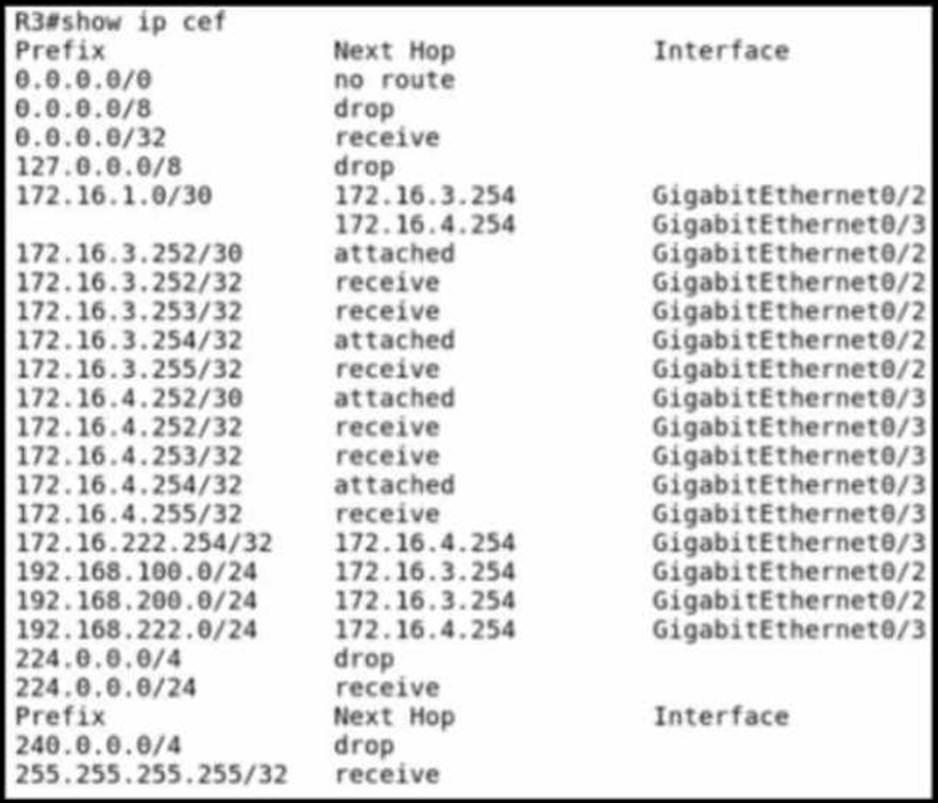
An engineer recently implemented uRPF by configuring the ip verify unicast source reachable-via rx command on interface gi0/3 The engineer noticed right after implementing F that an inbound packet on the giO-3 interface with a source address of 172 16 3 251 was dropped.
Which action resolves the issue?
- A . Configure uRPF loose mode to forward the packet.
- B . Permit the 172.16.3.251 in the inbound ACL on interface gi0/3.
- C . Permit the 172.16.3.251 in the inbound ACL on interface gi0/3 to allow 172.16.3.251.
- D . Configure uRPF strict mode to forward the packet
A
Explanation:
Option A configures uRPF loose mode to forward the packet. This mode allows the router to check if there is a route in the routing table that matches the source IP address of the incoming packet, regardless of the interface that is used to reach the source. This mode is suitable for networks that have asymmetric routing, where the incoming and outgoing interfaces for a packet may differ2.
Option B permits the 172.16.3.251 in the inbound ACL on interface gi0/3. This option does not resolve the issue, because it only allows the packet to pass the ACL check, but not the uRPF check. The packet will still be dropped by uRPF if there is no route to reach the source IP address via the same interface3.
Option C permits the 172.16.3.251 in the inbound ACL on interface gi0/3 to allow 172.16.3.251. This option is redundant and incorrect, because it repeats the same IP address twice in the ACL statement. It also does not resolve the issue for the same reason as Option B3.
Option D configures uRPF strict mode to forward the packet. This option does not resolve the issue, because it is the same mode that was already configured on the interface. Strict mode requires that the router has a route to reach the source IP address via the same interface where the packet was received. If this condition is not met, the packet will be dropped4.