
Practice Free 300-410 Exam Online Questions
The network administrator configured CoPP so that all SNMP traffic from Cisco Prime located at 192.168.1.11 toward the router CPU is limited to 1000 kbps. Any traffic that exceeds this limit must be dropped.
access-list 100 permit udp any any eq 161
class-map CM-SNMP
match access-group 100
policy-map PM-COPP
class CM-SNMP
police 1000 conform-action transmit
!
control-plane
service-policy input PM-COPP
The network administrator is not getting the desired result for the SNMP traffic and SNMP traffic is getting dropped frequently.
Which set of configurations resolves the issue?
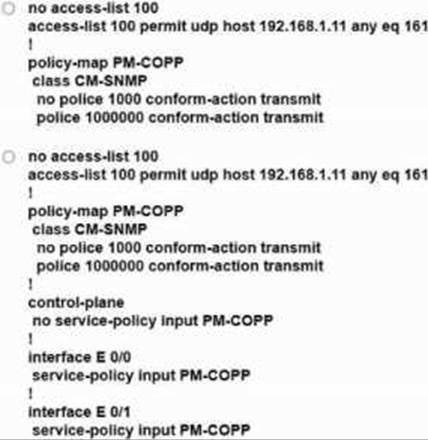
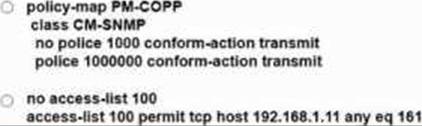
- A . Option A
- B . Option B
- C . Option C
- D . Option D
Refer to Exhibit.
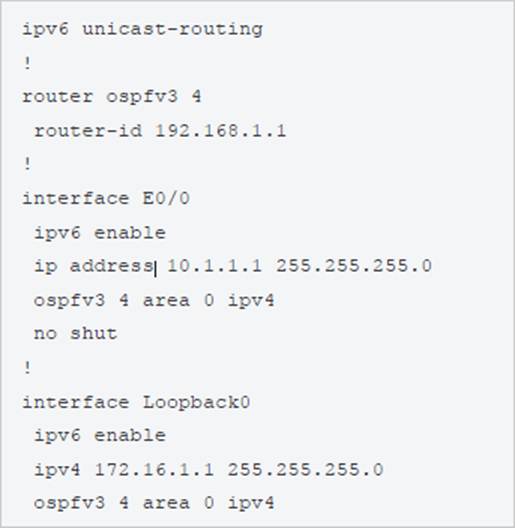
The network administrator configured the branch router for IPv6 on the E0/0 interface. The neighboring router is fully configured to meet requirements, but the neighbor relationship is not coming up.
Which action fixes the problem on the branch router to bring the IPv6 neighbors up?
- A . Enable the IPv4 address family under the router ospfv3 4 process by using the address-family ipv4 unicast command
- B . Disable IPv6 on the E0/0 interface using the no ipv6 enable command
- C . Enable the IPv4 address family under the E0/0 interface by using the address-family ipv4 unicast command
- D . Disable OSPF for IPv4 using the no ospfv3 4 area 0 ipv4 command under the E0/0 interface
A
Explanation:
Explanation
Once again, Cisco changed the IOS configuration commands required for OSPFv3 configuration. The new OSPFv3 configuration uses the “ospfv3” keyword instead of the earlier “ipv6 router ospf” routing process command and “ipv6 ospf” interface commands.
The Open Shortest Path First version 3 (OSPFv3) address families feature enables both IPv4 and IPv6 unicast traffic to be supported. With this feature, users may have two processes per interface, but only one process per address family (AF).
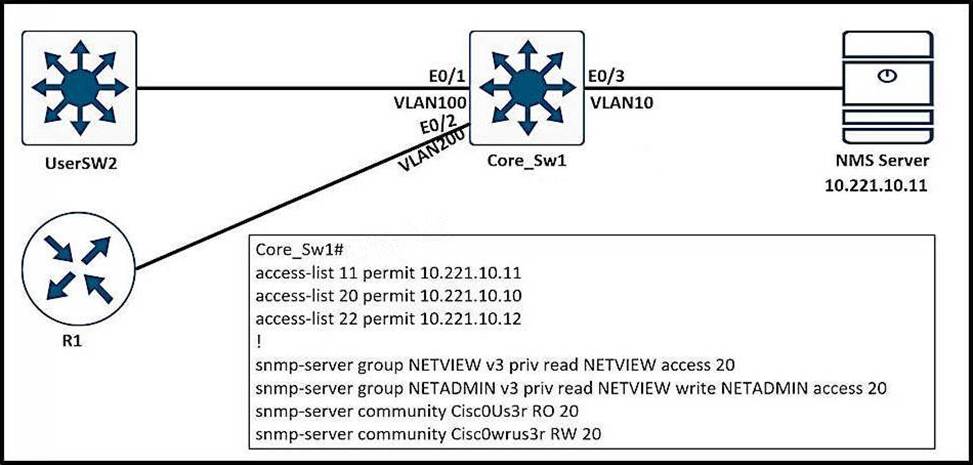
Refer to the exhibit.
- A . access-list 20 permit 10.221.10.12
- B . snmp-server group NETVIEW v2c priv read NETVIEW access 20
- C . snmp-server group NETADMIN v3 priv read NETVIEW write NETADMIN access 22
- D . access-list 20 permit 10.221.10.11
Refer to the exhibit.
A network engineer receives a fault ticket about traffic drops from BANK SITE to BANK
Users can reach BANK SITE Y from router RA as a source.
Routers RB and RD are acting as route reflectors.
Which configuration resolves the issue?
- A . RC(config)#router bgp 65201
RC(config-router)#neighbor 10.10.10.4 route-reflector-client - B . RF(config)#router bgp 65201
RF(config-router)#neighbor 10.10.10.6 route-reflector-client - C . RC(config)#router bgp 65201
RC(config-router)#neighbor 10.10.10.2 route-reflector-client - D . RB(config)router bgp 65201
RB(config-router)#neighbor 10.10.10.3 route-reflector-client
A customer reports to the support desk that they cannot print from their PC to the local printer id:401987778.
Which tool must be used to diagnose the issue using Cisco DNA Center Assurance?
- A . application trace
- B . path trace
- C . ACL trace
- D . device trace
Refer to the exhibit.
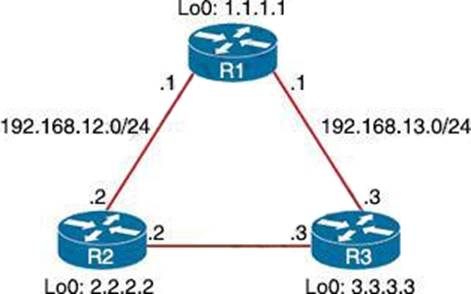
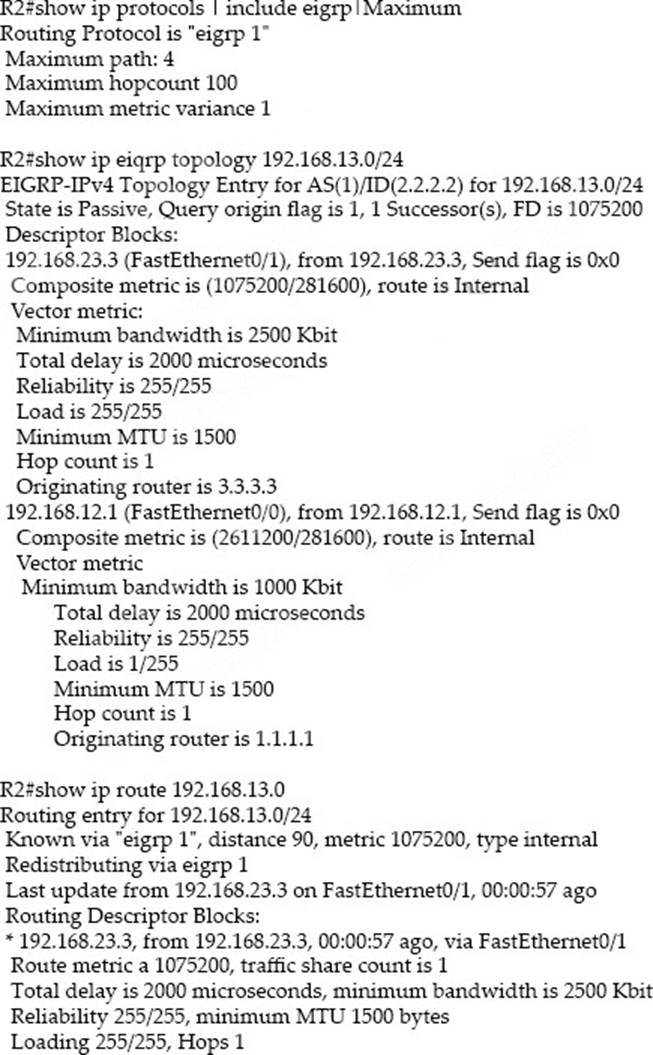
R2 has two paths to reach 192.168.13.0/24. but traffic is sent only through R3.
Which action allows traffic to use both paths?
- A . Configure the bandwidth 2000 command under interface FastEthernet0/0 on R2.
- B . Configure the variance 4 command under the EIGRP process on R2.
- C . Configure the delay 1 command under interface FastEthernet0/0 on R2.
- D . Configure the variance 2 command under the EIGRP process on R2
B
Explanation:
From the output of the “show ip eigrp topology …” command, we notice network 192.168.13.0/24 was learned via two routes:
+ From 192.168.23.3 (R3) with FD = 1075200 and AD = 281600
+ From 192.168.12.1 (R1) with FD = 2611200 and AD = 281600
From the output of the “show ip route …” command, we learned that the best (and chosen) path is via 192.168.23.3 (R3).
To use both paths (called unequal cost load balancing) with EIGRP, the second path via R1 must satisfy the feasibility condition. The feasibility condition states that, the Advertised Distance (AD) of a route must be lower than the feasible distance of the current successor route.
In this case, the second path satisfies the feasible condition as its AD (281600) is smaller than the FD (1075200) of the best path. Therefore we can configure loadbalancing with “variance” command.
In other words, EIGRP will install all paths with metric < variance * best_metric into the local routing table, provided that it meets the feasibility condition to preventrouting loop. Therefore we can calculate the variance > metric / best_metric = 2611200 / 1075200 =2.4.
So with a variance greater than 2 (and must be an integer), we can load balance traffic to network 192.168.13.0/24.
Refer to the exhibit.
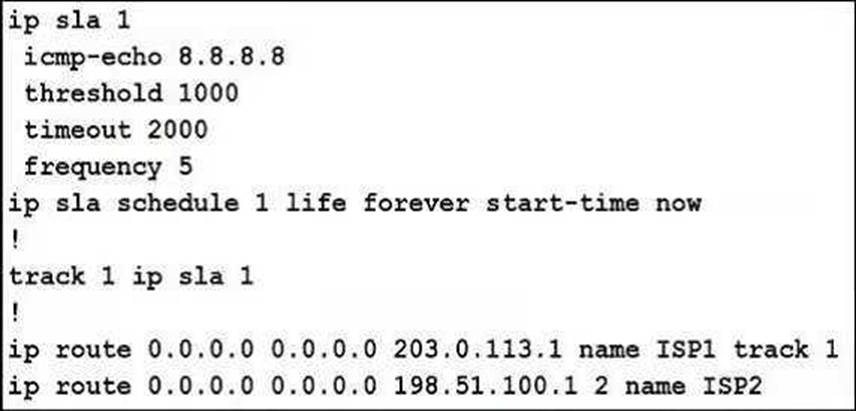
The administrator noticed that the connection was flapping between the two ISPs instead of switching to ISP2 when the ISP1 failed.
Which action resolves the issue?
- A . Include a valid source-interface keyword in the icmp-echo statement.
- B . Reference the track object 1 on the default route through ISP2 instead of ISP1.
- C . Modify the static routes to refer both to the next hop and the outgoing intertace.
- D . Modify the threshold to match the administrative distance of the ISP2 route.
A
Explanation:
https://www.cisco.com/c/en/us/support/docs/ip/ip-routing/200785-ISP-Failover-withdefault-routes-using-I.html
Refer to the exhibit.
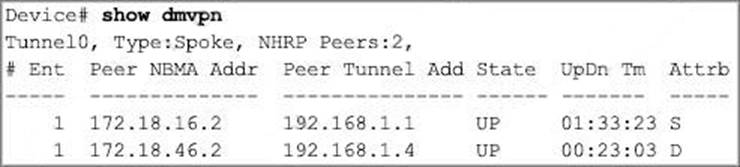
An engineer has configured DMVPN on a spoke router.
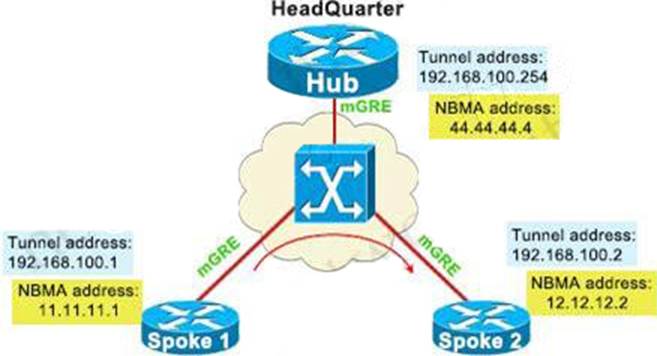
What is the WAN IP address of another spoke router within the DMVPN network?
- A . 172.18.46.2
- B . 192.168.1.4
- C . 172.18.16.2
- D . 192.168.1.1
A
Explanation:
From the output we can see there are 2 NHRP Peers. The first one with the NBMA Address of 172.18.16.2 and the “Attribute” (Attrb) of Static (S) so we can deduce it is the Hub device. Therefore the second one must be the remaining Spoke device with the attribute of Dynamic (D).
–> S – Static, D – Dynamic, I – Incomplete
N – NATed, L – Local, X – No Socket
# Ent –> Number of NHRP entries with same NBMA peer
NHS Status: E –> Expecting Replies, R –> Responding, W –> Waiting UpDn Time –> Up or Down Time for a Tunnel
==========================================================================
Interface: Tunnel1, IPv4 NHRP Details
Type: Spoke, NHRP Peers:2,
# Ent Peer NBMA Addr Peer Tunnel Add State UpDn Tm Attrb
—– ————— ————— —– ——– —–
1 44.44.44.4 192.168.100.254 UP 00:03:40 S
1 12.12.12.2 192.168.100.2 UP 00:03:20 D
Which two protocols can cause TCP starvation? (Choose two)
- A . TFTP
- B . SNMP
- C . SMTP
- D . HTTPS
- E . FTP
Refer to Exhibit.
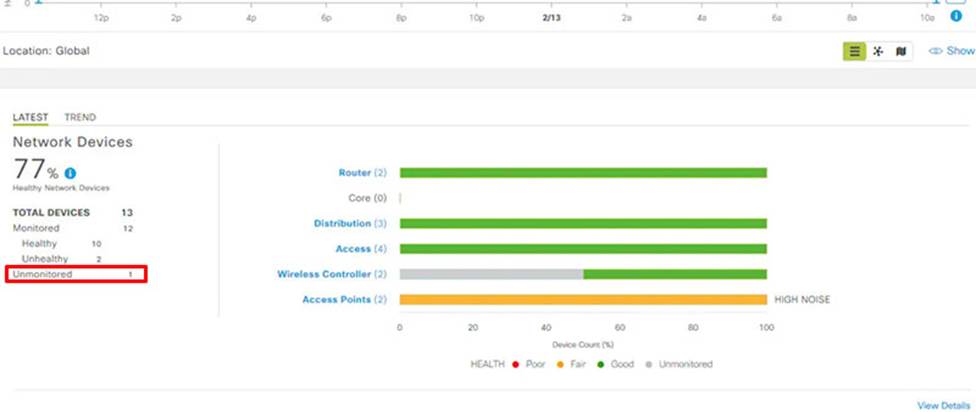
A network administrator added one router in the Cisco DNA Center and checked its discovery and health from the Network Health Dashboard. The network administrator observed that the router is still showing up as unmonitored.
What must be configured on the router to mount it in the Cisco DNA Center?
- A . Configure router with NetFlow data
- B . Configure router with the telemetry data
- C . Configure router with routing to reach Cisco DNA Center
- D . Configure router with SNMPv2c or SNMPv3 traps
B
Explanation:
Unmonitored: Unmonitored devices are devices for which Assurance did not receive any telemetry data during the specified time range.