
Practice Free 300-410 Exam Online Questions
Refer to the exhibit.
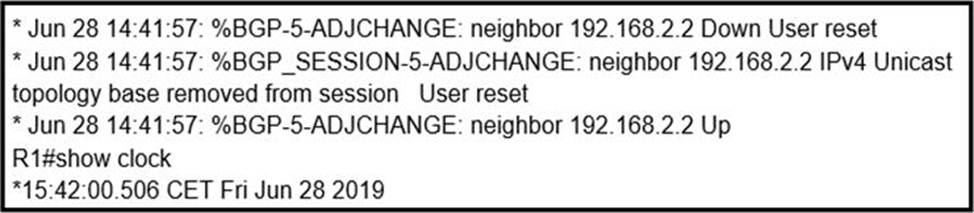
An engineer is troubleshooting BGP on a device but discovers that the clock on the device does not correspond to the time stamp of the log entries.
Which action ensures consistency between the two times?
- A . Configure the service timestamps log uptime command in global configuration mode.
- B . Configure the logging clock synchronize command in global configuration mode.
- C . Configure the service timestamps log datetime localtime command in global configuration mode.
- D . Make sure that the clock on the device is synchronized with an NTP server.
C
Explanation:
https://www.cisco.com/c/en/us/td/docs/routers/xr12000/software/xr12k_r3-9/system_management/command/reference/yr39xr12k_chapter4.html#wp1784026936
By default, syslog and debug messages are stamped by UTC, regardless of the time zone that device configured. You should append localtime key word to "service timestamp {log | debug} datetime msec" global command to change that behavior.
https://community.cisco.com/t5/networking-documents/router-log-timestamp-entries-are-different-from-the-system-clock/ta-p/3132258
https://www.cisco.com/E-Learning/bulk/public/tac/cim/cib/using_cisco_ios_software/cmdrefs/service_timestamps.htm
Refer to the exhibit.
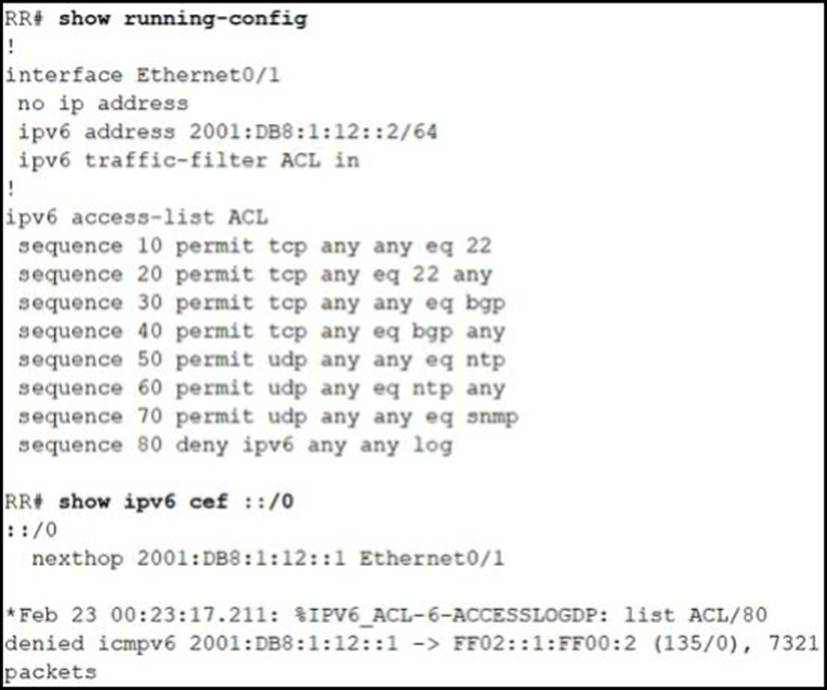
After a security audit, the administrator implemented an ACL in the route reflector. The RR became unreachable from any router in the network.
Which two actions resolve the issue? (Choose two.)
- A . Enable the ND proxy feature on the default gateway.
- B . Configure a link-local address on the Ethernet0/1 interface.
- C . Permit ICMPv6 neighbor discovery traffic in the ACL.
- D . Remove the ACL entry 80.
- E . Change the next hop of the default route to the link-local address of the default gateway.
Refer to the exhibit.
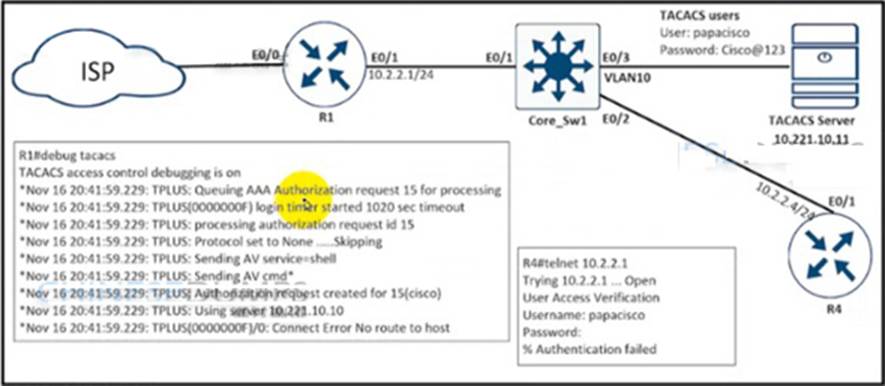
An engineer is trying to connect to R1 via Telnet with no success.
Which configuration resolves the issue?
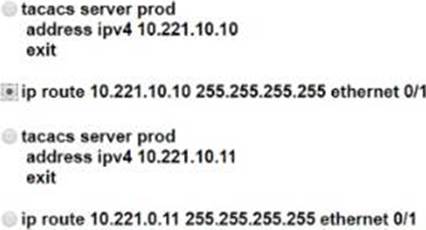
- A . Option A
- B . Option B
- C . Option C
- D . Option D
Refer to the exhibit.
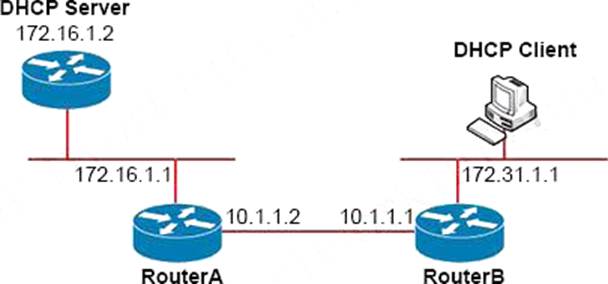
The DHCP client is unable to receive an IP address from the DHCP server RouterB is configured as follows:
Interface fastethernet 0/0
description Client DHCP ID 394482431
Ip address 172 31 11 255 255.255 0
!
ip route 172.16.1.0 255 255 255.0 10.1.1.2
Which command is required on the fastethernet 0/0 interface of RouterB to resolve this issue?
- A . Router B(config-if)#lp helper-address 172.31.1.1
- B . Router B(config-if)#lp helper-address 255.255 255 255
- C . Router B(config-if)#lp helper-address 172.16.1.1
- D . Router B(config-if)#lp helper-address 172.16.1.2
Refer to the exhibit.
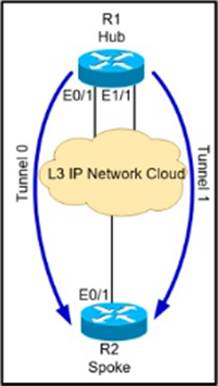
The hub and spoke are connected via two DMVPN tunnel interfaces. The NHRP is configured and the tunnels are detected on the hub and the spoke.
Which configuration command adds an IPsec profile on both tunnel interfaces to encrypt traffic?
- A . tunnel protection ipsec profile DMVPN multipoint
- B . tunnel protection ipsec profile DMVPN tunnel1
- C . tunnel protection ipsec profile DMVPN shared
- D . tunnel protection ipsec profile DMVPN unique
Refer to the exhibit.
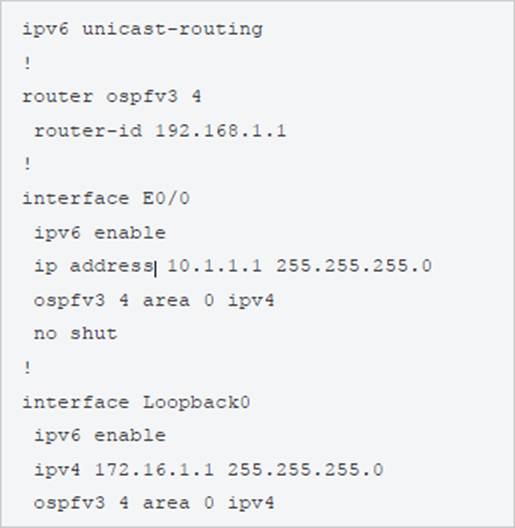
The network administrator configured the branch router for IPv6 on the E 0/0 interface The neighboring router is fully configured to meet requirements, but the neighbor relationship is not coming up.
Which action fixes the problem on the branch router to bring the IPv6 neighbors up?
- A . Enable the IPv4 address family under the E 0/0 interface by using the address-family Ipv4 unicast command
- B . Disable IPv6 on the E 0/0 interface using the no ipv6 enable command
- C . Enable the IPv4 address family under the router ospfv3 4 process by using the address-family ipv4
unicast command - D . Disable OSPF for IPv4 using the no ospfv3 4 area 0 ipv4 command under the E 0/0 interface.
C
Explanation:
Once again, Cisco changed the IOS configuration commands required for OSPFv3 configuration. The new OSPFv3 configuration uses the “ospfv3” keyword instead of the earlier “ipv6 router ospf” routing process command and “ipv6 ospf” interface commands.
The Open Shortest Path First version 3 (OSPFv3) address families feature enables both IPv4 and IPv6 unicast traffic to be supported. With this feature, users may have two processes per interface, but only one process per address family (AF).
Refer to the exhibit.
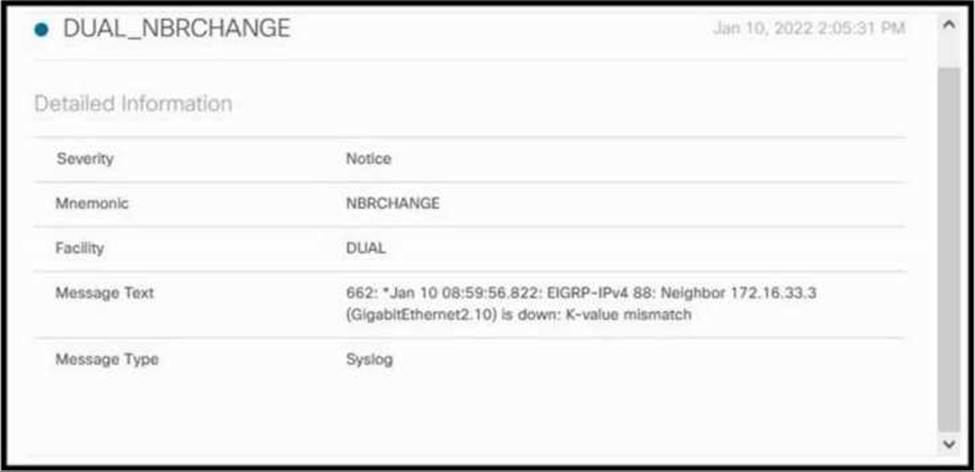
EIGRP peering was lost.
Which configuration resolves the issue?
- A . router EIGRP 88 metric weights 0 1 1 0 01
- B . router EIGRP 88 metric weights 1 0 1 0 10
- C . router EIGRP 88 metric weights 0 1 1 100
- D . router EIGRP 88 metric weights 111000
Which component of MPLS VPNs is used to extend the IP address so that an engineer is able to identify to which VPN it belongs?
- A . VPNv4 address family
- B . RD
- C . RT
- D . LDP
B
Explanation:

Refer to the exhibit.
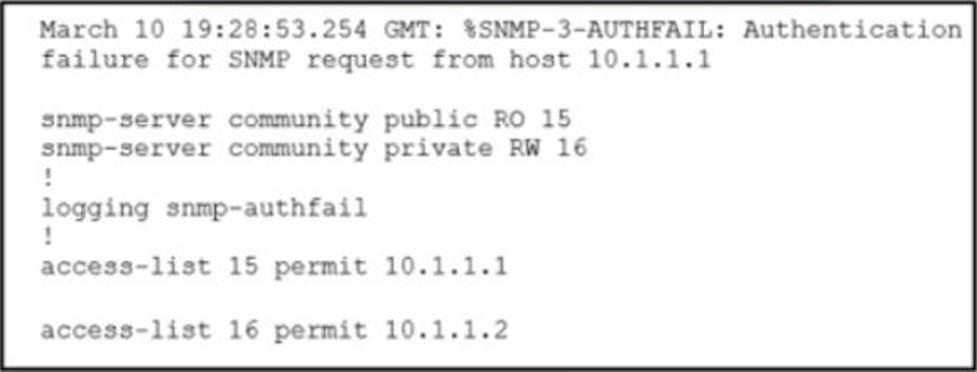
Which action resolves the issue?
- A . Configure host IP address in access-list 16
- B . Configure SNMPv3 on the router
- C . Configure SNMP authentication on the router
- D . Configure a valid SNMP community string
Refer to the exhibit.
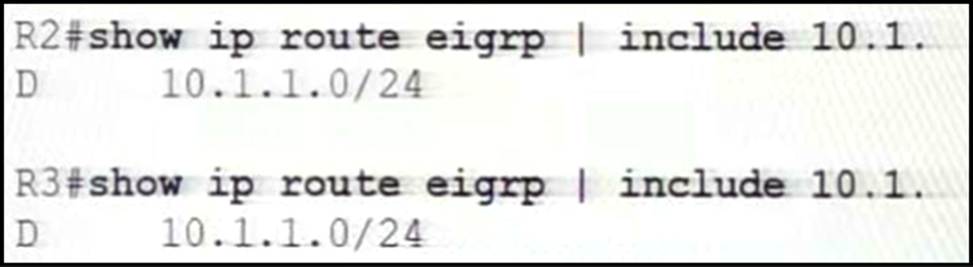
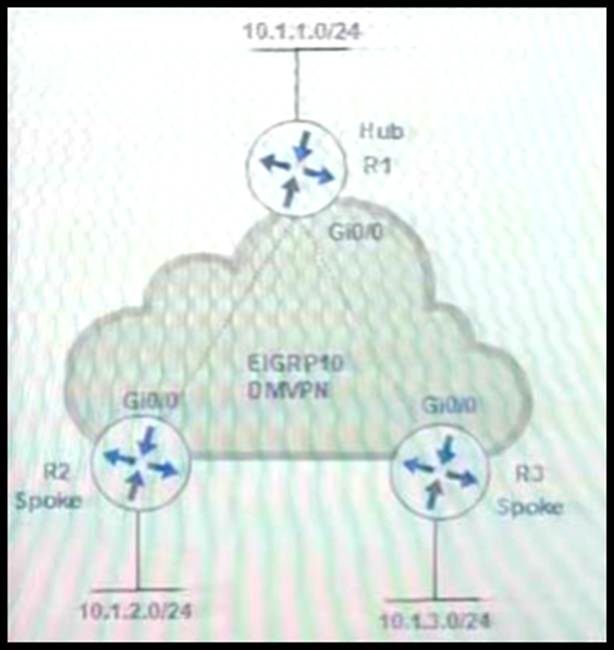
An engineer configures DMVPN and receives the hub location prefix of 10.1.1.0724 on R2 and R3 The R3 prefix of 10 1.3.0/24 is not received on R2. and the R2 prefix 10.1,2.0/24 is not received on R3.
Which action reserves the issue?
- A . Split horizon prevents the routes from being advertised between spoke routers it should be disabled with the command no ip split-horizon eigrp 10 on the tunnel interface of R1
- B . There is no spoke-to-spoke connection DMVPN configuration should be modified to enable a tunnel connection between R2 and R3 and neighbor relationship confirmed by use of the show ip eigrp neighbor command
- C . Split horizon prevents the routes from being advertised between spoke routers it should be disabled with the no ip split-horizon eigrp 10 command on the Gi0/0 interface of R1.
- D . There is no spoke-to-spoke connection DMVPN configuration should be modified with a manual neighbor relationship configured between R2 and R3 and confirmed bb use of the show ip eigrp neighbor command.
A
Explanation:
In this topology, the Hub router will receive advertisements from R2 Spoke router on its tunnel interface. The problem here is that it also has a connection with R3 Spoke on that same tunnel interface. If we don’t disable split-horizon, then the Hub will not relay routes from R2 to R3 and the other way around. That is because it received those routes on the same interface tunnel and therefore it cannot advertise back out that same interface (split-horizon rule). Therefore we must disable split horizon on the Hub router to make sure the Spokes know about each other.