
Practice Free 300-410 Exam Online Questions
Which statement about MPLS LDP router ID is true?
- A . If not configured, the operational physical interface is chosen as the router ID even if a loopback is configured.
- B . The loopback with the highest IP address is selected as the router ID.
- C . The MPLS LDP router ID must match the IGP router ID.
- D . The force keyword changes the router ID to the specified address without causing any impact.
B
Explanation:
Reference: https://www.cisco.com/c/en/us/td/docs/ios-xml/ios/mp_ldp/configuration/12-4m/mp-ldp-12-4mbook.pdf
Refer to the exhibit.
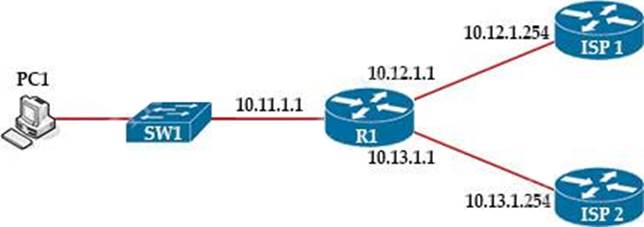
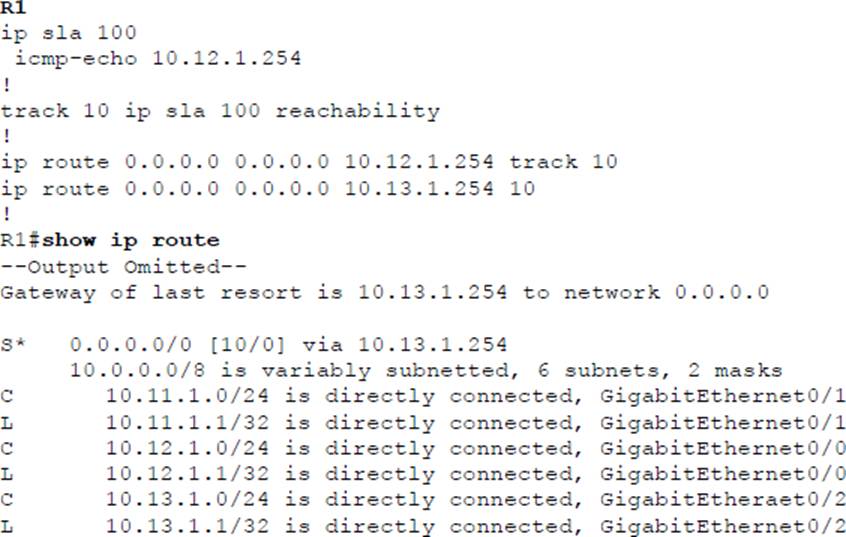
An engineer is monitoring reachability of the configured default routes to ISP1 and ISP2. The default route from ISP1 is preferred if available.
How is this issue resolved?
- A . Use the icmp-echo command to track both default routes
- B . Use the same AD for both default routes
- C . Start IP SLA by matching numbers for track and ip sla commands
- D . Start IP SLA by defining frequency and scheduling it
D
Explanation:
Reference: https://www.cisco.com/c/en/us/support/docs/ip/ip-routing/200785-ISP-Failover-with-default-routes-using-I.html
In the above configuration we have not had activated our IP SLA operation.
We can start it with this command:
R1(config)#ip sla schedule 100 life forever start-time now
Also we should specific the rate of ICMP echo:
R1(config-ip-sla-echo)#frequency 5 //Send ICMP echo every 5 seconds
Refer to the exhibit.
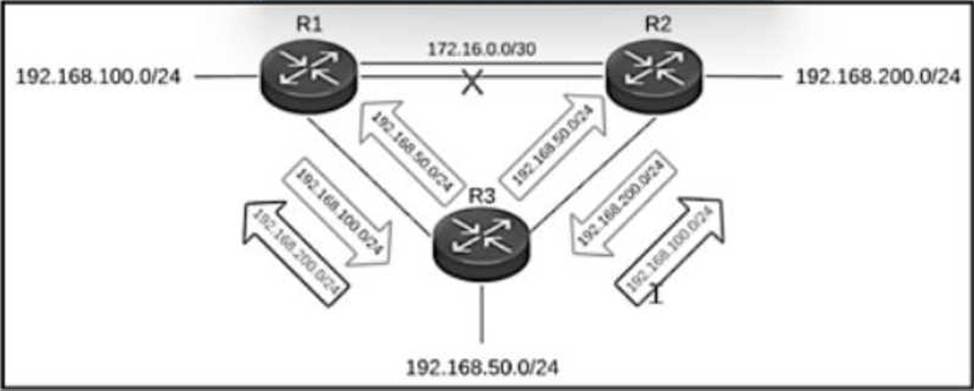
The primary link between R1 and R2 went down but R3 is still advertising the 192.166.200.0/24 network to R1 and the 192.166.100.0/24 network to R2, which creates a loop.
Which action resolves the issue?
- A . Configure the eigrp stub command under the EIGRP process on R3
- B . Configure the summary address 192.168.0.0 255.255.0.0 100 command on R3
- C . Configure the eigrp stub leak-map command under the EIGRP process on R1
- D . Configure the eigrp stub command under the EIGRP process on R2
A customer reports that traffic is not passing on an EIGRP enabled multipoint interface on a router configured as below:
interface Serial0/0
no ip address
interface Server0/0/0.9 multipoint
ip address 10.1.1.1 255.255.255.248
ip split-horizon eigrp 1
Which action resolves the issue?
- A . Enable poison reverse
- B . Enable split horizon
- C . Disable poison reverse
- D . Disable split horizon
Refer to the exhibit.
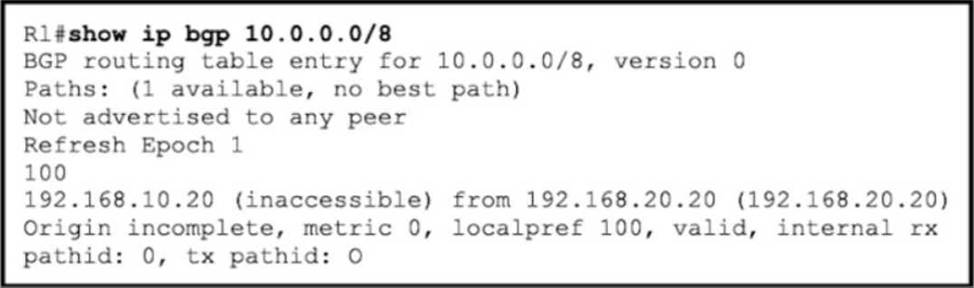
An engineer is troubleshooting a prefix advertisement issue from R3, which is not directly connected to R1.
Which configuration resolves the issue?
A)

B)

C)

D)

- A . Option A
- B . Option B
- C . Option C
- D . Option D
Refer to the exhibit.
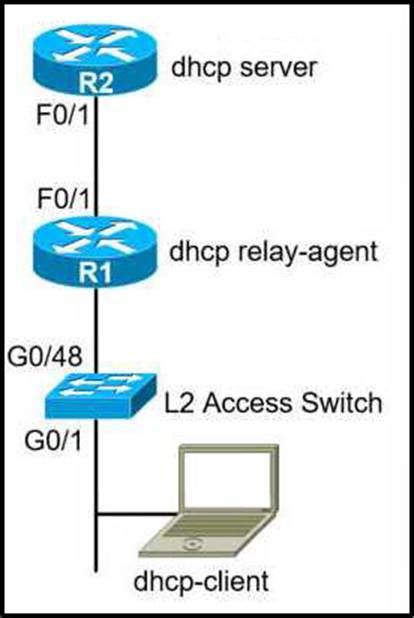
The network administrator can see the DHCP discovery packet in R1. but R2 is not replying to the DHCP request. The R1 related interface is configured with the DHCP helper address. If the PC is directly connected to the Fa0/1 interface on R2, the DHCP server assigns as IP address from the DHCP pool to the PC.
Which two commands resolve this issue? (Choose two.)
- A . service dhcp-relay command on R1
- B . ip dhcp option 82 command on R2
- C . service dhcp command on R1
- D . ip dhcp relay information enable command on R1
- E . ip dhcp relay information trust-all command on R2
C,E
Explanation:
Refer to the exhibit.
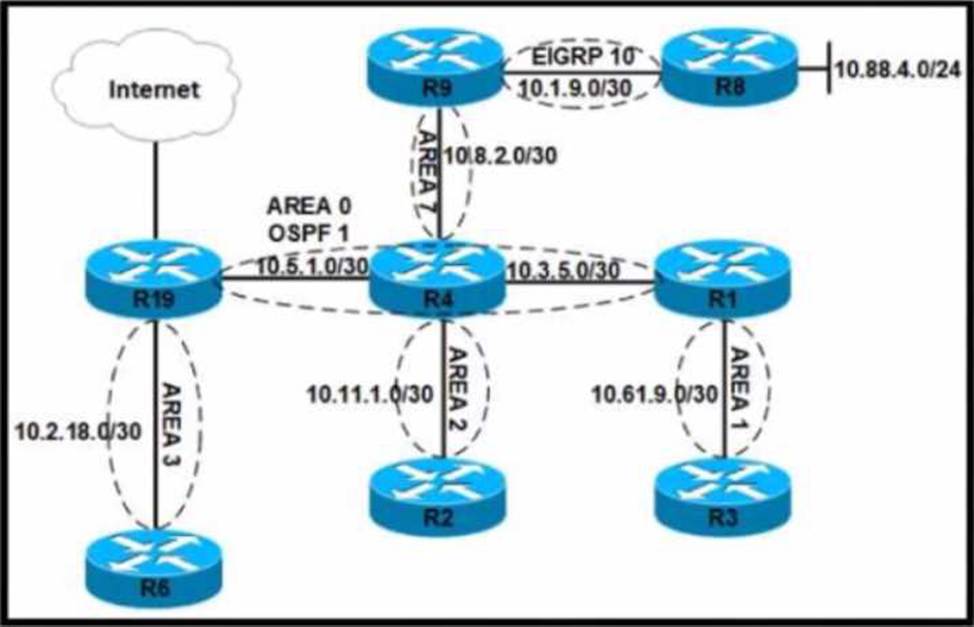
After an engineer modified the configuration for area 7 to permit type 1 2 and 7 LSAs only users connected to router R9 reported that they could no longer access the internet.
Which configuration restores internet access to users on R9 and permits only LSA type 1,2, and 7?
A)
B)
C)
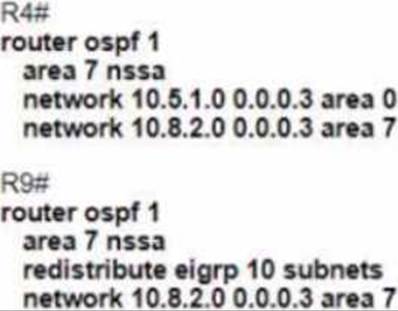
D)
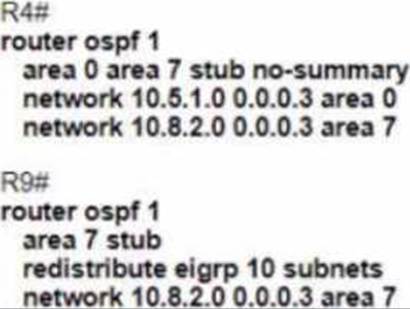
- A . Option A
- B . Option B
- C . Option C
- D . Option D
B
Explanation:
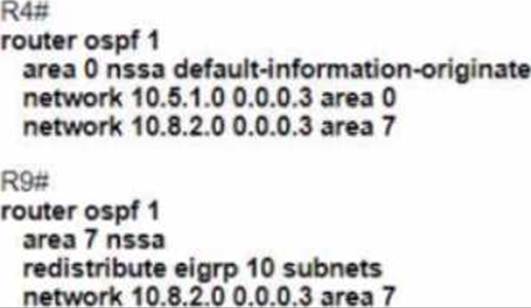
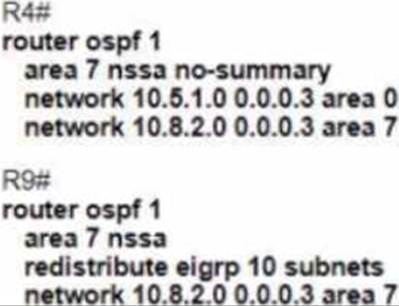
Option B configures area 7 as a not-so-stubby area (NSSA) with the no-summary option on the area border router (ABR) R4. This allows the injection of external routes from EIGRP into the OSPF domain as type 7 LSAs, while preventing the propagation of inter-area summary LSAs into area 7. The no-summary option also generates a default summary route for area 7, which can be used by R9 to reach the internet2.
Option A configures area 7 as a stub area, which does not allow any external routes or type 7 LSAs in the area. This prevents R9 from learning the EIGRP routes and accessing the internet3.
Option C configures area 7 as a NSSA without the no-summary option on R4. This allows the injection of type 7 LSAs into the area, but also allows the propagation of inter-area summary LSAs into the
area. However, this option does not generate a default summary route for area 7, which means R9 has no route to reach the internet4.
Option D configures area 7 as a NSSA with the default-information originate option on R4. This allows the injection of type 7 LSAs into the area, but also allows the propagation of inter-area summary LSAs into the area. The default-information originate option generates a type 7 default route for area 7, which can be used by R9 to reach the internet. However, this option is redundant and less efficient than Option B, because it injects both a type 3 and a type 7 LSA for the default route into the area5.
Refer to the exhibit.
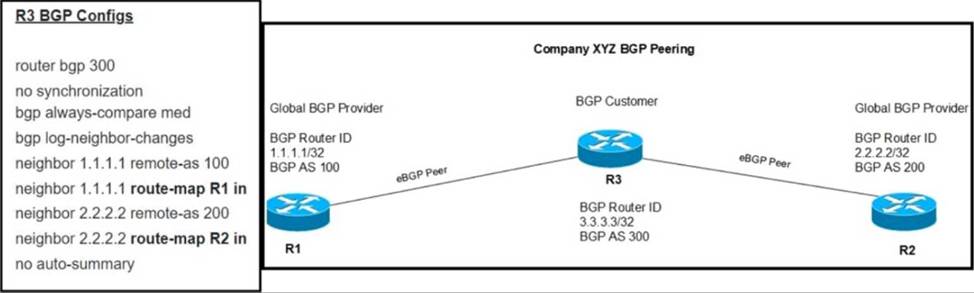
R3 is dual-homed to two service providers for traffic redundancy. R3 prefers its outbound traffic via R2.
Which set of configurations achieves this goal?
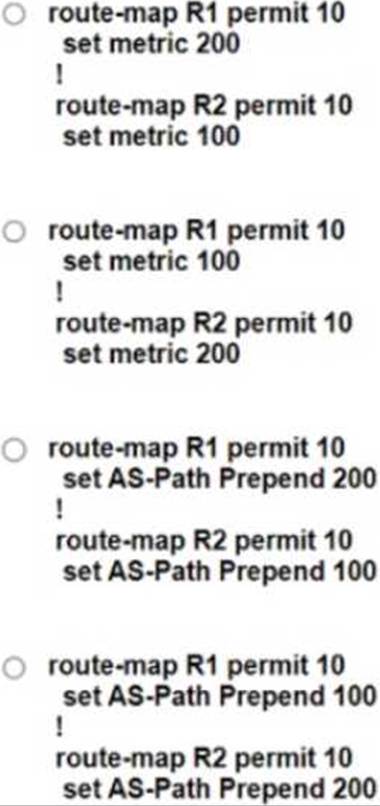
- A . Option A
- B . Option B
- C . Option C
- D . Option D
An engineer is creating a policy that overrides normal routing behavior. if the route to a destination of 10.100.100.0/24 is withdrawn from the routing Table, the policy must direct traffic to a next hop of 10.1 1.1. if the route is present in the routing table, then normal forwarding must occur.
Which configuration meets the requirements?
- A . access-list 100 permit ip any any
!
route-map POLICY permit 10
match ip address 100
set ip next-hop recursive 10.1.1.1 - B . access-list 100 permit ip any 10.100.100.0 0.0.0.255
!
Route-map POLICY permit 10
match ip address 100
set ip default next-hop 10.1.1.1 - C . access-list 100 permit ip any 10.100.100.0 0.0.0.255
!
route-map POLICY permit 10
match ip address 100
set ip next-hop 10.1.1.1
!
route map POLICY permit 20 - D . access-list 100 permit ip any 10.100.100.0 0.0.0.255
!
route map POLICY permit 10
match ip address 100
Set ip next-hop recursive 10.1.1.1
!
route-map POLICY permit 20
Refer to the exhibit.
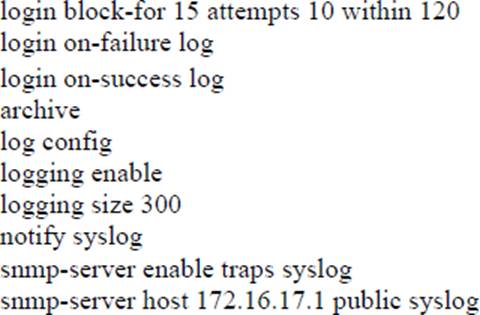
The administrator can see the traps for the failed login attempts, but cannot see the traps of successful login attempts.
What command is needed to resolve the issue?
- A . Configure logging history 2
- B . Configure logging history 3
- C . Configure logging history 4
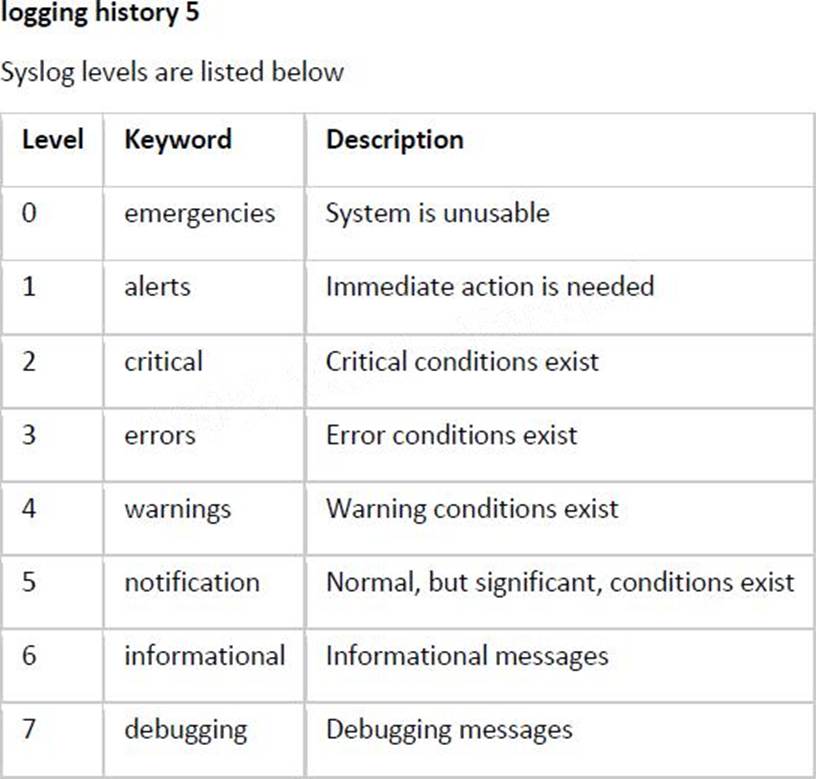
- D . Configure logging history 5
D
Explanation:
By default, the maximum severity sent as a syslog trap is warning. That is why you see syslog traps for login failures. Since a login success is severity 5 (notifications), those syslog messages will not be converted to traps.
To fix this, configure:
Note:
The syntax of login block is:
login block-for seconds attempts tries within seconds