
Practice Free 300-410 Exam Online Questions
Which protocol does MPLS use to support traffic engineering?
- A . Tag Distribution Protocol (TDP)
- B . Resource Reservation Protocol (RSVP)
- C . Border Gateway Protocol (BGP)
- D . Label Distribution Protocol (LDP)
B
Explanation:

Refer to the exhibit.
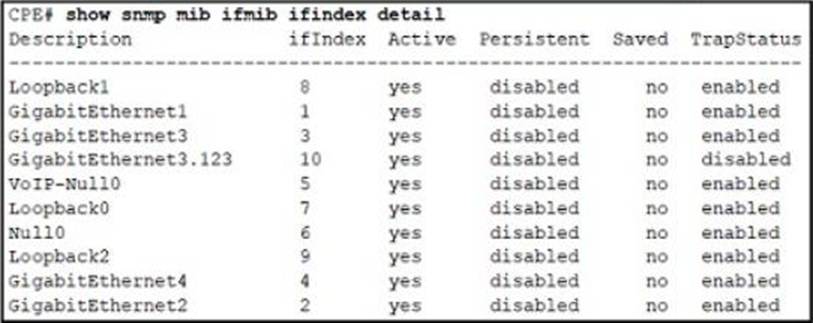
After reloading the router an administrator discovered that the interface utilization graphs displayed inconsistencies with their previous history in the NMS.
Which action prevents this issue from occurring after another router reload in the future?
- A . Rediscover all the router interfaces through SNMP after the router is reloaded
- B . Save the router configuration to startup-config before reloading the router
- C . Configure SNMP to use static OlDs referring to individual router interfaces
- D . Configure SNMP interface index persistence on the router
Which two components are needed for a service provider to utilize the LVPN MPLS application? (Choose two.)
- A . The P routers must be configured for MP-iBGP toward the PE routers
- B . The P routers must be configured with RSVP.
- C . The PE routers must be configured for MP-iBGP with other PE routers
- D . The PE routers must be configured for MP-eBGP to connect to CEs
- E . The P and PE routers must be configured with LDP or RSVP
C,E
Explanation:
MPLS Network Protocols
+ IGP: OSPF, EIGRP, IS-IS on core facing and core links+ RSVP and/or LDP on core and/or core facing links ->
+ MP-iBGP on PE devices (for MPLS services), MP-BGP: Multiprotocol Border Gateway Protocol, used for MPLS L3 VPN ->.
Reference: https://www.uio.no/studier/emner/matnat/ifi/IN3230/h19/kursmateriell/mpls-lecture.pdf
Refer to the exhibit.
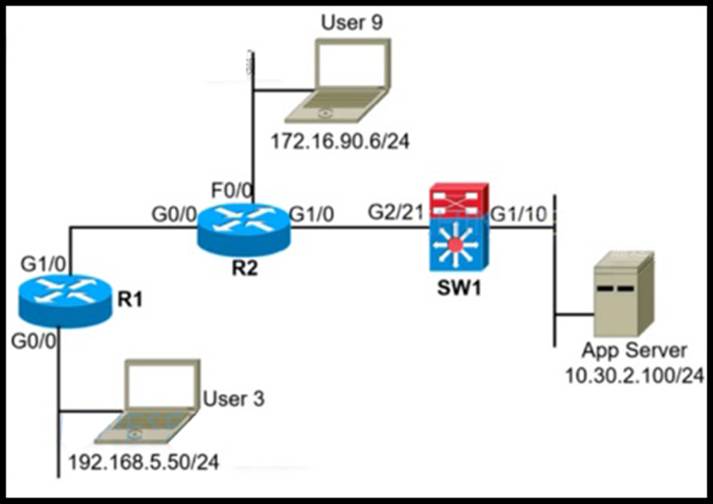
A network administrator must block ping from user 3 to the App Server only. An inbound standard access list is applied to R1 interface G0/0 to block ping. The network administrator was notified that user 3 cannot even ping user 9 anymore.
Where must the access list be applied in the outgoing direction to resolve the issue?
- A . R2 interface G1/0
- B . R2 interface G0/0
- C . SW1 interface G1/10
- D . SW1 interface G2/21
Refer to the exhibit.
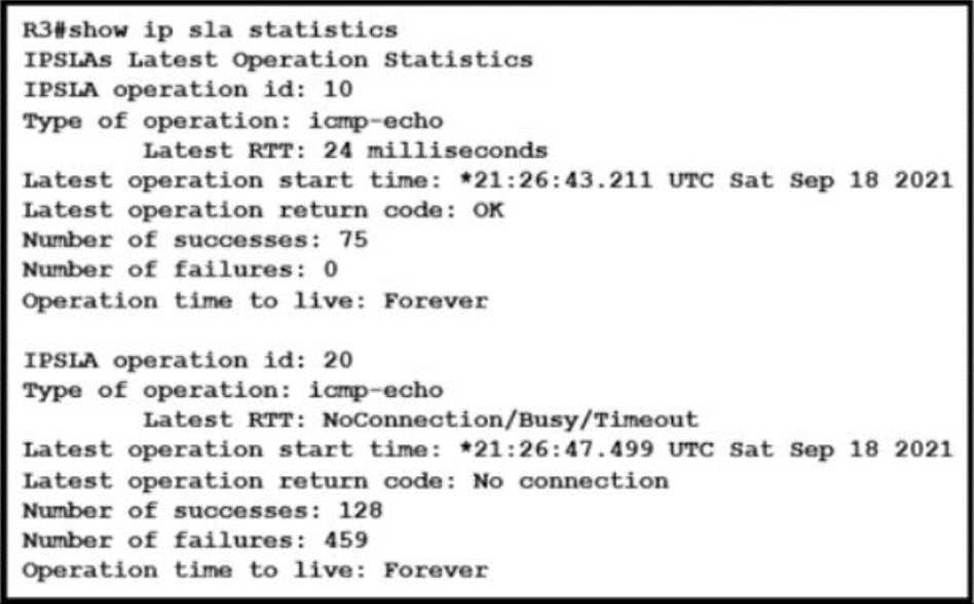
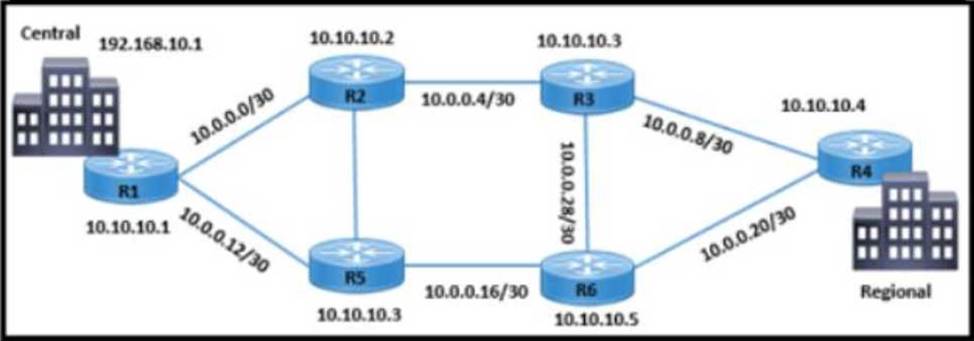
Traffic from R3 to the central site does not use alternate paths when R3 cannot reach 10 10 10 2 Traffic on R3 destined to R4 takes an alternate route via 10 10 10.6 when 10 10 10 4 is not accessible from R3.
Which configuration switches traffic destined to 10 10 10 2 from R3 on the alternate path’’
- A . R3(config)#ip route 192.168.10.1 255.255.265.255 10.10.10.2 track 20
- B . R2(config)#ip route 10.10 10 3 255 255.255 255 10.0.0.6
- C . R3(config)#track (20 ip sla 20 reachability
- D . R6(config)#ip route 10.10.10 3 255.255.255.255 10.0.0.30
Refer to the exhibit.
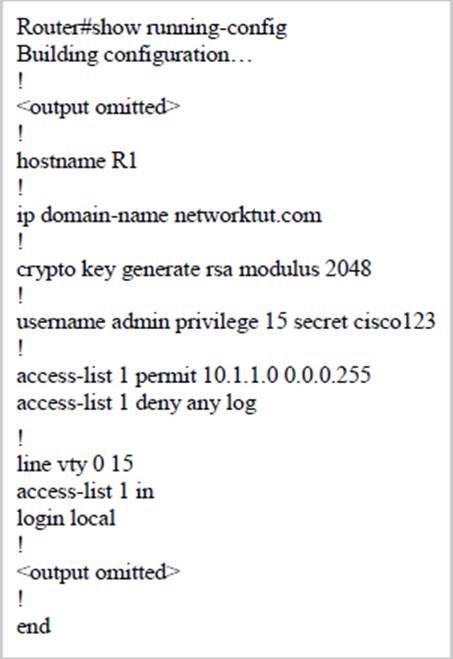
A user cannot SSH to the router.
What action must be taken to resolve this issue?
- A . Configure transport input ssh
- B . Configure transport output ssh
- C . Configure ip ssh version 2
- D . Configure ip ssh source-interface loopback0
A
Explanation:
https://www.cisco.com/c/en/us/td/docs/switches/lan/catalyst2960x/software/15-0_2_EX/security/configuration_guide/b_sec_152ex_2960-x_cg/b_sec_152ex_2960-x_cg_chapter_01001.html
A network engineer wants to redirect HTTP traffic originating from subnet 192.168.12.1/24 to the next-hop IP address of 10.2.12.1.
This configuration was implemented:
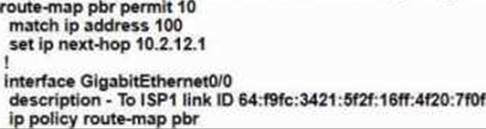
Which command completes the configuration?
- A . Router(config)# access-list 100 permit tep any eq 80 192.168.12.0 0.0.0.255
- B . Router(config)# access-list 100 permit tcp 192.168.12.0 0.0.0.255 eq any 80
- C . Router(config)# access-list 100 permit tcp 192.168.12.0 0.0.0.255 any eq 80
- D . Router(config)# access-list 100 permit tcp any 192.168.12.0 0.0.0.255 eq 80
R2 has a locally originated prefix 192.168.130.0/24 and has these configurations:
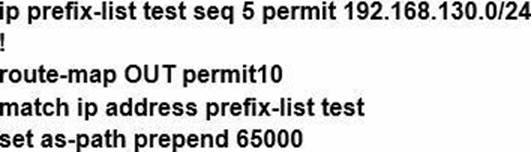
What is the result when the route-map OUT command is applied toward an eBGP neighbor R1 (1.1.1.1) by using the neighbor 1.1.1.1 route-map OUT out command?
- A . R1 sees 192.168.130.0/24 as two AS hops away instead of one AS hop away.
- B . R1 does not accept any routes other than 192.168.130.0/24
- C . R1 does not forward traffic that is destined for 192.168.30.0/24
- D . Network 192.168.130.0/24 is not allowed in the R1 table
Refer to the exhibit.
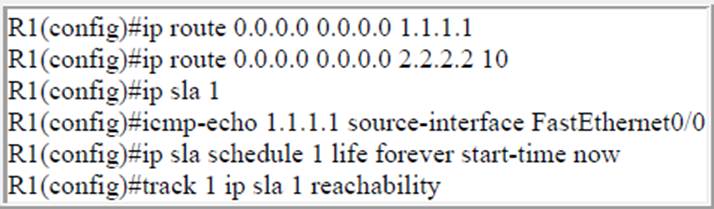
An IP SLA is configured to use the backup default route when the primary is down, but it is not working as desired.
Which command fixes the issue?
- A . R1(config)# ip route 0.0.0.0.0.0.0.0.2.2.2.2 10 track 1
- B . R1(config)# ip route 0.0.0.0.0.0.0.0.2.2.2.2
- C . R1(config)#ip sla track 1
- D . R1(config)# ip route 0.0.0.0.0.0.0.0.1.1.1.1 track 1
D
Explanation:
Reference: Note: By default Static Router AD value-1 hence ip route 0.0.0.0. 0.0.0.0. 1.1.1.1 track 1 means AD-1 which must be less than of back up route AD.
Define the backup route to use when the tracked object is unavailable. !— The administrative distance of the backup route must be greater than !— the administrative distance of the tracked route.!— If the primary gateway is unreachable, that route is removed!— and the backup route is installed in the routing table!— instead of the tracked route.
https://www.cisco.com/c/en/us/support/docs/ip/ip-routing/200785-ISP-Failover-with-default-routes-using-I.html
https://www.cisco.com/c/en/us/support/docs/security/asa-5500-x-series-next-generation-firewalls/118962-configure-asa-00.html
Refer to the exhibit.
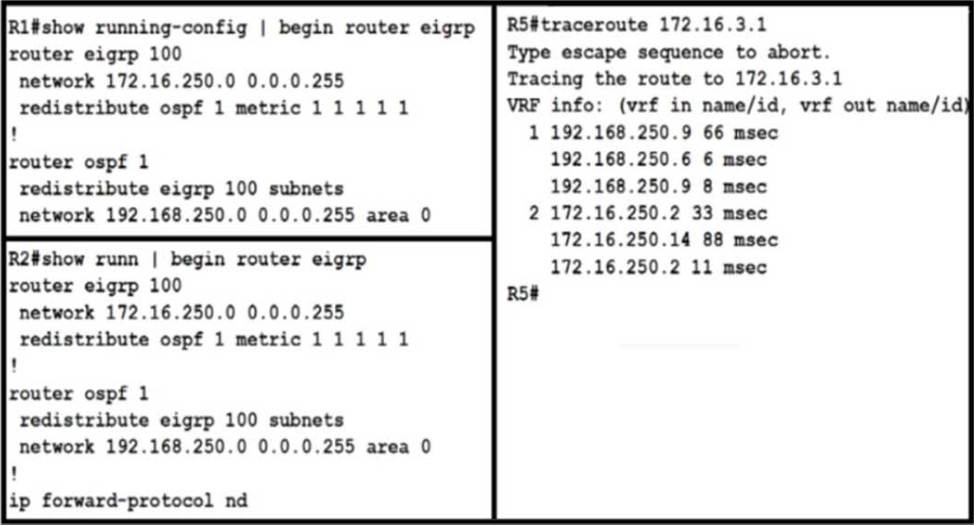
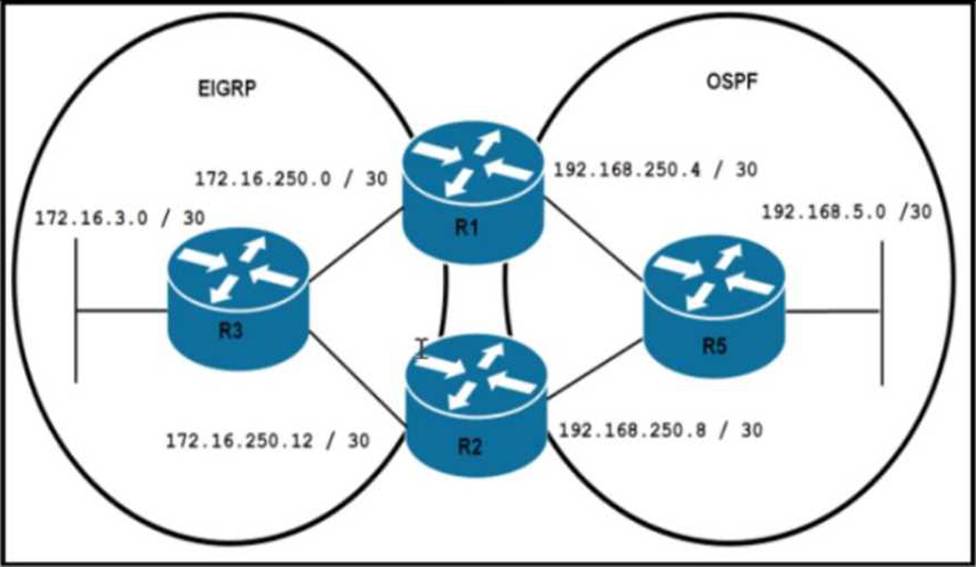
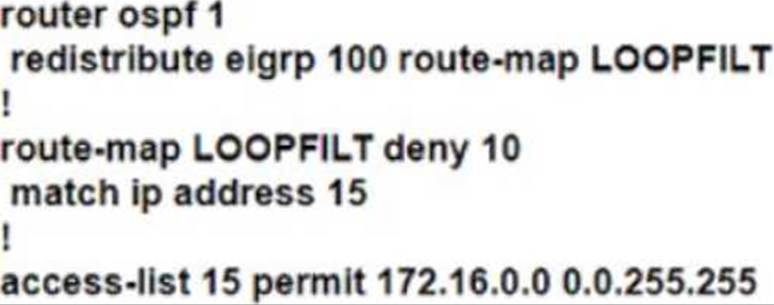
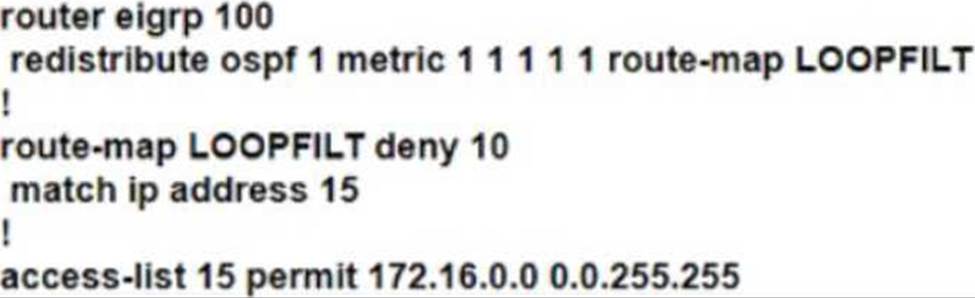
An engineer Is troubleshooting a routing loop on the network to reach the 172.16.3.0/16 from the OSPF domain.
Which configuration on router R1 resolves the Issue?
A)
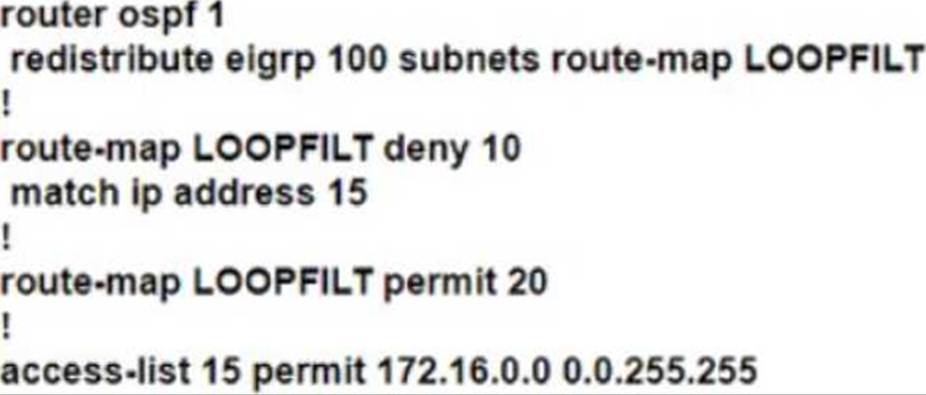
B)
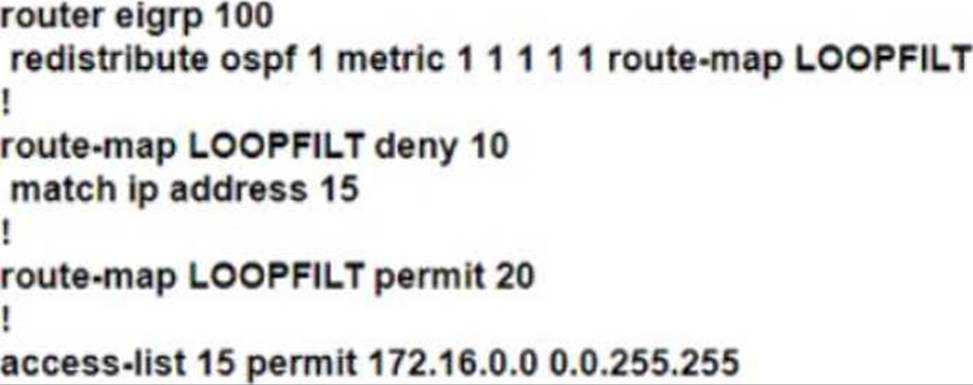
C)
D)
- A . Option A
- B . Option B
- C . Option C
- D . Option D