
Practice Free 300-410 Exam Online Questions
DRAG DROP
Drag and Drop the IPv6 First-Hop Security features from the left onto the definitions on the right.
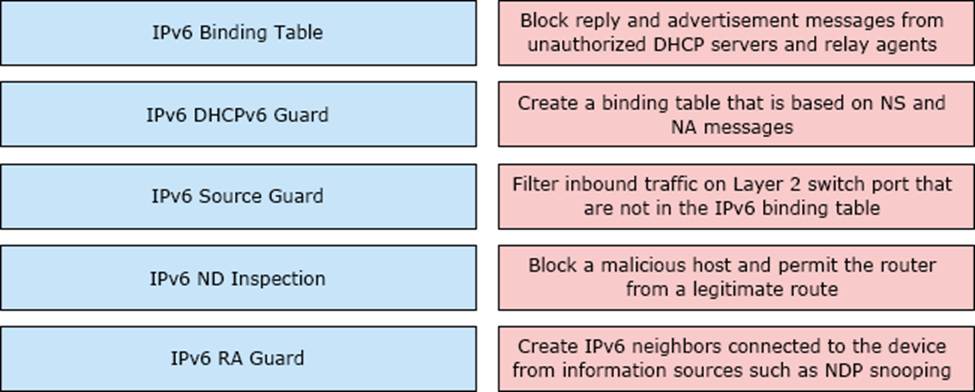
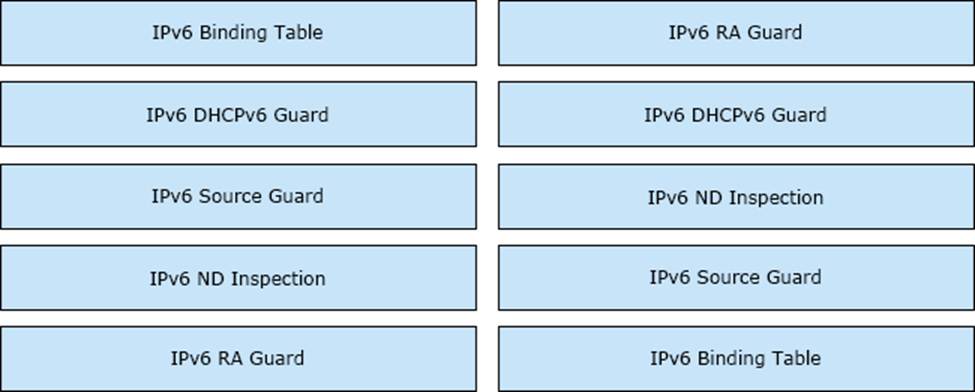
Explanation:
Graphical user
interface, chart Description automatically generated
DRAG DROP
Drag and drop the IPv6 first hop security device roles from the left onto the corresponding descriptions on the right.
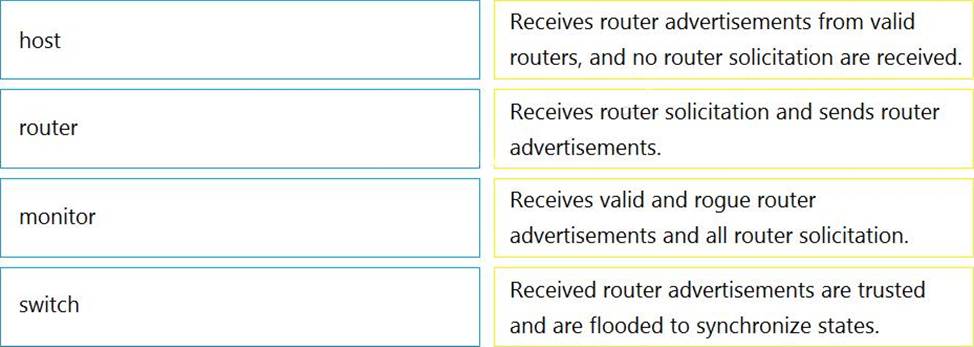
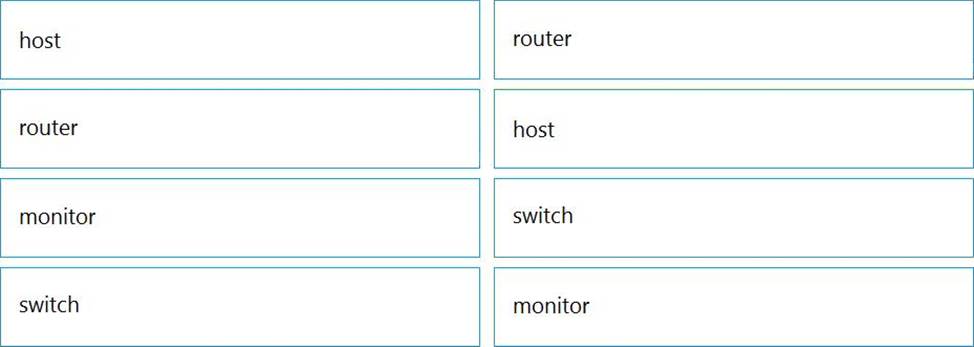
Explanation:
Graphical user interface, text, application, email Description automatically generated
Reference: https://www.cisco.com/c/en/us/td/docs/switches/datacenter/nexus9000/sw/7-x/security/configuration/guide/b_Cisco_Nexus_9000_Series_NX-OS_Security_Configuration_Guide_7x/b_Cisco_Nexus_9000_Series_NX-OS_Security_Configuration_Guide_7x_chapter_011011.pdf
Which security feature can protect DMVPN tunnels?
- A . IPsec
- B . TACACS+
- C . RTBH
- D . RADIUS
Refer to the exhibit.
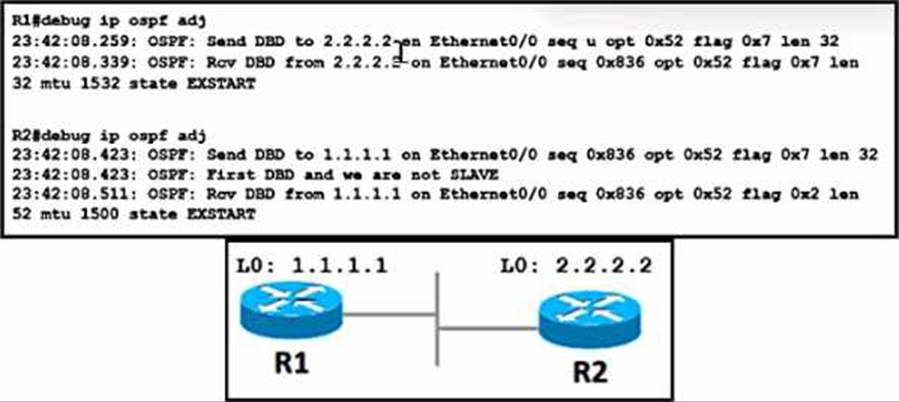
R1 cannot establish a neighbor relationship with R2.
Which action resolves the issue"?
- A . Configure the mtu Ignore command on the Interfaces of R1 and R2
- B . Configure the ip ospf network point-to-point command on the interfaces of R1 and R2
- C . Configure the ip ospf network broadcast command on the interfaces of R1 and R2
- D . Configure the neighbor 2.2.2.2 command on R1 under the OSPF process
A
Explanation:
In OSPF (Open Shortest Path First), the MTU (Maximum Transmission Unit) size must match on both sides of a link for OSPF neighbors to form an adjacency12. If the MTU sizes do not match, the OSPF adjacency will not form, and the routers will not become neighbors12.
In this case, R1 cannot establish a neighbor relationship with R2. One possible reason for this could be a mismatch in the MTU size on the interfaces of R1 and R212.
To resolve this issue, you can configure the mtu ignore command on the interfaces of R1 and R2 (Option A). This command allows OSPF to ignore the MTU size when determining if it can form an adjacency with a neighbor12. This means that even if the MTU sizes do not match, OSPF will still form an adjacency, and R1 and R2 will become neighbors12.
Reference: OSPF MTU Mismatch – NetworkLessons.com
Understanding OSPF MTU Mismatch Conditions and Solutions – Cisco
Which protocol does VRF-Lite support?
- A . IS-IS
- B . ODR
- C . EIGRP
- D . IGRP
Refer to the exhibit.
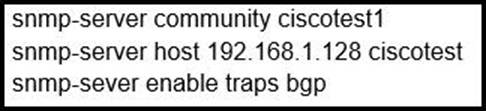
Network operations cannot read or write any configuration on the device with this configuration from the operations subnet.
Which two configurations fix the issue? (Choose two.)
- A . Configure SNMP rw permission in addition to community ciscotest.
- B . Modify access list 1 and allow operations subnet in the access list.
- C . Modify access list 1 and allow SNMP in the access list.
- D . Configure SNMP rw permission in addition to version 1.
- E . Configure SNMP rw permission in addition to community ciscotest 1.
16.0.0/16
The network administrator on R1 must improve convergence by blocking all subnets of 172-16.0.0/16 major network with a mask lower than 23 from coming in.
Which set of configurations accomplishes the task on R1?
- A . ip prefix-list PL-1 deny 172.16.0.0/16 le 23
ip prefix-list PL-1 permit 0.0.0.0/0 le 32
!
router bgp 100
neighbor 192.168.100.2 remote-as 200
neighbor 192.168.100.2 prefix-list PL-1 in - B . ip prefix-list PL-1 deny 172.16.0.0/16 ge 23
ip prefix-list PL-1 permit 0.0.0.0/0 le 32
!
router bgp 100
neighbor 192.168.100.2 remote-as 200
neighbor 192.168.100.2 prefix-list PL-1 in - C . access-list 1 deny 172.16.0.0 0.0.254.255
access-list 1 permit any
!
router bgp 100
neighbor 192.168.100.2 remote-as 200
neighbor 192.168.100.2 distribute-list 1 in - D . ip prefix-list PL-1 deny 172.16.0.0/16
ip prefix-list PL-1 permit 0.0.0.0/0
!
router bgp 100
neighbor 192.168.100.2 remote-as 200
neighbor 192.168.100.2 prefix-list PL-1 in
A
Explanation:
“Blocking all subnets of 172.16.0.0/16 major network with a mask lower than 23 from coming in” would block 172.16.16.0/20.
The first prefix-list “ip prefix-list PL-1 deny 172.16.0.0/16 le 23” means “all networks that fall within the 172.16.0.0/16 range AND that have a subnet mask of /23 or less” are denied.
The second prefix-list “ip prefix-list PL-1 permit 0.0.0.0/0 le 32” means allows all other prefixes.
Refer to Exhibit.
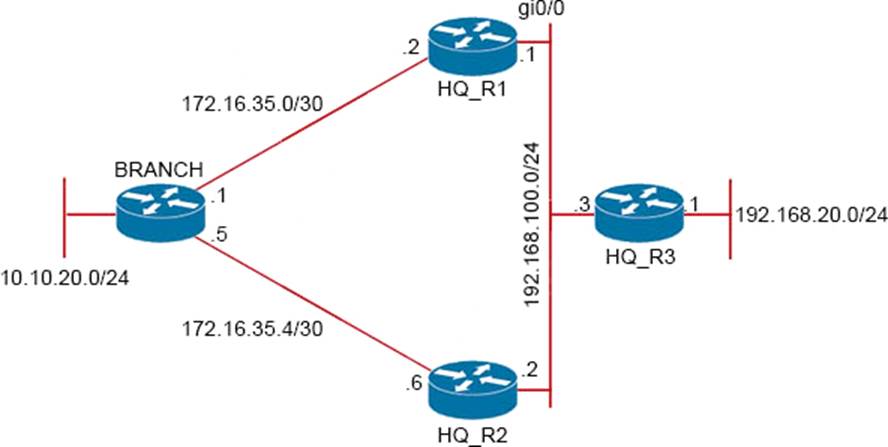
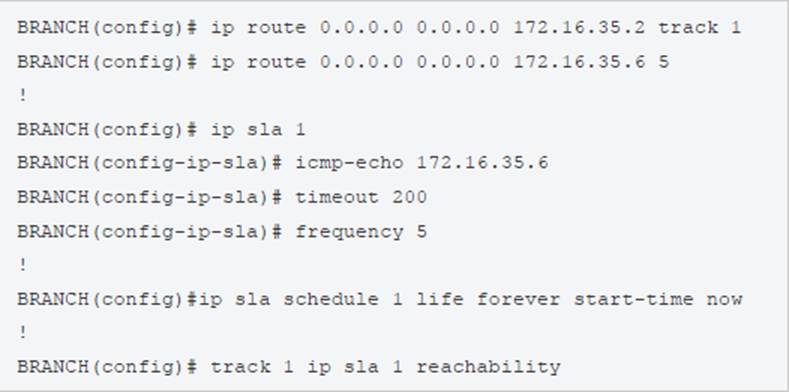
Traffic from the branch network should route through HQ R1 unless the path is unavailable. An engineer tests this functionality by shutting down interface on the BRANCH router toward HQ_R1 router but 192.168.20.0/24 is no longer reachable from the branch router.
Which set of configurations resolves the issue?
- A . HQ_R1(config)# ip sla responder
HQ_R1(config)# ip sla responder icmp-echo 172.16.35.2 - B . BRANCH(config)# ip sla 1
BRANCH(config-ip-sla)# icmp-echo 172.16.35.1 - C . HQ_R2(config)# ip sla responder
HQ_R2(config)# ip sla responder icmp-echo 172.16.35.5 - D . BRANCH(config)# ip sla 1
BRANCH(config-ip-sla)# icmp-echo 172.16.35.2
D
Explanation:
In the configuration above, the engineer has made a mistake as he was tracking 172.16.35.6 (the backup path) instead of tracking the main path (172.16.35.2). Therefore, when he shut down the main path, the track 1 was still up so traffic still went through the main path -> it failed.
To fix this issue, we just need to correct the tracking interface of the main path.
Refer to the exhibit.
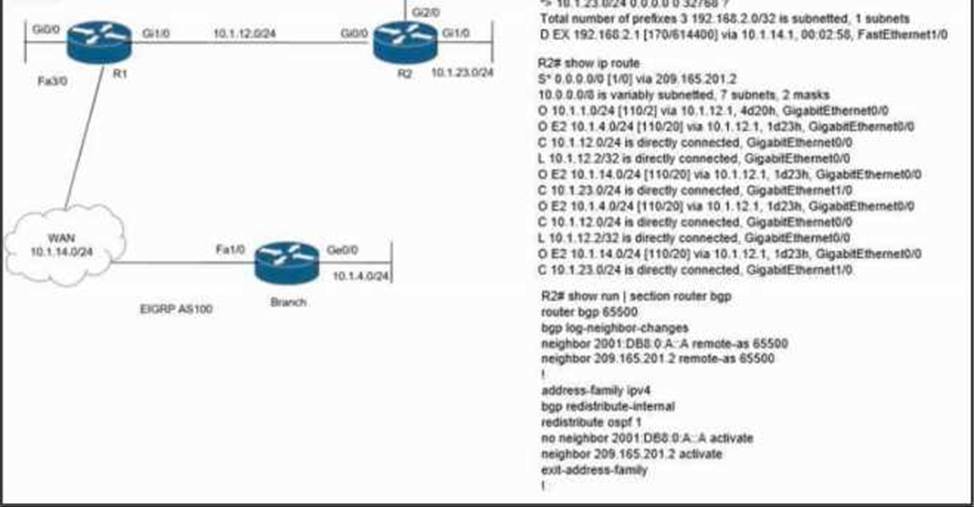
Users in BGP autonomous system 65500 cannot access IPv4 resources in the EIGRP IPv4 autonomous system 100.
Which action resolves the issue?
- A . Redistribute BGP routes into OSPF.
- B . Redistribute OSPF external routes into BGP.
- C . Redistribute OSPF internal routes into BGP.
- D . Redistribute EIGRP routes into OSPF.
Refer to the exhibit.
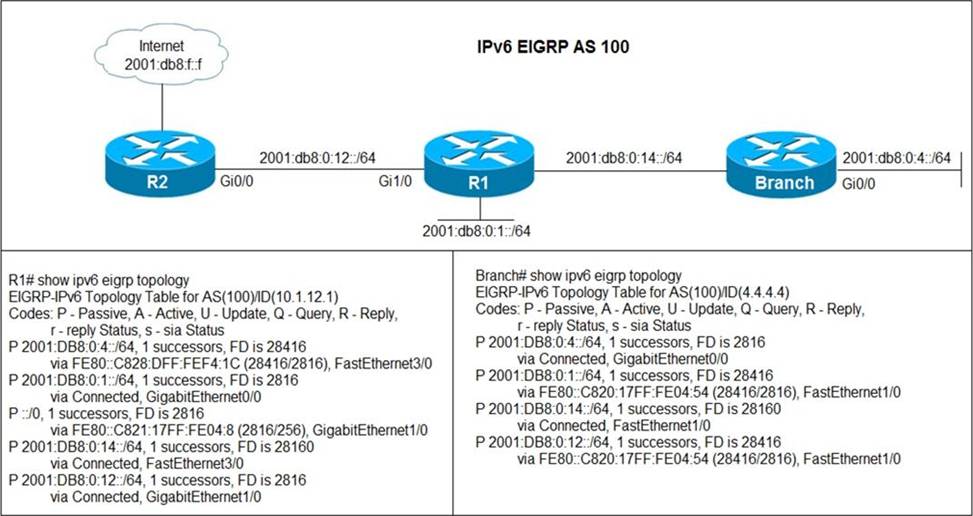
Users in the branch network of 2001:db8:0:4::/64 report that they cannot access the Internet.
Which command is issued in IPv6 router EIGRP 100 configuration mode to solve this issue?
- A . Issue the eigrp stub command on R1
- B . Issue the no neighbor stub command on R2.
- C . Issue the eigrp command on R2.
- D . Issue the no eigrp stub command on R1.