
Practice Free NSE6_SDW_AD-7.6 Exam Online Questions
An administrator is configuring SD-WAN to load balance their network traffic.
Which two things should they consider when setting up SD-WAN? (Choose two.)
- A . You can select the outbandwidth hash mode with all strategies that allow load balancing.
- B . Only the manual and best-quality strategies allow SD-WAN load balancing.
- C . When applicable. FortiGate load balances the traffic through all members that meet the SLA target.
- D . SD-WAN load balancing is possible only using the best quality and lowest cost (SLA) strategies.
You used the HUB IPsec_Recommended and the BRANCH IPsec_Recommended templates to define the overlay topology. Then, you used the SD-WAN template to define the SD- WAN members, rules, and performance SLAs.
You applied the changes to the devices and want to use the FortiManager monitors menu to get a graphical view that shows the status of each SD-WAN member.
Which statement best explains how to obtain this graphical view?
- A . Use the SD-WAN monitor template view to get a map view of the branches, hub, and tunnel status, including the SLA pass or missed status.
- B . Use the SD-WAN monitor table view to get a donut view and a table view that shows the status of each SD-WAN member, including the SLA pass or missed status.
- C . Use the VPN monitor map view to get a map view of the branches, hub, and tunnel status, including the SLA pass or missed status.
- D . Use the SD-WAN monitor asset view to get a donut view and a table view that shows the status of each device and the SLA status of each SD-WAN member.
You are planning a new SD-WAN deployment with the following criteria:
– Two regions
– Most of the traffic is expected to remain within its region
– No requirement for inter-region ADVPN
To remain within the recommended best practices, which routing protocol should you select for the overlays?
- A . OSPF for the routing within each region and EBGP between the regions.
- B . IBGP with BGP on loopback within each region and EBGP between the regions.
- C . IBGP with BGP per overlays within each region and IBGP with BGP on loopback between the regions.
- D . IBGP within each region and between the regions.
Which CLI command do you use to perform real-time troubleshooting for ADVPN negotiation?
- A . diagnose debug application ike
- B . diagnose sys virtual-wan-link service
- C . get ipsec tunnel list
- D . get router info routing-table
Which diagnostic command can you use to show the SD-WAN rules interface information and state?
- A . diagnose sys virtual-wan-link route-tag-list.
- B . diagnose sys virtual-wan-link service.
- C . diagnose sys virtual-wan-link member.
- D . diagnose sys virtual-wan-link neighbor.
Refer to the exhibits.
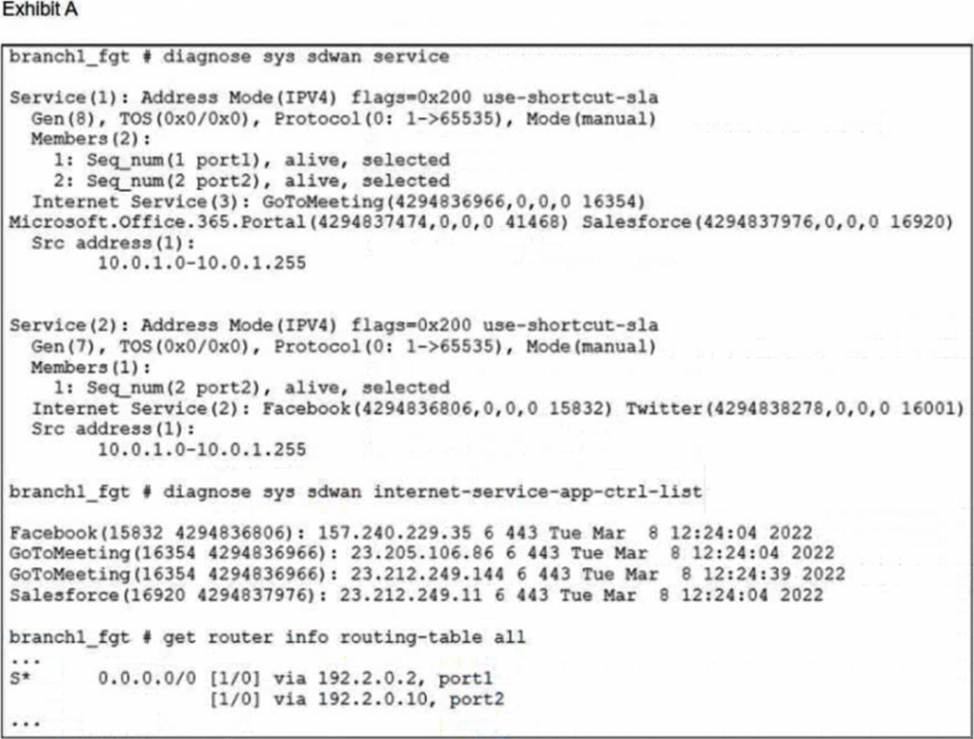
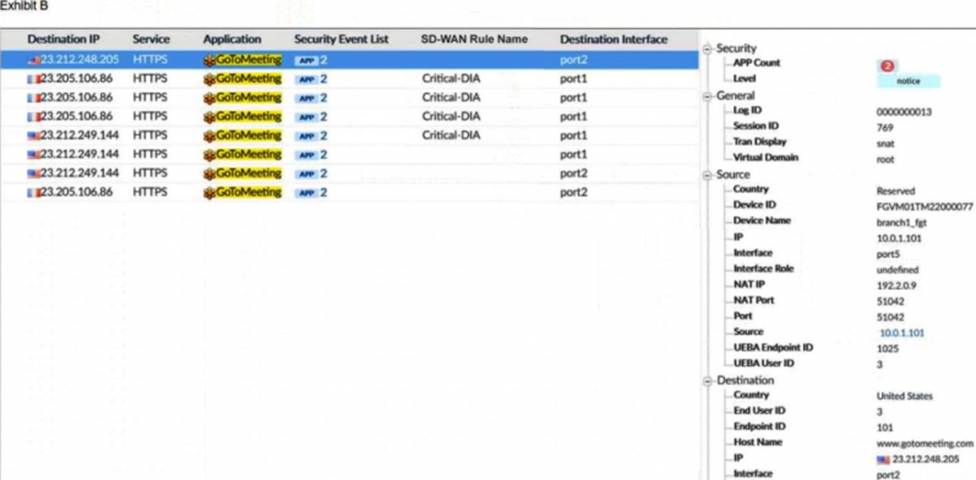
An administrator is testing application steering in SD-WAN. Before generating test traffic, the administrator collected the information shown in exhibit A.
After generating GoToMeeting test traffic, the administrator examined the respective traffic log on FortiAnalyzer, which is shown in exhibit B. The administrator noticed that the traffic matched the implicit SD-WAN rule, but they expected the traffic to match rule ID 1.
Which two reasons explain why the traffic matched the implicit SD-WAN rule? (Choose two.)
- A . FortiGate did not refresh the routing information on the session after the application was detected.
- B . Port1 and port2 do not have a valid route to the destination.
- C . Full SSL inspection is not enabled on the matching firewall policy.
- D . The session 3-tuple did not match any of the existing entries in the ISDB application cache.
An administrator configured a best quality SD-WAN rule with WAN1 and WAN2 as members. WAN1 has the highest configuration priority, and link-cost-threshold is set to 10. FortiGate reports a latency of 100 ms and 120 ms for WAN1 and WAN2, respectively.
Which change in the measured latency will make WAN2 the new preferred member?
- A . When WAN2 has a latency lower than ~91 ms
- B . When WAN1 has a latency lower than 100 ms
- C . When WAN1 has a latency of 120 ms
- D . When WAN2 has a latency of 100 ms
Refer to the exhibits.
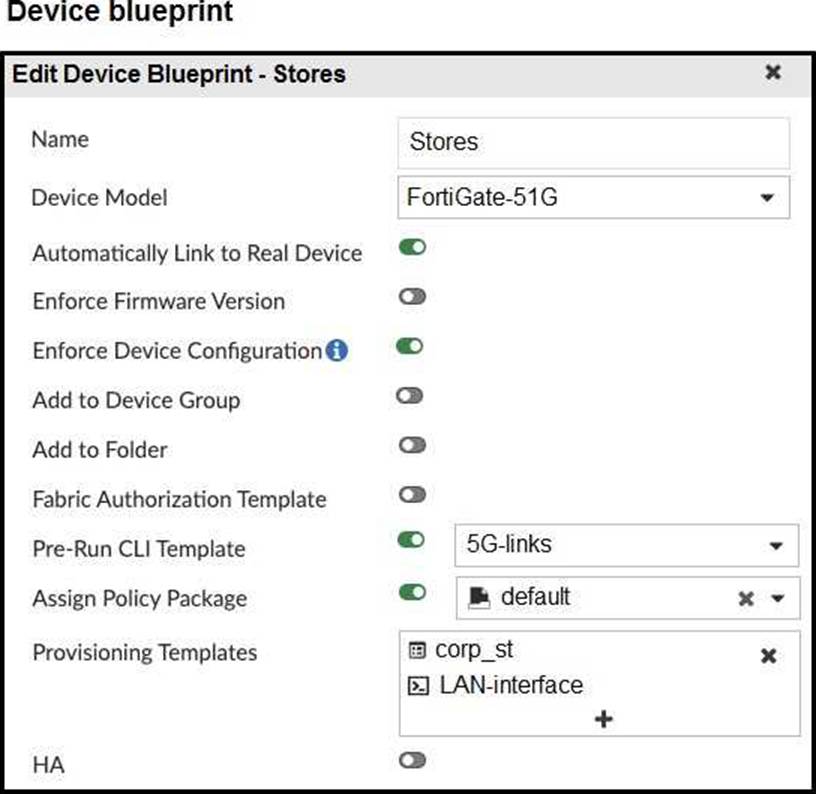
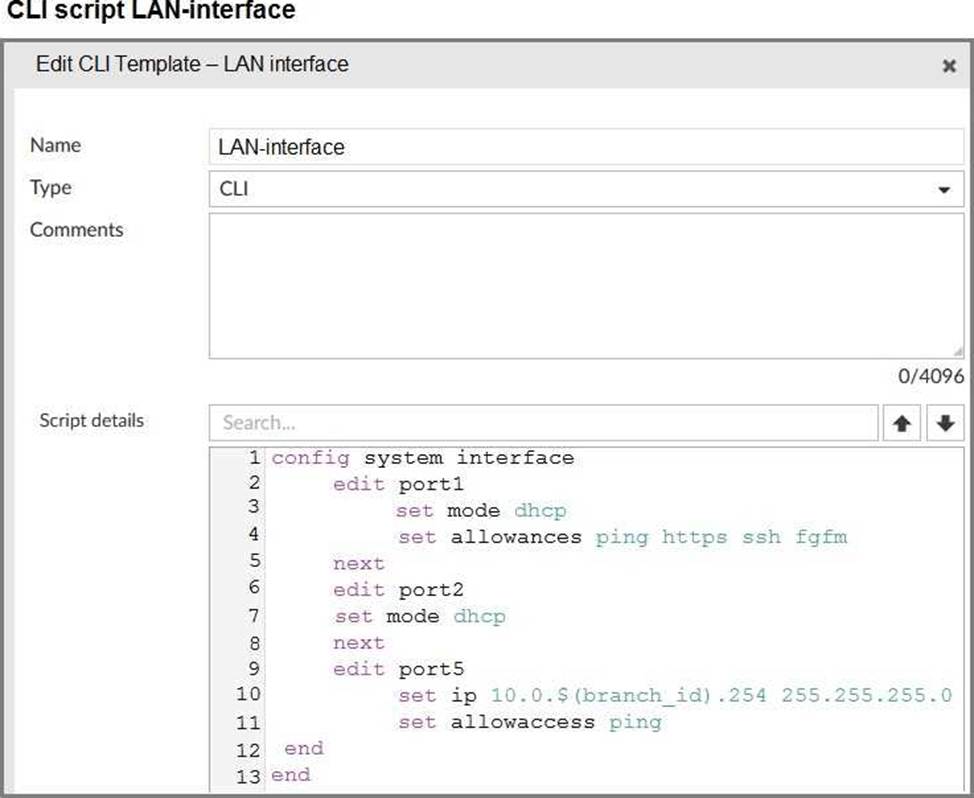
The administrator configured a device blueprint and CLI scripts as shown in the exhibits, to prepare for onboarding FortiGate devices in the company’s stores. Later, a technician prepares a FortiGate 51G with a basic configuration and connects it to the network. The basic configuration contains the port1 configuration and the minimal configuration required to allow the device to connect to FortiManager.
After the device first connects to FortiManager, FortiManager updates the device configuration.
Based on the exhibits, which actions does FortiManager perform?
- A . FortiManager updates the device configuration according to the selected templates. It applies the corp_st template first.
- B . FortiManager does not update the port1 configuration because FortiManager does not change the configuration of interfaces with fgfm access.
- C . FortiManager updates access rights only for port1. FortiManager cannot update the IP address because it was already set manually.
- D . FortiManager updates the configuration of port1, port2, and port5. The three ports might get new IP addresses.