
Practice Free NSE6_SDW_AD-7.6 Exam Online Questions
Refer to the exhibit.
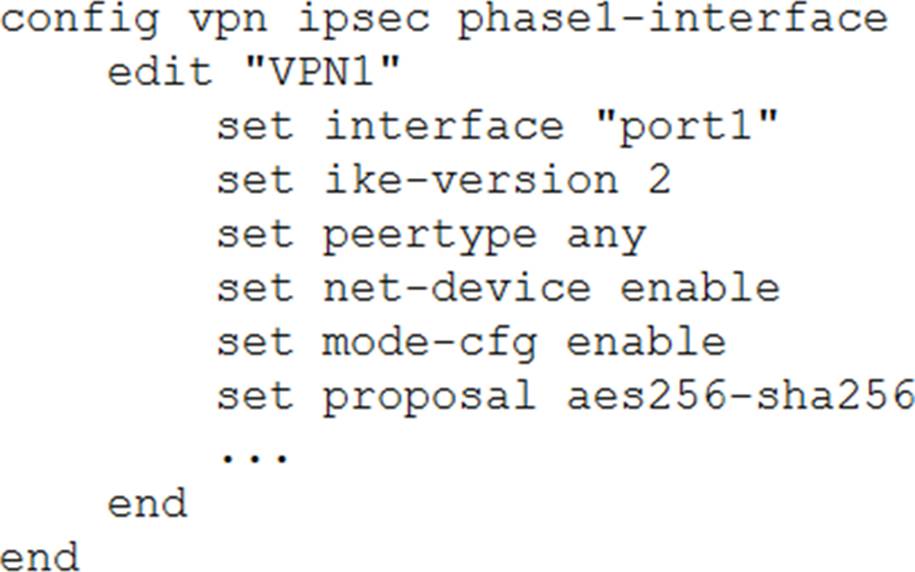
The administrator configured the IPsec tunnel VPN1 on a FortiGate device with the parameters shown in exhibit.
What are three consequences of selecting those parameters? (Choose three.)
- A . Administrators can use such a configuration to improve the tunnel set-up rate.
- B . Administrators should reserve such settings for spoke devices.
- C . This configuration includes a Fortinet-proprietary setting.
- D . dIPsec tunnels.
- E . The remote end must have the parameter net-device set to enable.
Which two statements correctly describe what happens when traffic matches the implicit SD-WAN rule? (Choose two.)
- A . The session information output displays no SD-WAN service ID.
- B . FortiGate flags the session with sdw-imp.
- C . The traffic is distributed through only static routes or directly connected routes.
- D . By default, FortiGate load balance the traffic according to the source IP address.
Refer to the exhibit.
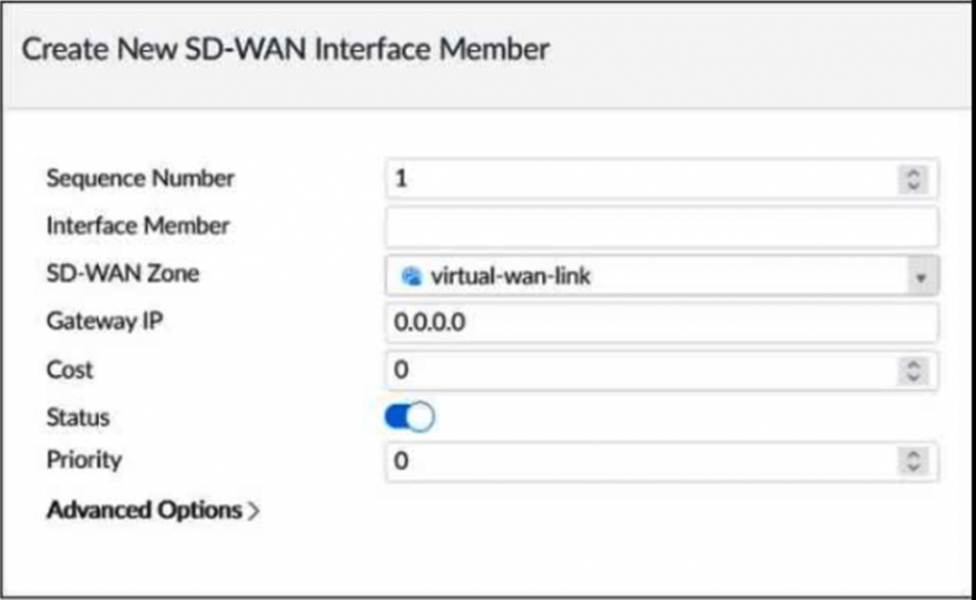
Which two SD-WAN template member settings support the use of FortiManager meta fields? (Choose two.)
- A . Cost
- B . Interface member
- C . Priority
- D . Gateway IP
Refer to the exhibit.

Which conclusion about the packet debug flow output is correct?
- A . The packet size exceeded the outgoing interface MTU.
- B . The number of concurrent sessions for 10.1.10.1 exceeded the maximum number of concurrent sessions configured in the traffic shaper, and the packet was dropped.
- C . The number of concurrent sessions for 10.1.10.1 exceeded the maximum number of concurrent sessions configured in the firewall policy, and the packet was dropped.
- D . The total number of daily sessions for 10.1.10.1 exceeded the maximum number of concurrent sessions configured in the traffic shaper, and the packet was dropped.
Refer to the exhibits.
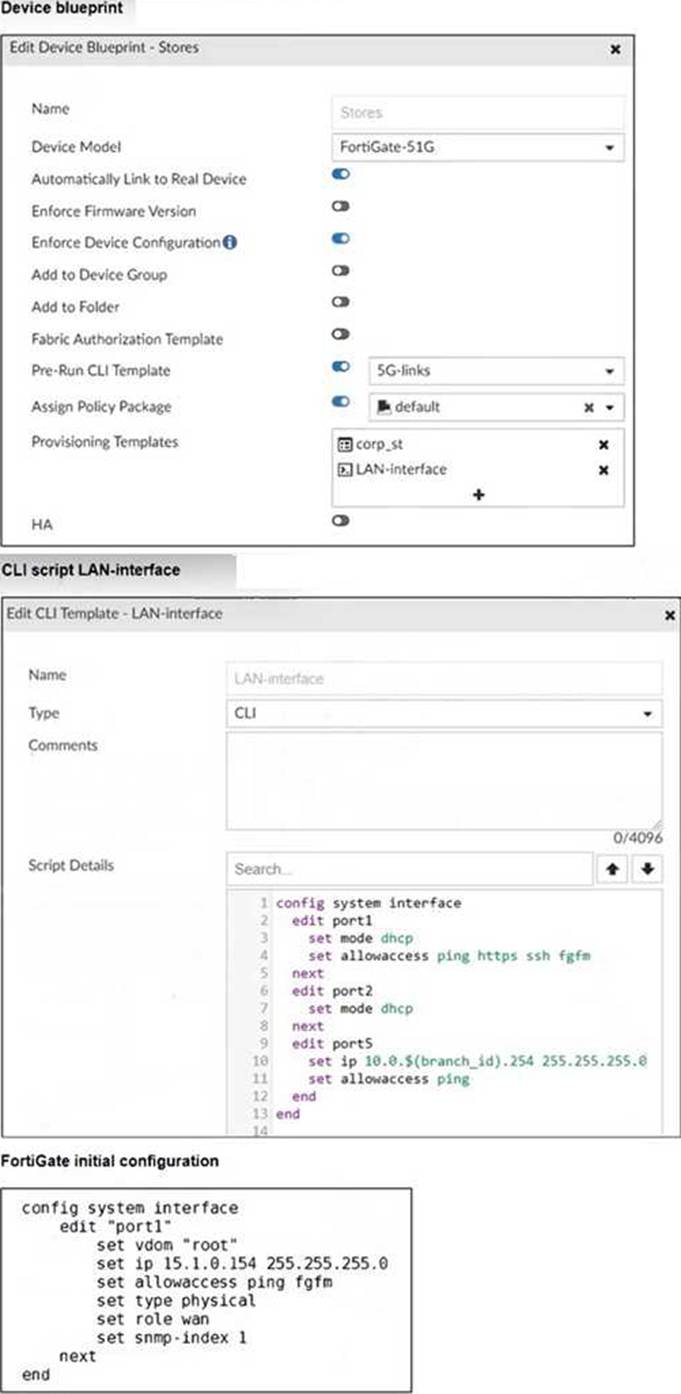
To prepare to onboard FortiGate devices to your company’s stores, you configure the device blueprint and CLI scripts shown in the exhibit. Then, a technician prepares a FortiGate 90G with a basic configuration and connects it to the network. The basic configuration contains the port1 configuration and the minimal configuration required to allow the device to connect to FortiManager.
After the device initially connects to FortiManager, FortiManager updates the device configuration.
Based on what is shown in the exhibits, which statement about the actions taken by FortiManager is true?
- A . FortiManager updates the configuration of port1, port2, and port5. The three ports might get new IP addresses
- B . FortiManager updates access rights only for port1. FortiManager cannot update the IP address because it was already set manually
- C . FortiManager updates the device configuration according to the selected templates and it applies the corp_st template first
- D . FortiManager does not update the port1 configuration because FortiManager does not change the configuration of interfaces with FortiGate-FortiManager communication protocol (FGFM) access
Refer to the exhibit.
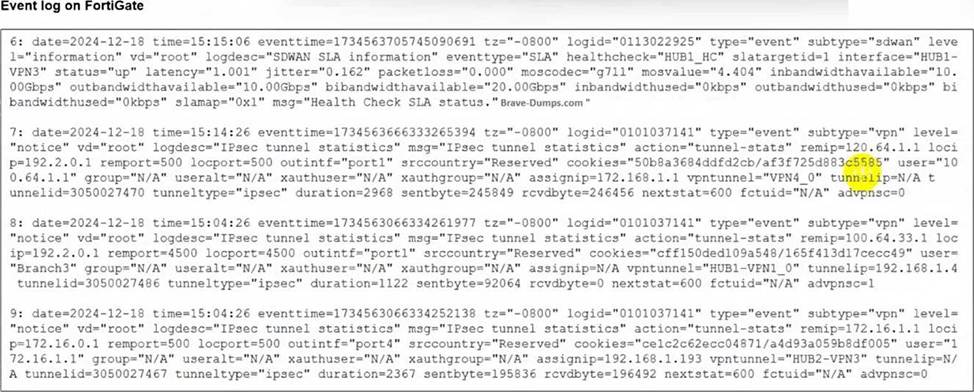
The event log on a FortiGate device is shown.
Based on the output shown in the exhibit, what can you conclude about the tunnels on this device? (Choose one answer))
- A . There is one shortcut tunnel built from the master tunnel VPN4.
- B . The voice traffic is steered through the VPN tunnel HUB1-VPN3.
- C . The VPN tunnel HUB1-VPN1_0 is a shortcut tunnel.
- D . The master tunnel HUB2-VPN3 cannot accept Auto-Discovery VPN (ADVPN) shortcuts.
Refer to the exhibit.
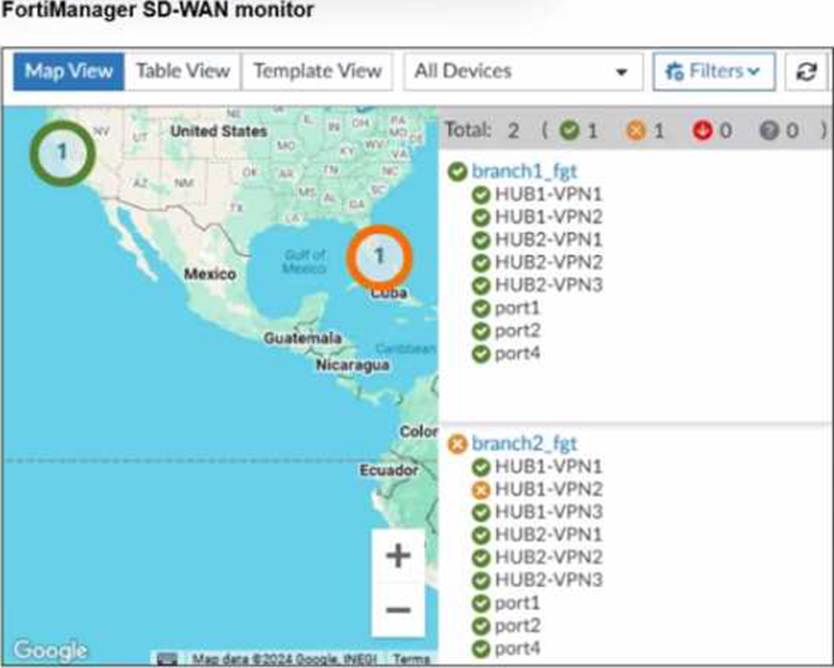
An administrator checks the status of an SD-WAN topology using the FortiManager SD-WAN monitor menus. All members are configured with one or two SLAs.
Which two conclusions can you draw from the output shown? (Choose two.)
- A . The template view should be used to see the hub devices.
- B . One member of branch2_fgt is missing the SLAs.
- C . branch2_fgt establishes six tunnels to the hubs and they are all up.
- D . This SD-WAN topology contains only two branch devices.
Which feature of FortiManager allows for the creation of custom templates for SD-WAN devices?
- A . Device Manager
- B . Policy Manager
- C . Template Manager
- D . Configuration Manager
What are the two minimum configuration requirements for an outgoing interface to be selected once the SD- WAN logical interface is enabled? (Choose two.)
- A . Specify outgoing interface routing cost.
- B . Configure SD-WAN rules interface preference.
- C . Select SD-WAN balancing strategy.
- D . Specify incoming interfaces in SD-WAN rules.
Exhibit.
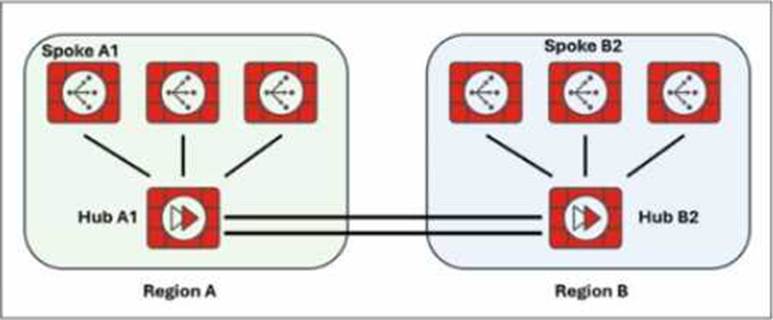
Two hub-and-spoke groups are connected through redundant site-to-site IPsec VPNs between Hub 1 and Hub 2
Which two configuration settings are required for the spoke A1 to establish an ADVPN shortcut with the spoke B2? (Choose two.)
- A . On hubs, auto-discovery-forwarder must be enabled on the IPsec VPNs to hubs.
- B . On hubs, auto-discovery-receiver must be enabled on the IPsec VPNs to spokes.
- C . On hubs, auto-discovery-forwarder must be enabled on the IPsec VPNs to spokes.
- D . On hubs, auto-discovery-sender must be enabled on the IPsec VPNs to spokes