
Practice Free PL-400 Exam Online Questions
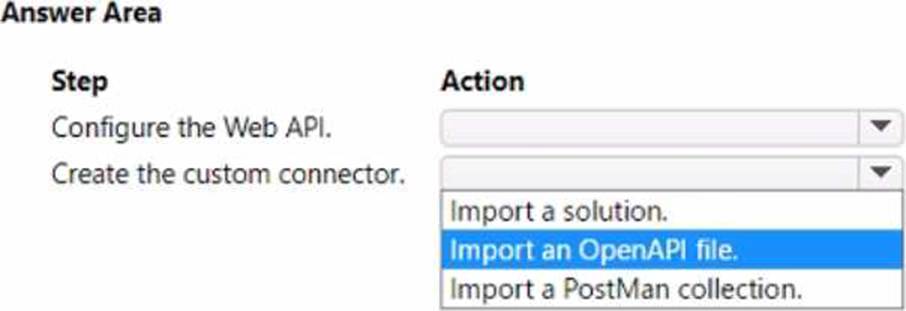
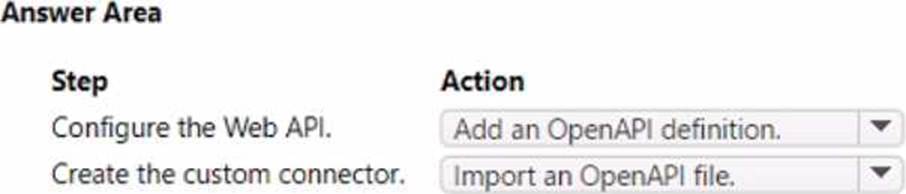
HOTSPOT
You need to configure the Web API and create the custom connector.
Which action should you perform for each step? To answer, select the appropriate options in the answer area. NOTE: Each correct selection is worth one point.
DRAG DROP
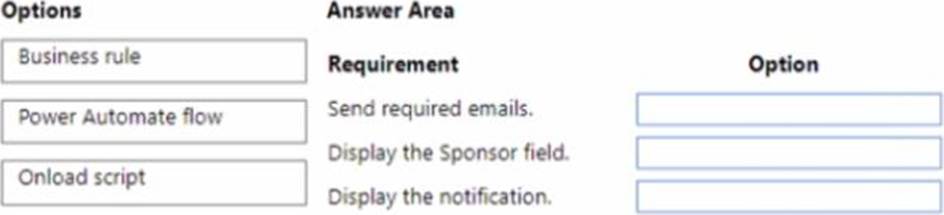
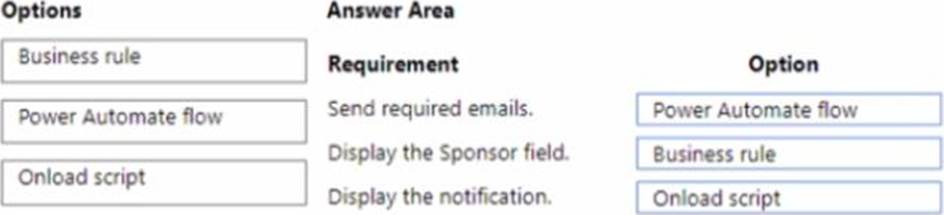
You are creating a model-driven app for a company Sales team members will use the app to manage leads. The app will interact with the Microsoft Dataverse Leads table.
You must configure the app to meet the following requirements:
• If the estimated value for a lead is greater than $10,000 the app must
• Send an email to a manager.
Display a field named Sponsor on the lead form.
• If the estimated value for a lead is greater than $100.000 the app must:
• Send an email to the company s vice president.
• Display the following message as a notification while the lead record is open: High value customer, handle will care.
You need to configure the app. The solution must minimize the use of code.
Which options should you use? To answer, drag the appropriate options to the correct requirements. Each option may be used once, more than once or not at all. You may need to drag the split bar between panes or scroll to view content. NOTE: Each correct selection is worth one point.
You need to create the eligibility assessment app.
Which command should you run?
- A . pac application install
- B . pac solution init
- C . pac plugin init
- D . pac pcf init
You create and deploy a Power Platform solution that includes synchronous plug-ins Users report performance issues with the solution.
You need to determine whether a plug-in is the cause of the performance issues.
Which two tools can you use? Each correct answer presents part of the solution. NOTE: Each correct selection is worth one point.
- A . Microsoft Dataverse Analytics
- B . Solution checker
- C . Tracing
- D . iSV Studio
- E . Data policies
You need to choose a technology to access the Web API.
Which technology should you select?
- A . Canvas app that uses the custom connector
- B . Plug-in that contacts the Web API
- C . Power Automate flow that uses the custom connector
- D . Webhook that contacts the Web API
You need to identify the Azure service to use for the Planning Hub application.
Which service should you use?
- A . Logic App
- B . Function
- C . Service Bus
- D . Key Vault
DRAG DROP
You are developing a Power Platform app for a school. The school plans to use the app to gather information about classes and students.
You must design a plug-in for the app. You must store data about students in the Contacts table and store data about classes in a custom table.
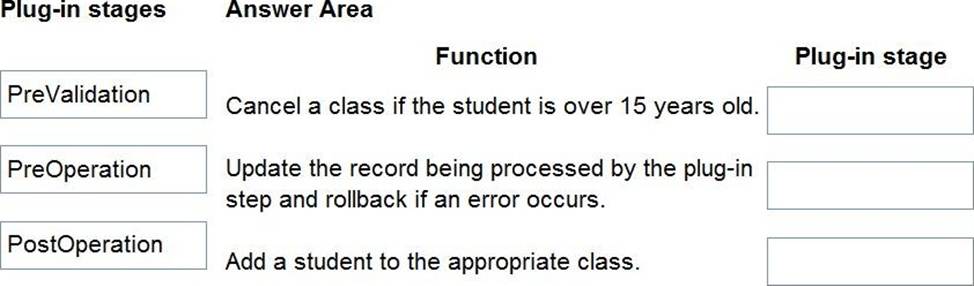
You need to select the stage in the event pipeline for each function.
Which stages should you use? To answer, drag the appropriate plug-in stages to the correct functions. Each plug-in stage may be used once, more than once, or not at all. You may need to drag the split bar between panes or scroll to view content. NOTE: Each correct selection is worth one point.
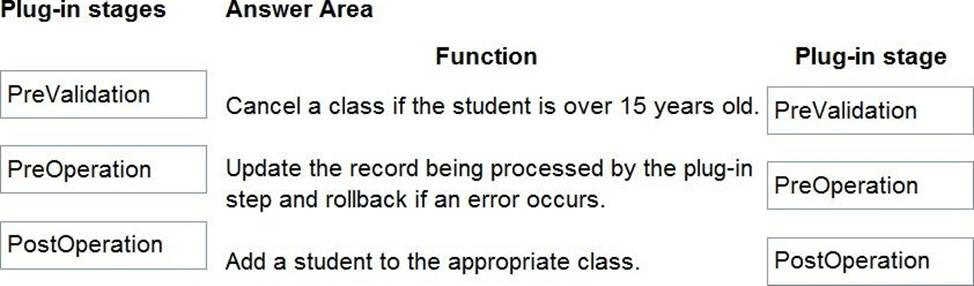
Explanation:
Box 1: PreValidation
For the initial operation, this stage will occur before the main system operation.
This provides an opportunity to include logic to cancel the operation before the database transaction.
Box 2: PreOperation
Occurs before the main system operation and within the database transaction.
If you want to change any values for an entity included in the message, you should do it here.
Avoid cancelling an operation here. Canceling will trigger a rollback of the transaction and have significant performance impact.
Box 3: PostOperation
Occurs after the main system operation and within the database transaction.
Use this stage to modify any properties of the message before it is returned to the caller.
Reference: https://docs.microsoft.com/en-us/powerapps/developer/data-platform/event-framework
You are creating a Power Apps app that retrieves customer information from Azure Active Directory when you use the app to look up a customer record.
You create an Azure Function by using JSON code to retrieve the customer information.
You need to make the application work.
Which two actions should you perform? Each correct answer presents part of the solution. NOTE: Each correct selection is worth one point.
- A . Create a Power Automate flow to import data.
- B . Create a custom connector that uses the Azure Function API.
- C . Copy your JSON code to the app.
- D . Create a custom connector that uses the JSON code.
- E . Create an API definition for the Azure Function.
BE
Explanation:
E: Before exporting an API, you must describe the API using an OpenAPI definition.
B: This OpenAPI definition contains information about what operations are available in an API and how the request and response data for the API should be structured. PowerApps and Microsoft Flow can create custom connectors for any OpenAPI 2.0 definition.
Reference: https://github.com/MicrosoftDocs/azure-docs/blob/master/articles/azure-functions/app-service-export-api-topowerapps-and-flow.md
DRAG DROP
You are creating an app that connects to Microsoft Dataverse on a nightly basis. You plan to integrate the app with an external system.
The application must not authenticate by using a Microsoft Azure Active Directory (Azure AD) user account.
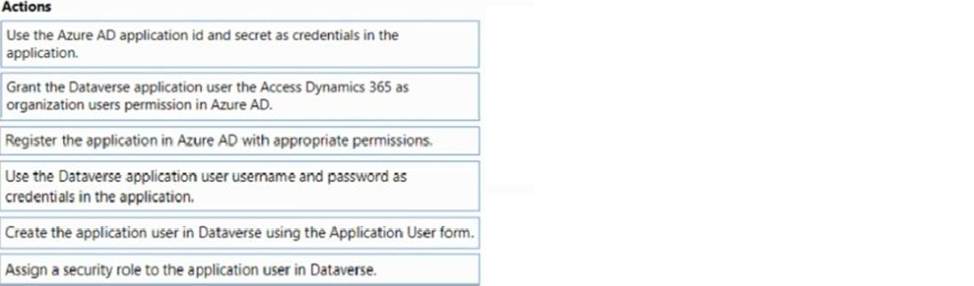
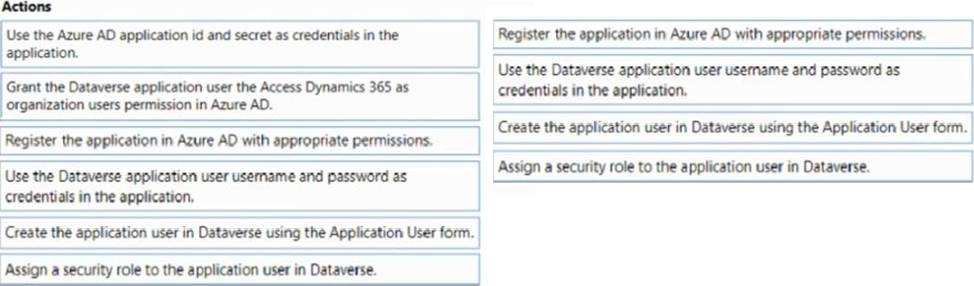
You need to enable the application to authenticate to Dataverse.
Which four actions should you perform in sequence? To answer, move the appropriate actions from the list of actions to the answer area and arrange them in the correct order.
A create a model-driven app. You run Solution checker. The tool displays the following error:
Solution checker fails to export solutions with model-driven app components.
You need to resolve the issue.
What should you do?
- A . Manually export the solution before running Solution checker
- B . Assign the Environment Maker security role to the Power Apps Checker application user
- C . Assign the System Administrator security role to your user ID
- D . Disable the Power Apps Checker application user
- E . Assign the Environment Maker security role to your user ID
B
Explanation:
To resolve this issue, grant the Environment Maker security role to the Power Apps Checker application user.
Note: Solution checker fails to export solutions with model-driven app components
If a solution contains a model-driven app, Solution Checker might fail to export the solution for analysis. This error is caused by role-based security for sharing of apps. If the Power Apps Checker application user does not have appropriate access to model-driven apps, any solutions containing them will fail to export with solution checker.
Reference: https://docs.microsoft.com/en-us/powerapps/maker/data-platform/common-issues-resolutions-solution-checker#solution-checker-fails-to-export-solutions-with-model-driven-app-components