
Practice Free DP-300 Exam Online Questions
You have an Azure subscription that contains a server named Server1. Server1 hosts two Azure SQL databases named DB1 and DB2.
You plan to deploy a Windows app named App1 that will authenticate to DB2 by using SQL authentication.
You need to ensure that App1 can access DB2.
The solution must meet the following requirements:
✑ App1 must be able to view only DB2.
✑ Administrative effort must be minimized.
What should you create?
- A . a contained database user for App1 on DB2
- B . a login for App1 on Server1
- C . a contained database user from an external provider for App1 on DB2
- D . a contained database user from a Windows login for App1 on DB2
D
Explanation:
Reference: https://docs.microsoft.com/en-us/sql/relational-databases/security/contained-database-users-making-your-database-portable?view=sql-server-ver15
You have an on-premises Microsoft SQL Server instance named SQL1 that hosts multiple databases. You have an Azure subscription that contains an Azure SQL managed instance named SQLM11. You need to perform an offline migration of the SQLi databases to SQLMH by using Azure Data Studio.
What should you install on SQL1?
- A . Data Migration Assistant (DMA)
- B . a self-hosted integration runtime
- C . SQL Server Data Tools (SSDT)
- D . an Azure Migrate appliance
DRAG DROP
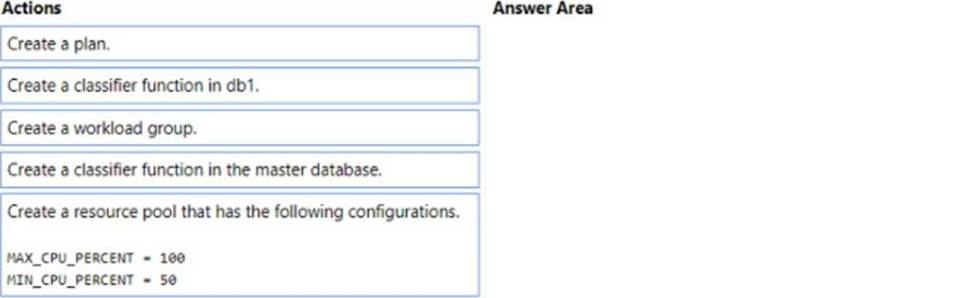
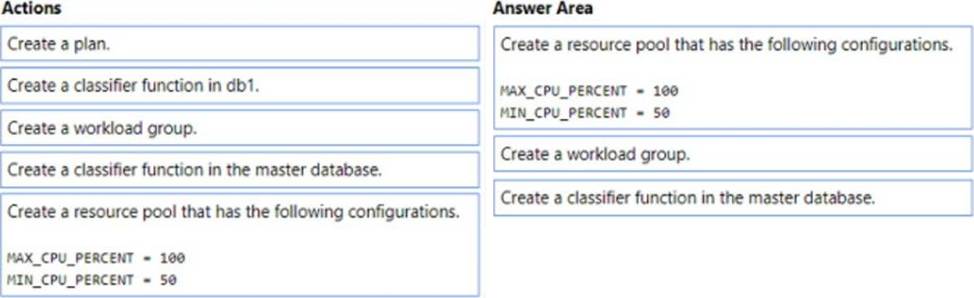
You have an Azure subscription that contains an Azure SQL managed instance, a database named db1, and an Azure web app named Appl. Appl uses db1.
You need to enable Resource Governor for a App1. The solution must meet the following requirements:
App1 must be able to consume all available CPU resources.
App1 must have at least half of the available CPU resources always available.
Which three actions should you perform in sequence? To answer. move the appropriate actions from the list of actions to the answer area and arrange them in the correct order. NOTE: More than one order of answer choices is correct. You will receive credit for any of the correct orders you select.
You have an on-premises Microsoft SQL Server 2019 database named SQL1 that uses merge replication. You need to migrate SQL1 to Azure.
Which service should you use?
- A . Azure SQL Edge
- B . Azure SQL Database
- C . SQL Server on Azure Virtual Machines
- D . Azure SQL Managed instance
You manage 100 Azure SQL managed instances located across 10 Azure regions.
You need to receive voice message notifications when a maintenance event affects any of the 10 regions. The solution must minimize administrative effort.
What should you do?
- A . From the Azure portal, create a service health alert.
- B . From the Azure portal, create an Azure Advisor operational excellence alert.
- C . From Microsoft SQL Server Management Studio (SSMS), configure a SQL Server agent job.
- D . From the Azure portal, configure an activity log alert.
You have a data warehouse in Azure Synapse Analytics.
You need to ensure that the data in the data warehouse is encrypted at rest.
What should you enable?
- A . Transparent Data Encryption (TDE)
- B . Advanced Data Security for this database
- C . Always Encrypted for all columns
- D . Secure transfer required
A
Explanation:
Transparent data encryption (TDE) helps protect Azure SQL Database, Azure SQL Managed Instance, and Azure Synapse Analytics against the threat of malicious offline activity by encrypting data at rest.
Reference: https://docs.microsoft.com/en-us/azure/azure-sql/database/transparent-data-encryption-tde-overview
Topic 1, Litware
Existing Environment
Network Environment
The manufacturing and research datacenters connect to the primary datacenter by using a VPN.
The primary datacenter has an ExpressRoute connection that uses both Microsoft peering and private peering. The private peering connects to an Azure virtual network named HubVNet.
Identity Environment
Litware has a hybrid Azure Active Directory (Azure AD) deployment that uses a domain named litwareinc.com. All Azure subscriptions are associated to the litwareinc.com Azure AD tenant.
Database Environment
The sales department has the following database workload:
– An on-premises named SERVER1 hosts an instance of Microsoft SQL Server 2012 and two 1-TB databases.
– A logical server named SalesSrv01A contains a geo-replicated Azure SQL database named SalesSQLDb1. SalesSQLDb1 is in an elastic pool named SalesSQLDb1Pool. SalesSQLDb1 uses database firewall rules and contained database users.
– An application named SalesSQLDb1App1 uses SalesSQLDb1.
The manufacturing office contains two on-premises SQL Server 2016 servers named SERVER2 and SERVER3. The servers are nodes in the same Always On availability group. The availability group contains a database named ManufacturingSQLDb1
Database administrators have two Azure virtual machines in HubVnet named VM1 and VM2 that run Windows Server 2019 and are used to manage all the Azure databases.
Licensing Agreement
Litware is a Microsoft Volume Licensing customer that has License Mobility through Software Assurance.
Current Problems
SalesSQLDb1 experiences performance issues that are likely due to out-of-date statistics and frequent blocking queries.
Requirements
Planned Changes
Litware plans to implement the following changes:
– Implement 30 new databases in Azure, which will be used by time-sensitive manufacturing apps that have varying usage patterns. Each database will be approximately 20 GB.
– Create a new Azure SQL database named ResearchDB1 on a logical server named ResearchSrv01. ResearchDB1 will contain Personally Identifiable Information (PII) data.
– Develop an app named ResearchApp1 that will be used by the research department to populate and access ResearchDB1.
– Migrate ManufacturingSQLDb1 to the Azure virtual machine platform.
– Migrate the SERVER1 databases to the Azure SQL Database platform.
Technical Requirements
Litware identifies the following technical requirements:
– Maintenance tasks must be automated.
– The 30 new databases must scale automatically.
– The use of an on-premises infrastructure must be minimized.
– Azure Hybrid Use Benefits must be leveraged for Azure SQL Database deployments.
– All SQL Server and Azure SQL Database metrics related to CPU and storage usage and limits must be analyzed by using Azure built-in functionality.
Security and Compliance Requirements
Litware identifies the following security and compliance requirements:
– Store encryption keys in Azure Key Vault.
– Retain backups of the PII data for two months.
– Encrypt the PII data at rest, in transit, and in use.
– Use the principle of least privilege whenever possible.
– Authenticate database users by using Active Directory credentials.
– Protect Azure SQL Database instances by using database-level firewall rules.
– Ensure that all databases hosted in Azure are accessible from VM1 and VM2 without relying on public endpoints.
Business Requirements
Litware identifies the following business requirements:
– Meet an SLA of 99.99% availability for all Azure deployments.
– Minimize downtime during the migration of the SERVER1 databases.
– Use the Azure Hybrid Use Benefits when migrating workloads to Azure.
– Once all requirements are met, minimize costs whenever possible.
HOTSPOT
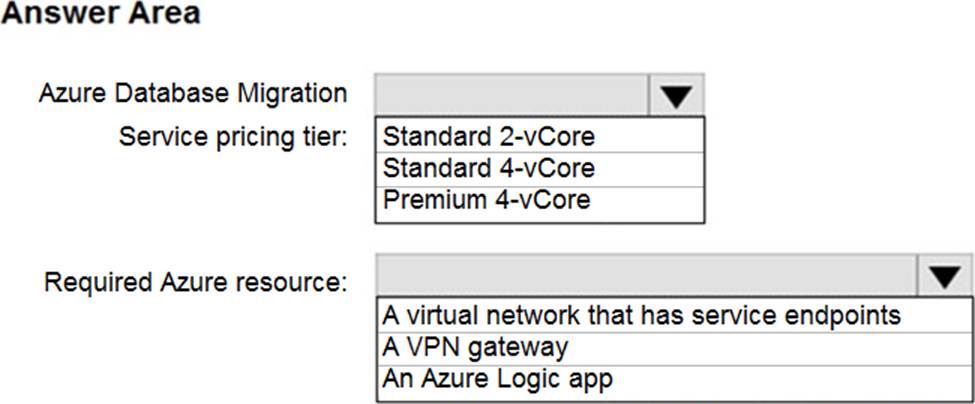
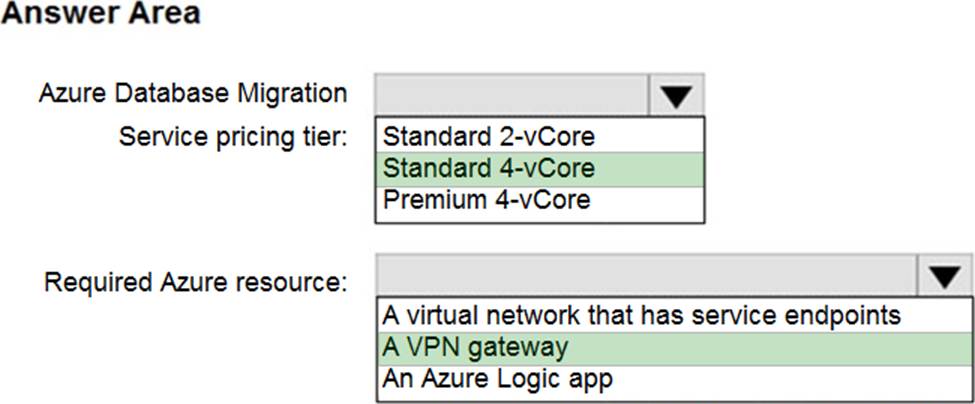
You are planning the migration of the SERVER1 databases. The solution must meet the business requirements.
What should you include in the migration plan? To answer, select the appropriate options in the answer area. NOTE: Each correct selection is worth one point.
Explanation:
Azure Database Migration service
Box 1: Premium 4-VCore
Scenario: Migrate the SERVER1 databases to the Azure SQL Database platform.
✑ Minimize downtime during the migration of the SERVER1 databases.
Premimum 4-vCore is for large or business critical workloads. It supports online migrations, offline migrations, and faster migration speeds.
Incorrect Answers:
The Standard pricing tier suits most small- to medium- business workloads, but it supports offline migration only.
Box 2: A VPN gateway
You need to create a Microsoft Azure Virtual Network for the Azure Database Migration Service by using the Azure Resource Manager deployment model, which provides site-to-site connectivity to your on-premises source servers by using either ExpressRoute or VPN.
Reference:
https://azure.microsoft.com/pricing/details/database-migration/
https://docs.microsoft.com/en-us/azure/dms/tutorial-sql-server-azure-sql-online
HOTSPOT
You have an Azure SQL database named db1 on a server named server1.
You use Query Performance Insight to monitor db1.
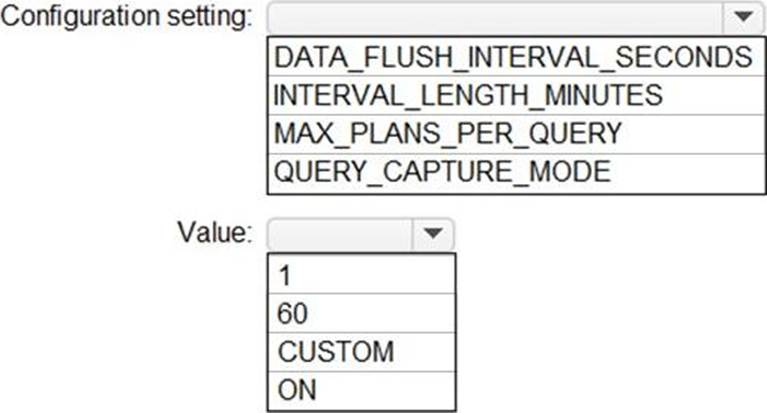
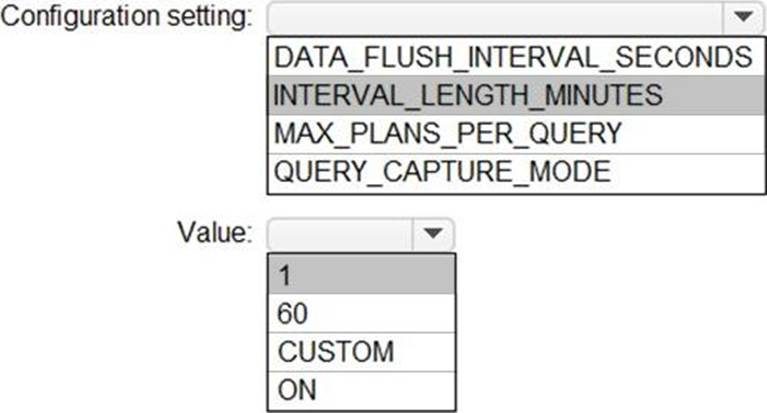
You need to modify the Query Store configuration to ensure that performance monitoring data is available as soon as possible.
Which configuration setting should you modify and which value should you configure? To answer, select the appropriate options in the answer area. NOTE: Each correct selection is worth one point.
You have an Azure subscription that contains an Azure SQL managed instance named SQLMI1. You need to configure SQLMI1 to use the Business Critical service tier.
Which PowerShell cmdlet should you run?
- A . Set-AzSqlServerConfigurationOption
- B . Update-SqlvM
- C . Set-AiSqlDatabase
- D . Set-AzSqllnstance
You are developing an application that uses Azure Data Lake Storage Gen 2.
You need to recommend a solution to grant permissions to a specific application for a limited time period.
What should you include in the recommendation?
- A . role assignments
- B . account keys
- C . shared access signatures (SAS)
- D . Azure Active Directory (Azure AD) identities
C
Explanation:
A shared access signature (SAS) provides secure delegated access to resources in your storage account. With a SAS, you have granular control over how a client can access your data.
For example:
What resources the client may access.
What permissions they have to those resources.
How long the SAS is valid.
Note: Data Lake Storage Gen2 supports the following authorization mechanisms:
✑ Shared Key authorization
✑ Shared access signature (SAS) authorization
✑ Role-based access control (Azure RBAC)
✑ Access control lists (ACL) Data Lake Storage Gen2 supports the following authorization mechanisms:
✑ Shared Key authorization
✑ Shared access signature (SAS) authorization
✑ Role-based access control (Azure RBAC)
✑ Access control lists (ACL)
Reference: https://docs.microsoft.com/en-us/azure/storage/common/storage-sas-overview