
Practice Free DP-300 Exam Online Questions
You have an Azure Data Factory that contains 10 pipelines.
You need to label each pipeline with its main purpose of either ingest, transform, or load. The labels must be available for grouping and filtering when using the monitoring experience in Data Factory.
What should you add to each pipeline?
- A . an annotation
- B . a resource tag
- C . a run group ID
- D . a user property
- E . a correlation ID
You have an on-premises app named App1 that stores data in an on-premises Microsoft SQL Server 2016 database named DB1.
You plan to deploy additional instances of App1 to separate Azure regions. Each region will have a separate instance of App1 and DB1. The separate instances of DB1 will sync by using Azure SQL Data Sync.
You need to recommend a database service for the deployment. The solution must minimize administrative effort.
What should you include in the recommendation?
- A . Azure SQL Managed instance
- B . Azure SQL Database single database
- C . Azure Database for PostgreSQL
- D . SQL Server on Azure virtual machines
You are designing an enterprise data warehouse in Azure Synapse Analytics that will contain a table named Customers. Customers will contain credit card information.
You need to recommend a solution to provide salespeople with the ability to view all the entries in Customers.
The solution must prevent all the salespeople from viewing or inferring the credit card information.
What should you include in the recommendation?
- A . row-level security
- B . data masking
- C . Always Encrypted
- D . column-level security
You are building a database backup solution for a SQL Server database hosted on an Azure virtual machine.
In the event of an Azure regional outage, you need to be able to restore the database backups. The solution must minimize costs.
Which type of storage accounts should you use for the backups?
- A . locally-redundant storage (LRS)
- B . read-access geo-redundant storage (RA-GRS)
- C . zone-redundant storage (ZRS)
- D . geo-redundant storage
HOTSPOT
You plan to develop a dataset named Purchases by using Azure Databricks. Purchases will contain the following columns:
✑ ProductID
✑ ItemPrice
✑ LineTotal
✑ Quantity
✑ StoreID
✑ Minute
✑ Month
✑ Hour
✑ Year
✑ Day
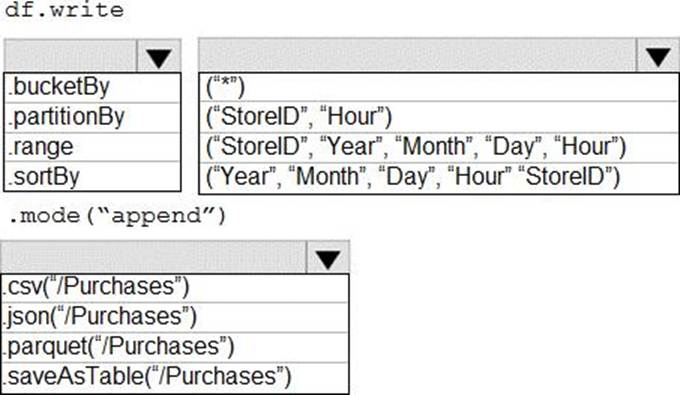
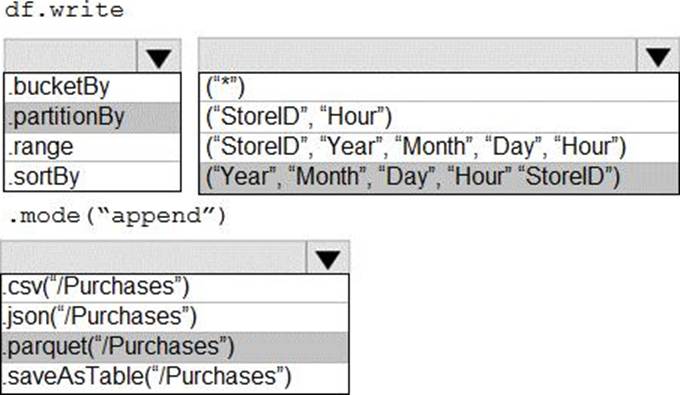
You need to store the data to support hourly incremental load pipelines that will vary for each StoreID. The solution must minimize storage costs.
How should you complete the code? To answer, select the appropriate options in the answer area. NOTE: Each correct selection is worth one point.
HOTSPOT
You plan to develop a dataset named Purchases by using Azure Databricks. Purchases will contain the following columns:
✑ ProductID
✑ ItemPrice
✑ LineTotal
✑ Quantity
✑ StoreID
✑ Minute
✑ Month
✑ Hour
✑ Year
✑ Day
You need to store the data to support hourly incremental load pipelines that will vary for each StoreID. The solution must minimize storage costs.
How should you complete the code? To answer, select the appropriate options in the answer area. NOTE: Each correct selection is worth one point.
You have an Azure Databricks resource.
You need to log actions that relate to changes in compute for the Databricks resource.
Which Databricks services should you log?
- A . clusters
- B . jobs
- C . DBFS
- D . SSH
- E . workspace
HOTSPOT
You have an Azure subscription.
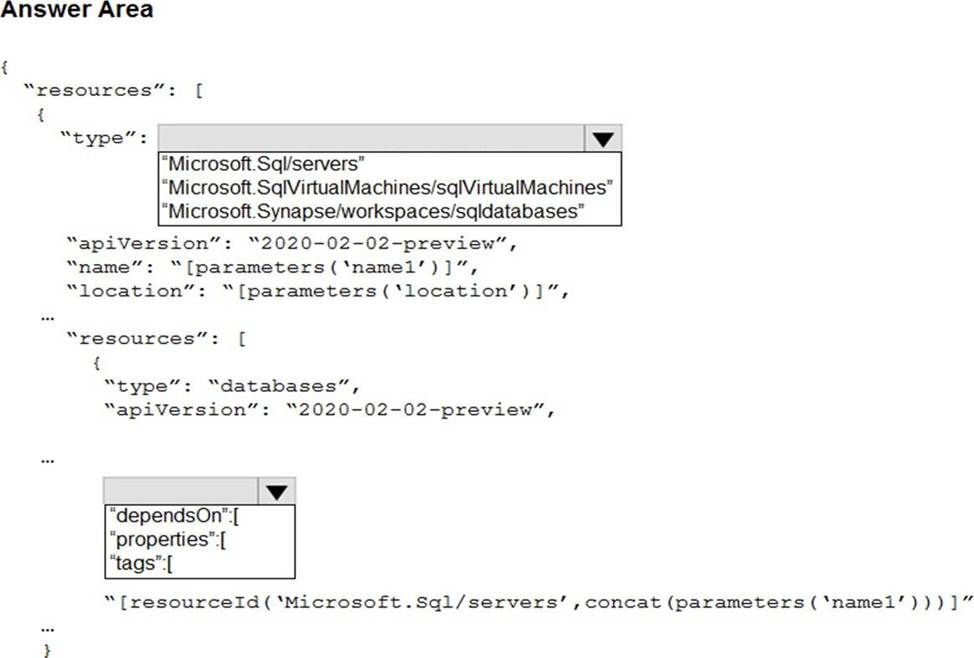
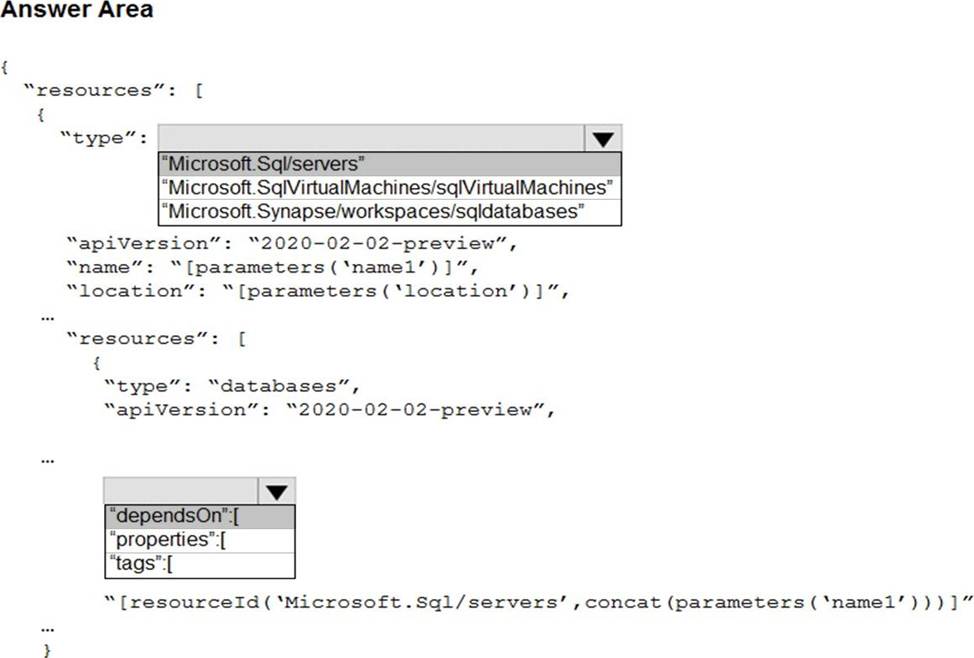
You plan to deploy an Azure SQL database by using an Azure Resource Manager template.
How should you complete the template? To answer, select the appropriate options in the answer area. NOTE: Each correct selection is worth one point.
SIMULATION
Task 6
You need to ensure that any enhancements made to the Query Optimizer through patches are available to dbl and db2 on sql37006895.
You have 40 Azure SQL databases, each for a different customer. All the databases reside on the same Azure SQL Database server.
You need to ensure that each customer can only connect to and access their respective database.
Which two actions should you perform? Each correct answer presents part of the solution. NOTE: Each correct selection is worth one point.
- A . Implement row-level security (RLS).
- B . Create users in each database.
- C . Configure the database firewall.
- D . Configure the server firewall.
- E . Create logins in the master database.
- F . Implement Always Encrypted.