
Practice Free DP-300 Exam Online Questions
You are planning a solution that will use Azure SQL Database. Usage of the solution will peak from October 1 to January 1 each year.
During peak usage, the database will require the following:
✑ 24 cores
✑ 500 GB of storage
✑ 124 GB of memory
✑ More than 50,000 IOPS
During periods of off-peak usage, the service tier of Azure SQL Database will be set to Standard.
Which service tier should you use during peak usage?
- A . Business Critical
- B . Premium
- C . Hyperscale
You plan to deploy two instances of SQL Server on Azure virtual machines in a highly available configuration that will use an Always On availability group.
You need to recommend a deployment solution that meets the following requirements:
• Provides a Service Level Agreement (SLA) of at least 99.95%
• Replicates databases in the same group synchronously
• Minimizes the latency of database writes
What should you recommend?
- A . Create a proximity group and an availability set. Deploy each virtual machine to the availability set Add both virtual machines to the proximity group.
- B . Create two proximity groups and a single availability set. Deploy both virtual machines to the availability set. Add one virtual machine to each proximity group.
- C . Create two proximity groups and two availability sets. Deploy each virtual machine to a unique availability set. Add one virtual machine to each proximity group.
- D . Create a proximity group and two availability sets. Deploy each virtual machine to a unique availability set. Add both virtual machines to the proximity group.
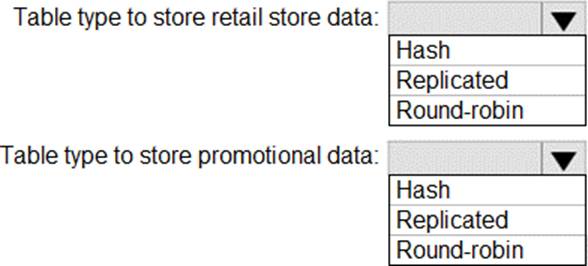
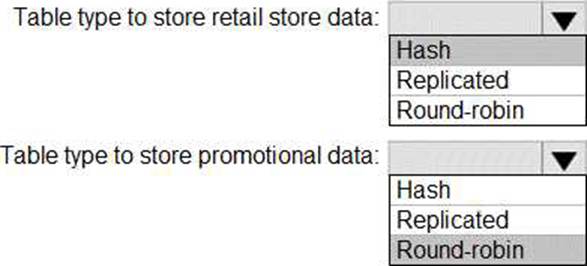
HOTSPOT
You need to design an analytical storage solution for the transactional data. The solution must meet the sales transaction dataset requirements.
What should you include in the solution? To answer, select the appropriate options in the answer area. NOTE: Each correct selection is worth one point.
DRAG DROP
You have an Azure subscription.
You plan to deploy a new Azure virtual machine that will host a Microsoft SQL Server instance.
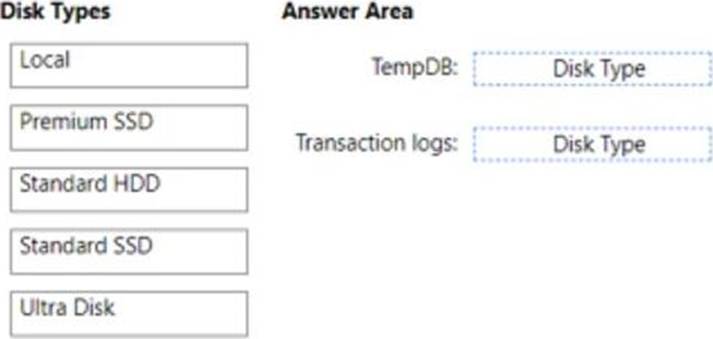
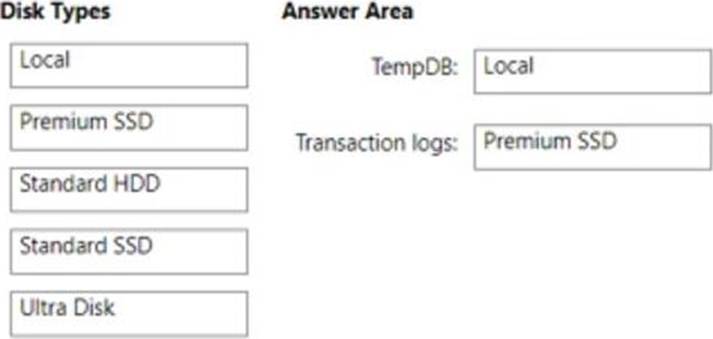
You need to configure the disks on the virtual machine.
The solution must meet the following requirements:
• Minimize latency for transaction logs.
• Minimize the impact on IO Of the virtual machine.
Which type of disk should you use for each workload? To answer. drag the appropriate disk types to the correct workloads. Each disk type may be used once, at all. You may need to drag the split bar between panes or scroll to view content. NOTE: Each correct selection is worth one point.
Note: This question is part of a series of questions that present the same scenario. Each question in the series contains a unique solution that might meet the stated goals. Some question sets might have more than one correct solution, while others might not have a correct solution.
After you answer a question in this section, you will NOT be able to return to it. As a result, these questions will not appear in the review screen.
You have SQL Server 2019 on an Azure virtual machine.
You are troubleshooting performance issues for a query in a SQL Server instance.
To gather more information, you query sys.dm_exec_requests and discover that the wait type is PAGELATCH_UP and the wait_resource is 2:3:905856.
You need to improve system performance.
Solution: You shrink the transaction log file.
Does this meet the goal?
- A . Yes
- B . No
You have an Azure SQL managed instance that hosts multiple databases.
You need to configure alerts for each database based on the diagnostics telemetry of the database.
What should you use?
- A . Azure SQL Analytics alerts based on metrics
- B . SQL Health Check alerts based on diagnostics logs
- C . SQL Health Check alerts based on metrics
- D . Azure SQL Analytics alerts based on diagnostics logs
Note: This question is part of a series of questions that present the same scenario. Each question in the series contains a unique solution that might meet the stated goals. Some question sets might have more than one correct solution, while others might not have a correct solution.
After you answer a question in this section, you will NOT be able to return to it. As a result, these questions will not appear in the review screen.
You have an Azure Synapse Analytics dedicated SQL pool that contains a table named Table1.
You have files that are ingested and loaded into an Azure Data Lake Storage Gen2 container named container1.
You plan to insert data from the files into Table1 and transform the data. Each row of data in the files will produce one row in the serving layer of Table1.
You need to ensure that when the source data files are loaded to container1, the DateTime is stored as an additional column in Table1.
Solution: You use an Azure Synapse Analytics serverless SQL pool to create an external table that has an additional DateTime column.
Does this meet the goal?
- A . Yes
- B . No
HOTSPOT
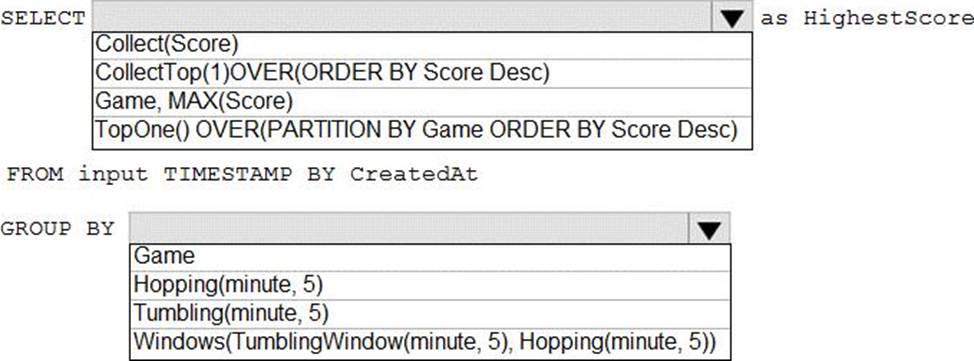
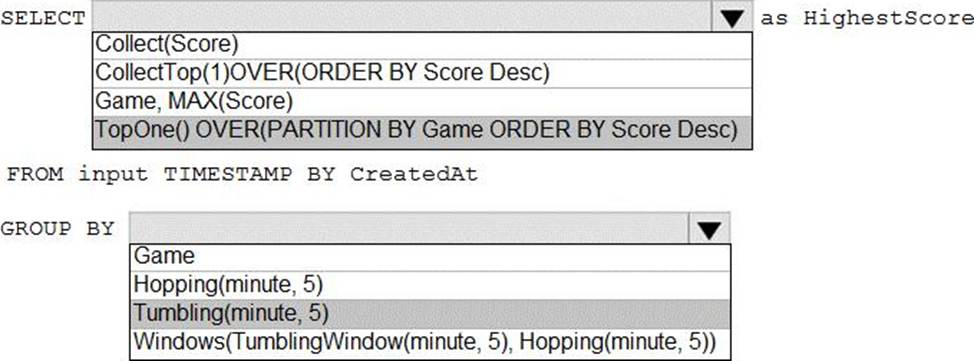
You are building an Azure Stream Analytics job to retrieve game data.
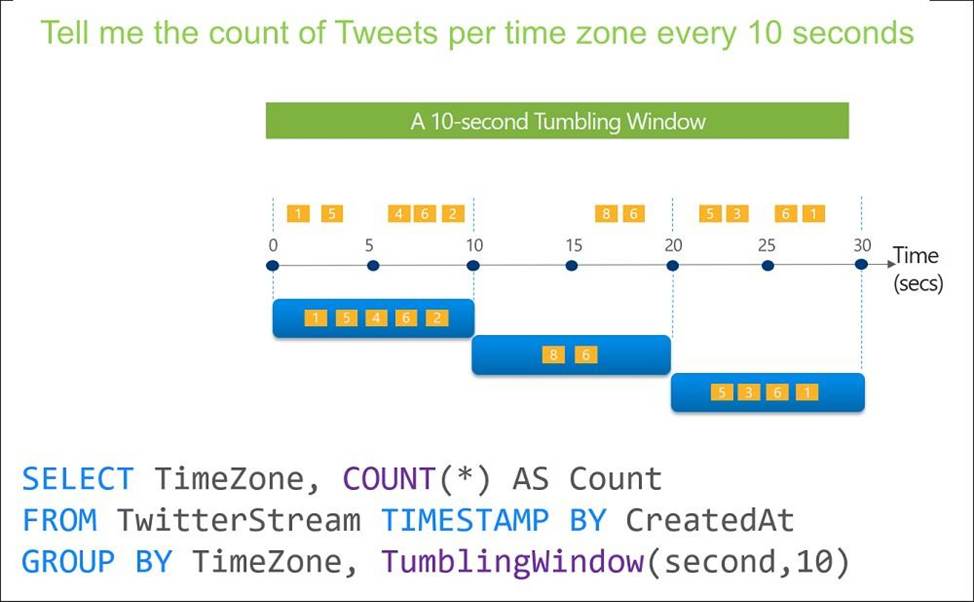
You need to ensure that the job returns the highest scoring record for each five-minute time interval of each game.
How should you complete the Stream Analytics query? To answer, select the appropriate options in the answer area. NOTE: Each correct selection is worth one point.
Your on-premises network contains a Microsoft SQL Server 2016 server that hosts a database named db1.
You have an Azure subscription.
You plan to migrate db1 to an Azure SQL managed instance.
You need to create the SQL managed instance. The solution must minimize the disk latency of the instance.
Which service tier should you use?
- A . Hyperscale
- B . General Purpose
- C . Premium
- D . Business Critical
You have an Azure subscription.
You plan to deploy an instance of SQL Sevier on Azure Virtual Machines that supports Write Accelerator.
Which virtual machine series should you use?
- A . H-series
- B . G -series
- C . M-series
- D . E-series