
Practice Free DP-300 Exam Online Questions
You have an Azure subscription that contains the resources shown in the following table.

App1 experiences transient connection errors and timeouts when it attempts to access db1 after extended periods of inactivity.
You need to modify db1 to resolve the issues experienced by Appl as soon as possible, without considering immediate costs
What you do?
- A . Increase the number of vCores allocated to db1.
- B . Decrease the auto-pause delay for db1.
- C . Disable auto-pause delay for db1.
- D . Enable automatic tuning for db1.
You deploy an instance of SQL Server on Azure Virtual Machines named VM1.
You need to create a SQL Server Agent job that will rebuild indexes of the databases hosted on VM1.
The solution must use the principle of least privilege.
What should you create first?
- A . an Elastic Job agent
- B . a local Windows account
- C . a system-assigned managed identity in Microsoft Entra ID
- D . a user-assigned managed identity in Microsoft Entra ID
You have an Azure SQL Database elastic pool that contains 10 databases.
You receive the following alert.
Msg 1132, Level 16, State 1, Line 1
The elastic pool has reached its storage limit. The storage used for the elastic pool cannot exceed (76800) MBs.
You need to resolve the alert. The solution must minimize administrative effort.
Which three actions can you perform? Each correct answer presents a complete solution. NOTE: Each correct selection is worth one point.
- A . Delete data from a database.
- B . Remove a database from the pool.
- C . Increase the maximum storage of the elastic pool.
- D . Shrink individual databases.
- E . Enable data compression.
HOTSPOT
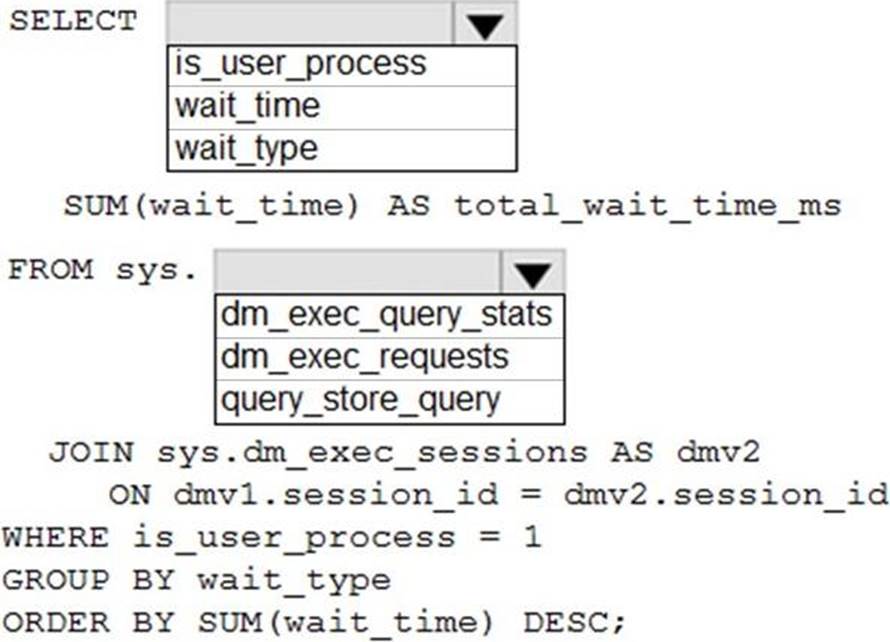
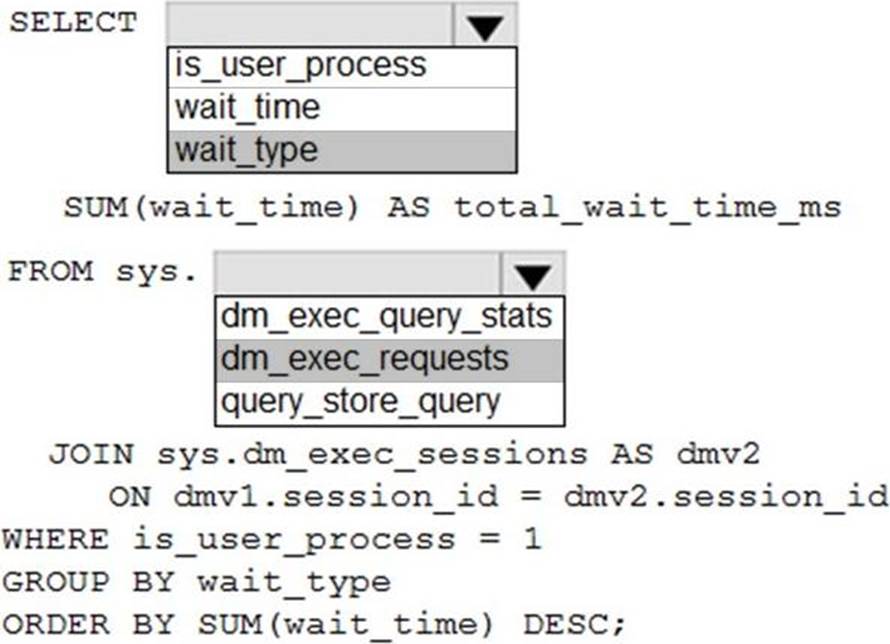
You have an Azure subscription that contains an Azure SQL database.
The database fails to respond to queries in a timely manner.
You need to identify whether the issue relates to resource_semaphore waits.
How should you complete the Transact-SQL query? To answer, select the appropriate options in the answer area. NOTE: Each correct selection is worth one point.
Explanation:
Reference: https://docs.microsoft.com/en-us/azure/azure-sql/database/monitoring-with-dmvs
You are designing a star schema for a dataset that contains records of online orders. Each record includes an order date, an order due date, and an order ship date.
You need to ensure that the design provides the fastest query times of the records when querying for arbitrary date ranges and aggregating by fiscal calendar attributes.
Which two actions should you perform? Each correct answer presents part of the solution. NOTE: Each correct selection is worth one point.
- A . Create a date dimension table that has a DateTime key.
- B . Create a date dimension table that has an integer key in the format of YYYYMMDD.
- C . Use built-in SQL functions to extract date attributes.
- D . Use integer columns for the date fields.
- E . Use DateTime columns for the date fields.
BD
Explanation:
Reference: https://community.idera.com/database-tools/blog/b/community_blog/posts/why-use-a-date-dimension-table-ina-data-warehouse
Note: This question is part of a series of questions that present the same scenario. Each question in the series contains a unique solution that might meet the stated goals. Some question sets might have more than one correct solution, while others might not have a correct solution.
After you answer a question in this section, you will NOT be able to return to it. As a result, these questions will not appear in the review screen.
You have two Azure SQL Database servers named Server1 and Server2. Each server contains an Azure SQL database named Database1.
You need to restore Database1 from Server1 to Server2. The solution must replace the existing Database1 on Server2.
Solution: You restore Database1 from Server1 to the Server2 by using the RESTORE Transact-SQL command and the REPLACE option.
Does this meet the goal?
- A . Yes
- B . No
A
Explanation:
The REPLACE option overrides several important safety checks that restore normally performs.
The overridden checks are as follows:
✑ Restoring over an existing database with a backup taken of another database.
With the REPLACE option, restore allows you to overwrite an existing database with whatever database is in the backup set, even if the specified database name differs from the database name recorded in the backup set. This can result in accidentally overwriting a database by a different database.
Reference: https://docs.microsoft.com/en-us/sql/t-sql/statements/restore-statements-transact-sql
You have an Azure SQL database named DB1 that has default configurations.
You review the Data Discovery & Classification blade for D61 as shown in the following exhibit.
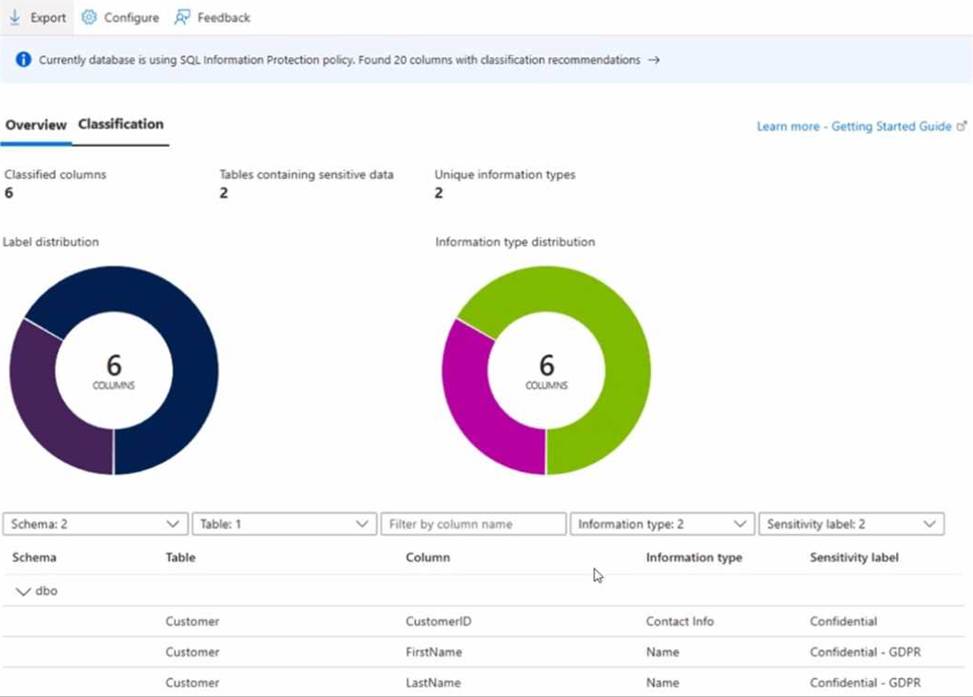
You need to identify the process for creating a custom sensitivity label and assigning it to the Customer ID column.
Which two actions should you perform? Each correct answer presents part of the solution. NOTE: Each correct answer is worth one point
- A . Select Export
- B . Filter by the Contact Info Information type-
- C . Filter by the CustomerID column name.
- D . Select the Classification page.
- E . Select Configure
You have an Azure Stream Analytics job.
You need to ensure that the job has enough streaming units provisioned.
You configure monitoring of the SU % Utilization metric.
Which two additional metrics should you monitor? Each correct answer presents part of the solution. NOTE: Each correct selection is worth one point.
- A . Late Input Events
- B . Out of order Events
- C . Backlogged Input Events
- D . Watermark Delay
- E . Function Events
CD
Explanation:
To react to increased workloads and increase streaming units, consider setting an alert of 80% on the SU Utilization metric. Also, you can use watermark delay and backlogged events metrics to see if there is an impact.
Note: Backlogged Input Events: Number of input events that are backlogged. A non-zero value for this metric implies that your job isn’t able to keep up with the number of incoming events. If this value is slowly increasing or consistently non-zero, you should scale out your job, by increasing the SUs.
Reference: https://docs.microsoft.com/en-us/azure/stream-analytics/stream-analytics-monitoring
You have an Azure Stream Analytics job.
You need to ensure that the job has enough streaming units provisioned.
You configure monitoring of the SU % Utilization metric.
Which two additional metrics should you monitor? Each correct answer presents part of the solution. NOTE: Each correct selection is worth one point.
- A . Late Input Events
- B . Out of order Events
- C . Backlogged Input Events
- D . Watermark Delay
- E . Function Events
CD
Explanation:
To react to increased workloads and increase streaming units, consider setting an alert of 80% on the SU Utilization metric. Also, you can use watermark delay and backlogged events metrics to see if there is an impact.
Note: Backlogged Input Events: Number of input events that are backlogged. A non-zero value for this metric implies that your job isn’t able to keep up with the number of incoming events. If this value is slowly increasing or consistently non-zero, you should scale out your job, by increasing the SUs.
Reference: https://docs.microsoft.com/en-us/azure/stream-analytics/stream-analytics-monitoring
You have an Azure Stream Analytics job.
You need to ensure that the job has enough streaming units provisioned.
You configure monitoring of the SU % Utilization metric.
Which two additional metrics should you monitor? Each correct answer presents part of the solution. NOTE: Each correct selection is worth one point.
- A . Late Input Events
- B . Out of order Events
- C . Backlogged Input Events
- D . Watermark Delay
- E . Function Events
CD
Explanation:
To react to increased workloads and increase streaming units, consider setting an alert of 80% on the SU Utilization metric. Also, you can use watermark delay and backlogged events metrics to see if there is an impact.
Note: Backlogged Input Events: Number of input events that are backlogged. A non-zero value for this metric implies that your job isn’t able to keep up with the number of incoming events. If this value is slowly increasing or consistently non-zero, you should scale out your job, by increasing the SUs.
Reference: https://docs.microsoft.com/en-us/azure/stream-analytics/stream-analytics-monitoring