
Practice Free DP-300 Exam Online Questions
You have an Azure SQL database.
You need to implement a disaster recovery solution that meets the following requirements:
• Minimizes how long it takes to recover the database if a datacenter fails
• Minimizes administrative effort
What should you include in the solution?
- A . Azure Backup
- B . active geo-replication
- C . Azure Site Recovery
- D . auto-failover groups
You are monitoring an Azure Stream Analytics job.
You discover that the Backlogged input Events metric is increasing slowly and is consistently non-zero.
You need to ensure that the job can handle all the events.
What should you do?
- A . Remove any named consumer groups from the connection and use $default.
- B . Change the compatibility level of the Stream Analytics job.
- C . Create an additional output stream for the existing input stream.
- D . Increase the number of streaming units (SUs).
D
Explanation:
Backlogged Input Events: Number of input events that are backlogged. A non-zero value for this metric implies that your job isn’t able to keep up with the number of incoming events. If this value is slowly increasing or consistently non-zero, you should scale out your job, by increasing the SUs.
Reference: https://docs.microsoft.com/en-us/azure/stream-analytics/stream-analytics-monitoring
What should you use to migrate the PostgreSQL database?
- A . Azure Data Box
- B . AzCopy
- C . Azure Database Migration Service
- D . Azure Site Recovery
C
Explanation:
Reference: https://docs.microsoft.com/en-us/azure/dms/dms-overview
You have an Azure SQL database named DB3.
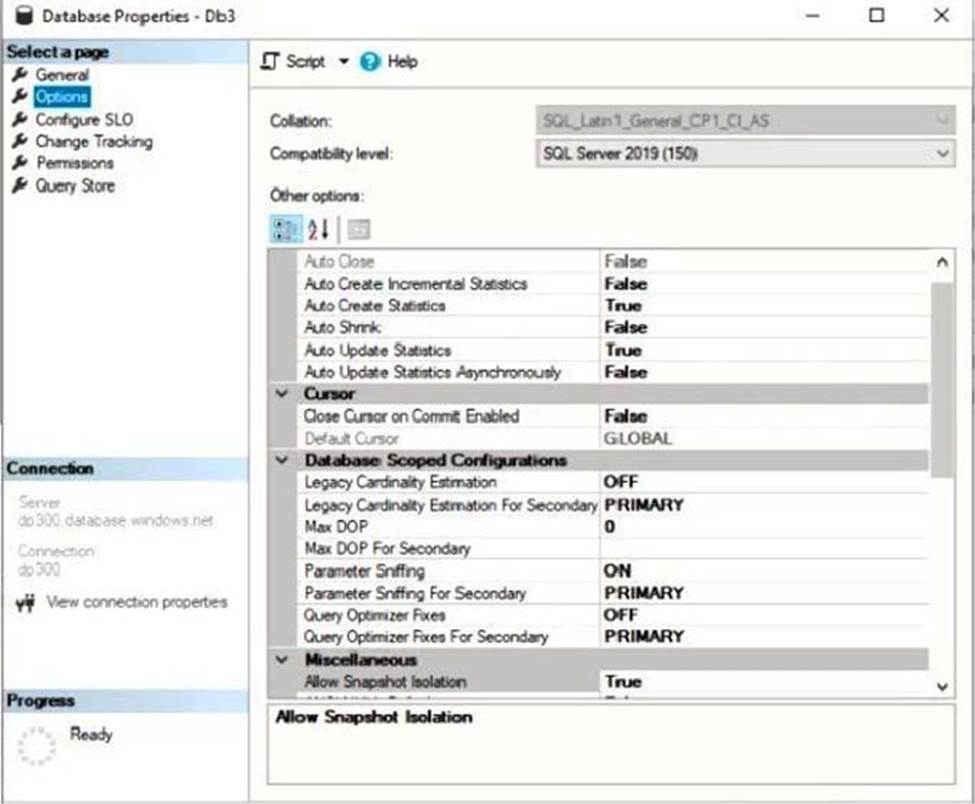
You need to provide a user named DevUser with the ability to view the properties of DB3 from Microsoft SQL Server Management Studio (SSMS) as shown in the exhibit. (Click the Exhibit tab.)
Which Transact-SQL command should you run?
- A . GRANT SHOWPLAN TO DevUser
- B . GRANT VIEW DEFINITION TO DevUser
- C . GRANT VIEW DATABASE STATE TO DevUser
- D . GRANT SELECT TO DevUser
C
Explanation:
The exhibits displays Database [State] properties.
To query a dynamic management view or function requires SELECT permission on object and VIEW SERVER STATE or VIEW DATABASE STATE permission.
Reference: https://docs.microsoft.com/en-us/sql/relational-databases/databases/database-properties-options-page
You have an Azure subscription that contains 50 instances of SQL Server on Azure Virtual Machines. The instances host 500 Azure SQL databases. You need to ensure that all the databases have the same configuration.
The solution must meet the following requirements:
• Auditing must be enabled.
• Azure Defender must be enabled.
• Public network access must be disabled.
• Administrative effort must be minimized.
Which two resources should you create in the subscription? Each correct answer presents part of the solution. NOTE: Each correct selection is worth one point.
- A . an Azure Policy assignment
- B . an Azure Automation account
- C . an Azure Policy initiative
- D . an Azure Automation runbook
- E . an Azure Policy definition
HOTSPOT
You have an Azure data factory that has two pipelines named PipelineA and PipelineB.
PipelineA has four activities as shown in the following exhibit.

PipelineB has two activities as shown in the following exhibit.

You create an alert for the data factory that uses Failed pipeline runs metrics for both pipelines and all failure types.
The metric has the following settings:
✑ Operator: Greater than
✑ Aggregation type: Total
✑ Threshold value: 2
✑ Aggregation granularity (Period): 5 minutes
✑ Frequency of evaluation: Every 5 minutes
Data Factory monitoring records the failures shown in the following table.

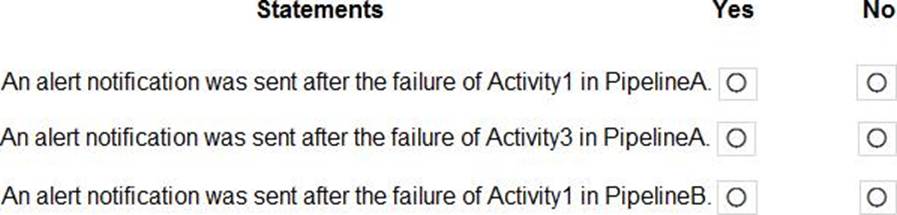
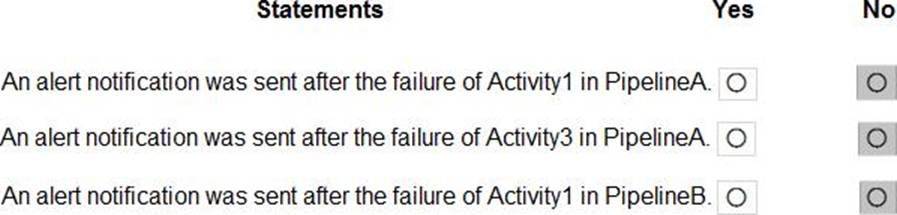
For each of the following statements, select Yes if the statement is true. Otherwise, select No. NOTE: Each correct selection is worth one point.
Explanation:
Box 1: No
Just one failure within the 5-minute interval.
Box 2: No
Just two failures within the 5-minute interval.
Box 3: No
Just two failures within the 5-minute interval.
Reference: https://docs.microsoft.com/en-us/azure/azure-monitor/alerts/alerts-metric-overview
You plan to move two 100-GB databases to Azure.
You need to dynamically scale resources consumption based on workloads. The solution must minimize downtime during scaling operations.
What should you use?
- A . two Azure SQL Databases in an elastic pool
- B . two databases hosted in SQL Server on an Azure virtual machine
- C . two databases in an Azure SQL Managed instance
- D . two single Azure SQL databases
A
Explanation:
Azure SQL Database elastic pools are a simple, cost-effective solution for managing and scaling multiple databases that have varying and unpredictable usage demands. The databases in an elastic pool are on a single server and share a set number of resources at a set price.
Reference: https://docs.microsoft.com/en-us/azure/azure-sql/database/elastic-pool-overview
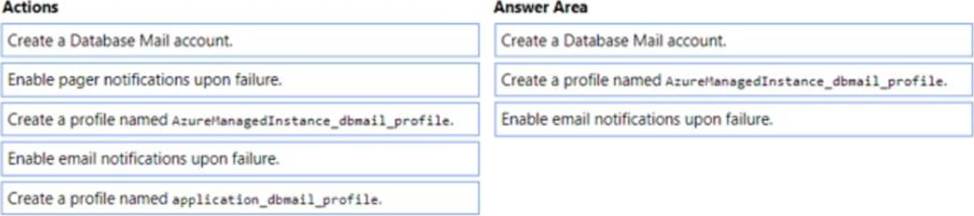
DRAG DROP
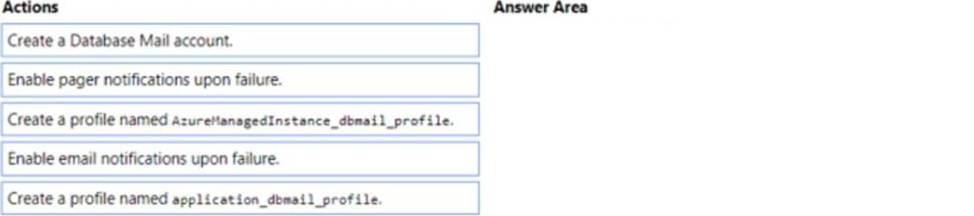
You create a new Azure SQL managed instance named SQL1 and enable Database Mail extended stored.
You need to ensure that SQ Server Agent jobs running on SQL 1 can notify when a failure Occurs
Which three actions should you perform in sequence 7 TO answer. move the appropriate actions from the list Of actions to answer area and arrange them in correct order.
You need to identify the event_file target for monitonng DB3 after the migration to Azure SQL Database. The solution must meet the management requirements.
What should you use as the event_file target?
- A . an Azure SQL database
- B . an Azure Blob Storage container
- C . a SQL Server filegroup
- D . an Azure Files share
Note: This question is part of a series of questions that present the same scenario. Each question in the series contains a unique solution that might meet the stated goals. Some question sets might have more than one correct solution, while others might not have a correct solution.
After you answer a question in this section, you will NOT be able to return to it. As a result, these questions will not appear in the review screen.
You have SQL Server 2019 on an Azure virtual machine.
You are troubleshooting performance issues for a query in a SQL Server instance.
To gather more information, you query sys.dm_exec_requests and discover that the wait type is PAGELATCH_UP and the wait_resource is 2:3:905856.
You need to improve system performance.
Solution: You create additional tempdb files.
Does this meet the goal?
- A . Yes
- B . No
A
Explanation:
Reference: https://docs.microsoft.com/en-US/troubleshoot/sql/performance/recommendations-reduce-allocation-contention