
Practice Free AI-102 Exam Online Questions
You have an Azure subscription that contains a multi-service Azure Cognitive Services Translator resource named Translator1.
You are building an app that will translate text and documents by using Translator1.
You need to create the REST API request for the app.
Which headers should you include in the request?
- A . the subscription key and the client trace ID
- B . the subscription key, the subscription region, and the content type
- C . the resource ID and the content language
- D . the access control request, the content type, and the content length
You are training a Language Understanding model for a user support system.
You create the first intent named GetContactDetails and add 200 examples.
You need to decrease the likelihood of a false positive.
What should you do?
- A . Enable active learning.
- B . Add a machine learned entity.
- C . Add additional examples to the GetContactDetails intent.
- D . Add examples to the None intent.
A
Explanation:
Active learning is a technique of machine learning in which the machine learned model is used to identify informative new examples to label. In LUIS, active learning refers to adding utterances from the endpoint traffic whose current predictions are unclear to improve your model.
Reference: https://docs.microsoft.com/en-us/azure/cognitive-services/luis/luis-glossary
You have an Azure subscription that contains an Azure OpenAI resource named AH and an Azure Al Content Safety resource named CS1.
You build a chatbot that uses All to provide generative answers to specific questions and CS1 to check input and output for objectionable content.
You need to optimize the content filter configurations by running tests on sample questions.
Solution: From Content Safety Studio, you use the Protected material detection feature to run the tests.
Does this meet the requirement?
- A . Yes
- B . No
Note: This question is part of a series of questions that present the same scenario. Each question in the series contains a unique solution that might meet the stated goals. Some question sets might have more than one correct solution, while others might not have a correct solution.
After you answer a question in this section, you will NOT be able to return to it. As a result, these questions will not appear in the review screen.
You have a chatbot that uses question answering in Azure Cognitive Service for Language
Users report that the responses of the chatbot lark formality when answering spurious questions. You need to ensure that the chatbot provides formal responses to spurious questions.
Solution: From Language Studio, you change the chitchat source to qna_chitchit_friindly.tsv. and then retrain and republish the model.
Does this meet the goal?
- A . Yes
- B . No
DRAG DROP
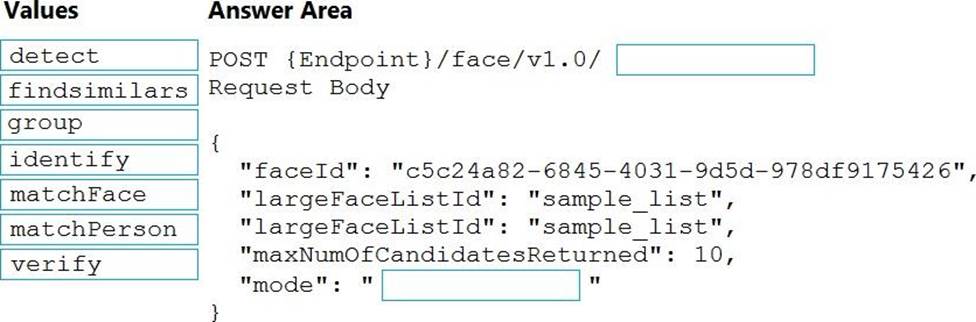
You are developing a photo application that will find photos of a person based on a sample image by using the Face API.
You need to create a POST request to find the photos.
How should you complete the request? To answer, drag the appropriate values to the correct targets. Each value may be used once, more than once, or not at all. You may need to drag the split bar between panes or scroll to view content. NOTE: Each correct selection is worth one point.
Explanation:
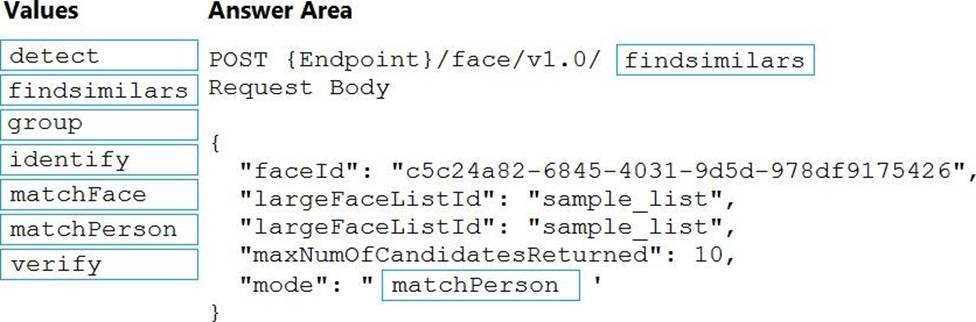
Box 1: findsimilars
https://docs.microsoft.com/en-us/rest/api/faceapi/face/find-similar
Box 2: matchPerson
Find similar has two working modes, "matchPerson" and "matchFace". "matchPerson" is the default mode that it tries to find faces of the same person as possible by using internal same-person thresholds. It is useful to find a known person’s other photos. Note that an empty list will be returned if no faces pass the internal thresholds. "matchFace" mode ignores same-person thresholds and returns ranked similar faces anyway, even the similarity is low. It can be used in the cases like searching celebrity-looking faces.
Reference:
https://docs.microsoft.com/en-us/rest/api/faceapi/face/detectwithurl
https://docs.microsoft.com/en-us/rest/api/faceapi/face/findsimilar
You are building a bot on a local computer by using the Microsoft Bot Framework. The bot will use an existing Language Understanding model.
You need to translate the Language Understanding model locally by using the Bot Framework CLI.
What should you do first?
- A . From the Language Understanding portal, clone the model.
- B . Export the model as an .lu file.
- C . Create a new Speech service.
- D . Create a new Language Understanding service.
B
Explanation:
You might want to manage the translation and localization for the language understanding content for your bot independently.
Translate command in the @microsoft/bf-lu library takes advantage of the Microsoft text translation API to automatically machine translate .lu files to one or more than 60+ languages supported by the Microsoft text translation cognitive service.
What is translated?
An .lu file and optionally translate Comments in the lu file
LU reference link texts
List of .lu files under a specific path.
Reference: https://github.com/microsoft/botframework-cli/blob/main/packages/luis/docs/translate-command.md
You have an Azure subscription that contains an Azure Cognitive Service for Language resource. You need to identify the URL of the REST interface for the Language service.
Which blade should you use in the Azure portal?
- A . Identity
- B . Keys and Endpoint
- C . Properties
- D . Networking
You have an Azure subscription that contains an Azure Cognitive Service for Language resource. You need to identify the URL of the REST interface for the Language service.
Which blade should you use in the Azure portal?
- A . Identity
- B . Keys and Endpoint
- C . Properties
- D . Networking
You are building a solution that will detect anomalies in sensor data from the previous 24 hours.
You need to ensure that the solution scans the entire dataset, at the same time, for anomalies.
Which type of detection should you use?
- A . batch
- B . streaming
- C . change point
A
Explanation:
Batch anomaly detection is a type of anomaly detection that scans the entire dataset at once for outliers and unusual patterns. Batch anomaly detection is suitable for offline analysis of historical data, such as sensor data from the previous 24 hours. Batch anomaly detection can use various techniques, such as statistical methods, machine learning methods, or hybrid methods, to identify anomalies in the data123.
HOTSPOT
You are planning the product creation project.
You need to build the REST endpoint to create the multilingual product descriptions.
How should you complete the URI? To answer, select the appropriate options in the answer area. NOTE: Each correct selection is worth one point.


Explanation:
Box 1: api-nam.cognitive.microsofttranslator.com https://docs.microsoft.com/en-us/azure/cognitive-services/translator/reference/v3-0-reference
Box 2: /translate
Reference: https://docs.microsoft.com/en-us/azure/cognitive-services/translator/reference/v3-0-translate