
Practice Free AI-102 Exam Online Questions
You have an Azure subscription that contains an Azure Al Document Intelligence resource named DM. DI1 uses the Standard SO pricing tier
You have the files shown in the following table.

Which files can you analyze by using DI1?
- A . File1.pdf only
- B . File2.jpg only
- C . File3 tiff only
- D . File2.jpg and File3.tiff only
- E . File1.pdf,File2,jpg, and File3,tiff
You have a computer that contains the files shown in the following table.
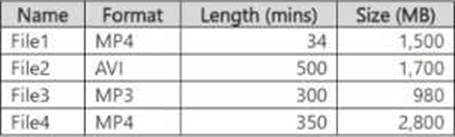
Which files can you upload and analyze by using Azure Al Video Indexer?
- A . File1 only
- B . File3 only
- C . File1 and File3 only
- D . File1, File2, and File3 only
- E . File1, File2, File3, and File4
What should you use to build a Microsoft Power Bi paginated report?
- A . Power BI Report Builder
- B . Charciculator
- C . Power BI Desktop
- D . the Power BI service
HOTSPOT
You have an Azure OpenAl resource named Al1 that hosts three deployments of the GPT 3.5 model.
Each deployment is optimized for a unique workload.
You plan to deploy three apps. Each app will access Al1 by using the REST API and will use the deployment that was optimized for the app’s intended workload.
You need to provide each app with access to Al1 and the appropriate deployment. The solution must ensure that only the apps can access Al1.
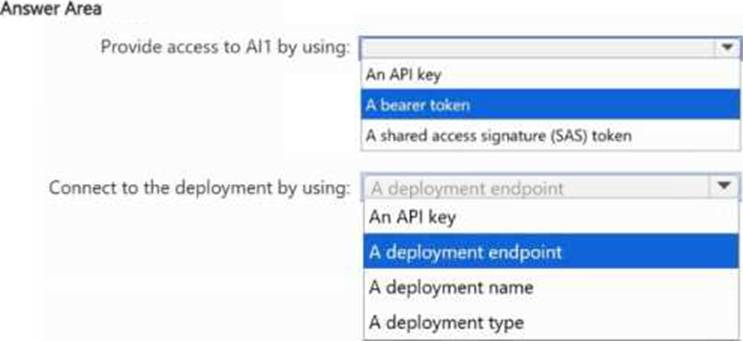
What should you use to provide access to Al1, and what should each app use to connect to its appropriate deployment? To answer, select the appropriate options in the answer area. NOTE: Each correct selection is worth one point.

Explanation:
Provide access to AI1 by using: A bearer token
Connect to the deployment by using: A deployment name
To ensure only your apps can access the Azure OpenAI resource, authenticate with Microsoft Entra ID (Azure AD) and obtain a Bearer token (ideally via managed identity). This avoids sharing long-lived API keys and lets you scope access by app identity and Azure RBAC. Microsoft’s guidance recommends token-based auth for Azure OpenAI and shows how to acquire a bearer token/managed identity token for calls
When calling the REST API, Azure OpenAI requires you to specify the deployment name to select which model deployment to use. The REST route includes {deployment-id} (deployment name) in the path, e.g., …/openai/deployments/{deployment-id}/chat/completions. This is explicitly documented as a key difference from OpenAI’s public API, which takes only a model.
Therefore:
Access method: Bearer token (via Entra ID/managed identity) Deployment selector: Deployment name in the REST path Microsoft Reference
Authenticate to Azure OpenAI with Microsoft Entra ID / Managed identity (bearer token): guidance and how-to
Azure OpenAI request header recommends token-based authentication (Bearer).
Azure OpenAI requires deployment name in API calls; REST path uses
You are building an app that will include one million scanned magazine articles. Each article will be stored as an image file. You need to configure the app to extract text from the images. The solution must minimize development effort.
What should you include in the solution?
- A . Computer Vision Image Analysis
- B . the Read API in Computer Vision
- C . Form Recognizer
- D . Azure Cognitive Service for Language
You have an Azure Cognitive Search solution and a collection of blog posts that include a category
field. You need to index the posts.
The solution must meet the following requirements:
• Include the category field in the search results.
• Ensure that users can search for words in the category field.
• Ensure that users can perform drill down filtering based on category.
Which index attributes should you configure for the category field?
- A . searchable, facetable, and retrievable
- B . retrievable, filterable, and sortable
- C . retrievable, facetable, and key
- D . searchable, sortable, and retrievable
You have an Azure Cognitive Search solution and a collection of blog posts that include a category
field. You need to index the posts.
The solution must meet the following requirements:
• Include the category field in the search results.
• Ensure that users can search for words in the category field.
• Ensure that users can perform drill down filtering based on category.
Which index attributes should you configure for the category field?
- A . searchable, facetable, and retrievable
- B . retrievable, filterable, and sortable
- C . retrievable, facetable, and key
- D . searchable, sortable, and retrievable
You need to build a chatbot that meets the following requirements:
Supports chit-chat, knowledge base, and multilingual models
Performs sentiment analysis on user messages
Selects the best language model automatically
What should you integrate into the chatbot?
- A . QnA Maker, Language Understanding, and Dispatch
- B . Translator, Speech, and Dispatch
- C . Language Understanding, Text Analytics, and QnA Maker
- D . Text Analytics, Translator, and Dispatch
C
Explanation:
Language Understanding: An AI service that allows users to interact with your applications, bots, and IoT devices by using natural language.
QnA Maker is a cloud-based Natural Language Processing (NLP) service that allows you to create a natural conversational layer over your data. It is used to find the most appropriate answer for any input from your custom knowledge base (KB) of information.
Text Analytics: Mine insights in unstructured text using natural language processing (NLP)―no machine learning expertise required. Gain a deeper understanding of customer opinions with sentiment analysis. The Language Detection feature of the Azure Text Analytics REST API evaluates text input
Incorrect Answers:
A, B, D: Dispatch uses sample utterances for each of your bot’s different tasks (LUIS, QnA Maker, or custom), and builds a model that can be used to properly route your user’s request to the right task, even across multiple bots.
Reference:
https://azure.microsoft.com/en-us/services/cognitive-services/text-analytics/
https://docs.microsoft.com/en-us/azure/cognitive-services/qnamaker/overview/overview
You are developing a method that uses the Computer Vision client library. The method will perform optical character recognition (OCR) in images.
The method has the following code.
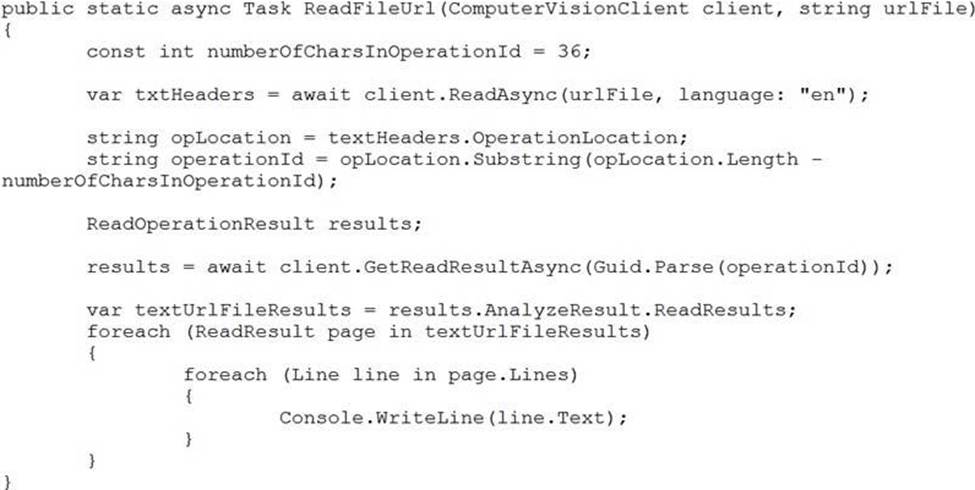
During testing, you discover that the call to the GetReadResultAsync method occurs before the read operation is complete.
You need to prevent the GetReadResultAsync method from proceeding until the read operation is complete.
Which two actions should you perform? Each correct answer presents part of the solution. NOTE: Each correct selection is worth one point. (Choose two.)
- A . Remove the Guid.Parse(operationId) parameter.
- B . Add code to verify the results.Status value.
- C . Add code to verify the status of the txtHeaders.Status value.
- D . Wrap the call to GetReadResultAsync within a loop that contains a delay.
BD
Explanation:
Example code:
do
{
results = await client.GetReadResultAsync(Guid.Parse(operationId));
}
while ((results.Status == OperationStatusCodes.Running || results.Status == OperationStatusCodes.NotStarted));
Reference: https://github.com/Azure-Samples/cognitive-services-quickstart-code/blob/master/dotnet/ComputerVision/ComputerVisionQuickstart.cs
DRAG DROP
Match the Azure services to the appropriate locations in the architecture.
To answer, drag the appropriate service from the column on the left to its location on the right. Each service may be used once, more than once, or not at all. NOTE: Each correct match is worth one point.

