
Practice Free 300-120 Exam Online Questions
An administrator receives reports of many interferers in the wireless network and wants to get the location of these interferers from the maps in Cisco Prime Infrastructure. When looking at the floor plans/maps, the administrator does not see any interferers, but can see all wireless clients located successfully.
Which two statements define the cause of the issue? (Choose two.)
- A . MSE is not added to Cisco Prime infrastructure and synchronized.
- B . Interferer tracking is not enabled on the MSE.
- C . SNMP between Cisco Prime Infrastructure and the WLC is failing.
- D . Context Aware Service tracking limit has already been reached with tracking other elements.
- E . NSMP communication is inactive with the WLC.
The security learn is concerned about the access to all network devices, including the Cisco WLC. To permit only the admin subnet to have access to management, a CPU ACL is created and applied.
However, guest users cannot get to the web portal.
What must be configured to permit only admins to have access?
- A . The guest portal must be configured on the CPU ACLs on the Cisco WLC.
- B . Access to Cisco ISE must be allowed on the pre authentication ACL.
- C . Management traffic from the guest network must be configured on the ACL rules.
- D . Traffic toward the virtual interface must be permitted.
Suppose you discover that there are some issues in high-density areas of your network caused by high channel utilization and co-channel interference between APs using the same 5GHz channel.
Which one of the following design decisions could you take to alleviate the problem?
- A . Raise the TPC maximum transmit power level limit value.
- B . Disable the channels that show co-channel interference in the global DCA channel list.
- C . Disable more 5GHz channels and try to steer clients toward the 2.4GHz band instead.
- D . Use RxSOP with a carefully chosen threshold.
Refer to the exhibit.
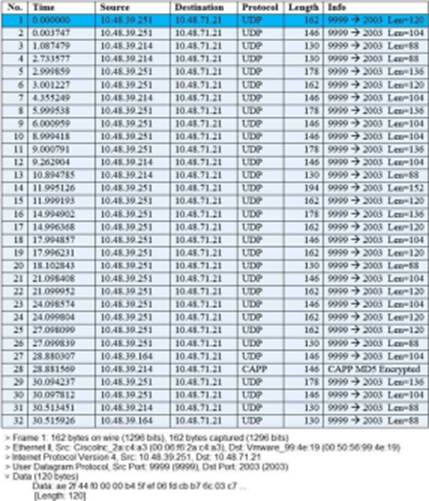
The image shows a packet capture that was taken at the CLI of the Cisco CMX server. It shows UDP traffic from the WLC coming into the server.
What does the capture prove?
- A . The Cisco CMX server receives NetFlow data from the WLC.
- B . The Cisco CMX server receives NMSP traffic from the WLC.
- C . The Cisco CMX server receives SNMP traffic from the WLC.
- D . The Cisco CMX server receives Angle-of-Arrival data from the WLC.
Which of the following statements are true about Central Web Authentication (CWA)?
- A . With CWA, there is no need for a local Web Auth certificate on the controller.
- B . CWA is included with the controller.
- C . CWA happens purely at Layer 3.
- D . CWA requires an external authentication server and portal.
- E . CWA happens at both Layer 2 and Layer 3.
Which technology/protocol is referred to in the following text?
In 2015, its Version 4.2 extended the specification to low-energy communication, thus allowing a mobile device to exchange frames with surrounding objects for purposes others than establishing a primary/subordinate relationship with a dependent object (for example, headset or printer).
- A . Bluetooth Low Energy (BLE)
- B . Wi-Fi
- C . Ultra-Wideband (UWB)
- D . Global Positioning System (GPS)
What is a “zone” in CMX Analytics?
- A . The coverage area of a single AP (that is, the AP cell)
- B . An area where location can be computed with good accuracy
- C . An area where devices are expected to be mobile (that is, a transition area)
- D . An area with a label, with no specific RF meaning
What methods are available to control QoS on a wireless client? (Choose all that apply.)
- A . Microsoft Group Policy
- B . Apple Configurator
- C . Meraki MDM
- D . Catalyst Center (formerly called DNA Center)
Which technique would you expect to provide the best accuracy when deployed properly?
- A . RSSI trilateration
- B . Cell of origin
- C . Angle of Arrival
- D . SNR trilateration
Suppose you need to design a wireless network to support location-based applications.
Which one of the following is a correct strategy?
- A . Tracked devices must be associated to the APs on the same floor.
- B . Make sure at least one AP can receive a tracked device’s signal at any location.
- C . Make sure the tracked device can be received at a minimum signal strength of C72 dBm.
- D . Make sure the tracked device can receive at least one AP’s signal above C72 dBm.