
Practice Free OGEA-103 Exam Online Questions
This deliverable is most often produced as an output of the Preliminary Phase. It can also be created because of an approved architecture change request.
What is this deliverable?
- A . Architecture Vision
- B . Requirements Impact Assessment
- C . Statement of Architecture Work
- D . Request for Architecture Work
C
Explanation:
Comprehensive and Detailed In-Depth Explanation from Expert in Enterprise Architecture, guiding in TOGAF and ArchiMate:
The Statement of Architecture Work is a key governance and control document in TOGAF.
It defines:
Scope of the architecture work
Constraints and assumptions
Deliverables and milestones
Roles, responsibilities, and acceptance criteria
Governance and approval mechanisms
Why Option C is correct:
The Statement of Architecture Work is most commonly produced in the Preliminary Phase to formally define how architecture work will be conducted once the Architecture Capability is established.
It may also be re-created or updated following an approved Architecture Change Request, ensuring controlled continuation or re-initiation of architecture activities.
Why the other options are incorrect:
Exhibit:
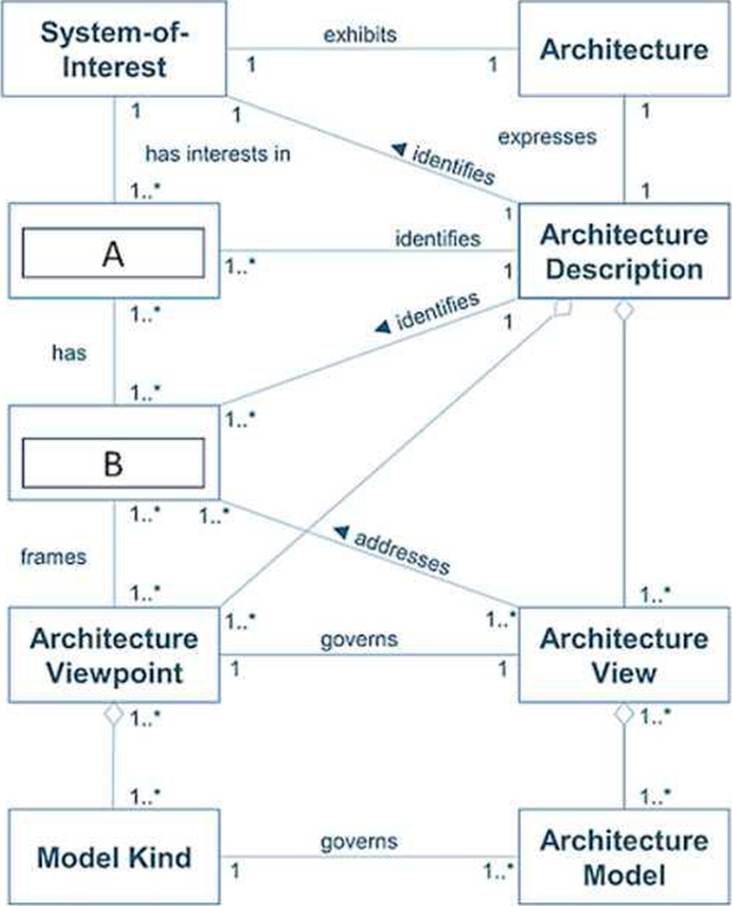
Consider the image showing basic architectural concepts.
What are items A and B?
- A . A-Candidate Architecture, B-Trade-off
- B . A-User, B-Requirement
- C . A-Stakeholder, B-Concern
- D . A-Base Architecture, B-Target Architecture
C
Explanation:
In the context of TOGAF, a stakeholder is any individual, team, or organization who has interests in, or concerns relative to, the outcome of the architecture. Concerns are those interests which pertain to any aspect of the system’s functioning, development or operation, including considerations such as performance, reliability, and security1.
Reference: • The TOGAF Standard, Version 9.2 – Definitions – The Open Group
You are working as an Enterprise Architect within the Enterprise Architecture (EA) team at a healthcare and life sciences company. The EA team is developing a secure system for researchers to share clinical trial information easily across the organization and with external partners.
Due to the highly sensitive nature of the information, each architecture domain must consider privacy and safety concerns. The healthcare division has been directed to minimize disruptions to clinical trials while introducing the new system gradually.
How would you identify the work packages for introducing the new system? Based on the TOGAF standard, which of the following is the best answer?
- A . Use a Consolidated Gaps, Solutions, and Dependencies Matrix to create work packages and sequence them into Capability Increments. Document in a Transition Architecture State Evolution Table.
- B . Identify Solution Building Blocks for development or procurement, then use a CRUD matrix to rank and select the most cost-effective work packages. Schedule the rollout sequentially across regions.
- C . Use a Consolidated Gaps, Solutions, and Dependencies Matrix to classify each solution, group them into work packages, then regroup into Capability Increments. Document in an Architecture Definition Increments Table.
- D . Draw up an Implementation Factor Catalog to indicate actions and constraints. Use a Consolidated Gaps, Solutions, and Dependencies Matrix, then group similar activities into work packages and identify dependencies.
C
Explanation:
In the TOGAF framework, understanding and addressing stakeholder concerns is crucial, particularly for complex projects with high stakes like the AI-first initiative described in the scenario. This approach aligns well with TOGAF’s ADM (Architecture Development Method) and its emphasis on effective stakeholder management and risk assessment. Here’s why this is the best course of action:
Stakeholder Analysis and Documentation: Conducting a stakeholder analysis is foundational in the early stages of any TOGAF project, particularly during the Preliminary and Architecture Vision phases. This process involves identifying the different stakeholders, understanding their positions, documenting their concerns, and considering any cultural factors that might influence their perspective on the AI-first initiative. Given the diverse concerns raised (such as job security, skill requirements, and cybersecurity), it’s essential to have a clear understanding of each stakeholder group’s priorities and fears.
Recording Concerns in the Architecture Vision Document: The Architecture Vision phase in TOGAF focuses on defining the high-level scope and objectives of the architecture project. By documenting stakeholder concerns and the corresponding views in the Architecture Vision document, the EA team ensures that these concerns are transparently acknowledged and addressed as part of the strategic direction. This step not only aligns with TOGAF best practices but also helps in building stakeholder buy-in and trust.
Architecture Requirements Specification and Risk Management: Risk management is a key aspect of TOGAF’s ADM, particularly in the Requirements Management and Implementation Governance phases. Documenting the requirements for addressing specific risks in the Architecture Requirements Specification provides a structured way to ensure that identified risks are acknowledged and managed throughout the transformation. Regular assessments and feedback loops ensure ongoing alignment and adaptability to emerging risks, which is particularly important given the dynamic nature of AI and its associated challenges.
Alignment with TOGAF ADM Phases: This approach follows the prescribed flow of TOGAF’s ADM, starting with stakeholder engagement in the Preliminary and Architecture Vision phases and progressing to risk assessment in the Requirements Management phase. By maintaining a focus on stakeholder needs and formalizing these into architecture requirements, the EA team can ensure that the architecture not only meets business objectives but also mitigates stakeholder concerns.
TOGAF Reference on Stakeholder Management Techniques: TOGAF places significant emphasis on managing stakeholder concerns through its stakeholder management techniques, which highlight the need to systematically identify, analyze, and address the concerns of all involved parties. This practice helps ensure that the architecture is viable and accepted across the organization.
By conducting a thorough stakeholder analysis and integrating the findings into both the Architecture Vision and the Architecture Requirements Specification, the EA team can proactively address stakeholder concerns, manage risks, and align the AI-first initiative with the agency’s strategic objectives. This approach is consistent with TOGAF’s guidance and provides a structured framework for addressing both business and technical challenges in the context of an AI-first transformation.
Which of the following are interests important to the stakeholders in a system?
- A . Requirements
- B . Principles
- C . Concerns
- D . Architecture views
C
Explanation:
Concerns are interests important to the stakeholders in a system. They are used to identify and classify the system’s stakeholders and to guide the selection of viewpoints for the architecture description.
Reference: The TOGAF® Standard | The Open Group Website, Section 3.2.1 Architecture Viewpoints
What does the TOGAF ADM recommend for use in developing an Architecture Vision document?
- A . Requirements Management
- B . Architecture Principles
- C . Gap Analysis
- D . Business Scenarios
D
Explanation:
Business scenarios are a technique recommended by the TOGAF ADM for use in developing an Architecture Vision document12. Business scenarios are a means of capturing the business requirements and drivers, the processes and actors involved, and the desired outcomes and measures of success34. Business scenarios help to create a common vision and understanding among the stakeholders, and to identify and validate the architecture requirements. Business scenarios also provide a basis for analyzing the impact and value of the proposed architecture.
Reference:
• The TOGAF Standard, Version 9.2 – Phase A: Architecture Vision – The Open Group
• TOGAF® Standard ― Introduction – Phase A: Architecture Vision
• The TOGAF Standard, Version 9.2 – Definitions – The Open Group
• Business Scenarios – The Open Group
• [The TOGAF Standard, Version 9.2 – Architecture Requirements Specification – The Open Group]
• [The TOGAF Standard, Version 9.2 – Architecture Vision – The Open Group]
• [The TOGAF Standard, Version 9.2 – Business Transformation Readiness Assessment – The Open Group]
Scenario:
You are working as an Enterprise Architect at a large company. The company runs a chain of home improvement stores, as well as a website for selling products. The website lets many brands work with the company.
The stores open seven days a week and use a standard method to track sales and inventory. This involves sending accurate and timely sales data to a central inventory management system that can predict demand, adjust stock levels, and automate reordering. The website is supported by regional fulfillment centers and also uses the central inventory management system. The central inventory management system is housed at the company’s central data center.
The company has agreed to merge with a major competitor. The leadership teams of both organizations have said they are committed to a smooth transition for customers. All stores will keep their own brand names. They will combine the systems of the organizations, which includes merging retail operations and systems. Duplicated systems will be replaced with one standard retail management system. Additionally, they will reduce the number of applications being used. The CIO expects that these changes will lead to substantial cost savings for the newly merged company.
An enterprise plan for both organizations has been created. The aim is to set priorities for the transition, especially in terms of information management and application development. It is crucial to make decisions that will create long-term value.
The company has a mature Enterprise Architecture (EA) practice and uses the TOGAF standard for its architecture development method. The EA program is sponsored by the Chief Information Officer (CIO).
The Request for Architecture Work to oversee the transition has been approved. The project has been scoped, and you have been assigned to work on it.
You have been asked to confirm the most relevant architecture principles for the transition.
Based on the TOGAF Standard, which of the following is the best answer?
- A . Control Technical Diversity, Interoperability, Data is an Asset, Data is Shared, Business Continuity
- B . Service Orientation, Compliance with the Law, Requirements Based Change, Responsive Change Management, Data Security
- C . Common Use Applications, Data is an Asset, Common Vocabulary and Data Definitions, Maximize Benefit to the Enterprise, Business Continuity
- D . Ease of Use, Common Use Applications, Data is an Asset, Technology Independence, Business Continuity
C
Explanation:
The correct answer is C, as it aligns with the key TOGAF principles necessary for guiding enterprise architecture in a merger scenario where retail operations and systems are being consolidated.
Analysis of the Principles in Option C:
Common Use Applications
Since the two companies are merging, it is essential to standardize applications across the enterprise.
Using common applications ensures consistency, reduces costs, and improves efficiency.
TOGAF emphasizes this principle to prevent duplicate or redundant systems, which aligns with the CIO’s goal of reducing the number of applications used.
Data is an Asset
In the scenario, a central inventory management system is a core business function.
Treating data as an asset ensures it is managed properly, shared efficiently, and used strategically across the merged organization.
This principle supports the company’s ability to predict demand, adjust stock levels, and automate reordering.
Common Vocabulary and Data Definitions
The merger requires integrating different systems and data structures.
Having a common vocabulary ensures that all stakeholders (stores, fulfillment centers, and digital platforms) use consistent terminology and data definitions.
This minimizes confusion and ensures interoperability across business functions.
Maximize Benefit to the Enterprise
Every architectural decision should focus on the overall benefit to the business.
By consolidating IT systems and reducing redundancies, the company achieves cost savings, which directly supports this principle.
Business Continuity
The stores operate seven days a week, so system changes must ensure uninterrupted service.
Business continuity ensures that customers are not affected during the transition and that critical retail operations (sales, inventory tracking, and fulfillment) remain functional.
Why Other Options Are Incorrect?
Option A: Control Technical Diversity, Interoperability, Data is an Asset, Data is Shared, Business Continuity
Control Technical Diversity is not the primary concern here. The focus is on system consolidation, not
necessarily on limiting technology diversity.
Interoperability is important but not as critical as defining a common system and data structure.
Option B: Service Orientation, Compliance with the Law, Requirements-Based Change, Responsive Change Management, Data Security
While service orientation and compliance are valuable, they are not the most relevant to this specific business transition.
Change management and data security are important but do not address the primary enterprise-wide architectural concerns of system consolidation.
Option D: Ease of Use, Common Use Applications, Data is an Asset, Technology Independence, Business Continuity
Ease of Use is beneficial but is not a core architecture principle in this case.
Technology Independence is useful but does not align directly with the scenario’s priority, which is consolidating applications and data structures.
Reference: TOGAF Standard, ADM Techniques, Architecture Principles (Section 2.6) TOGAF Standard, Part III: ADM Guidelines and Techniques TOGAF Enterprise Architecture Principles C The Open Group
Which of the following does the TOGAF standard describe as a package of functionality defined to meet business needs across an organization?
- A . An application
- B . A deliverable
- C . A solution architecture
- D . A building block
Consider the following ADM phases objectives.
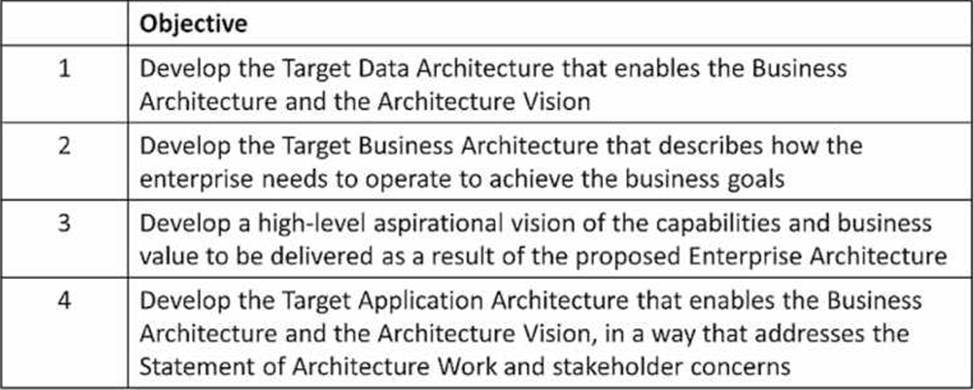
Which phase does each objective match?
- A . 1C-2B-3A-4C
- B . 1A-2B-3C-4D
- C . 1B-2D-3A-4C
- D . 1C-2D-3B-4A
A
Explanation:
The objectives listed in the question correspond to the objectives of different phases of the TOGAF ADM (Architecture Development Method), which is a method for developing and managing an enterprise architecture1.
The ADM consists of nine phases, each with a specific purpose and output.
The phases are1:
Preliminary Phase: To prepare and initiate the architecture development cycle, including defining the architecture framework, principles, and governance.
Phase A: Architecture Vision: To define the scope, vision, and stakeholders of the architecture initiative, and to obtain approval to proceed.
Phase B: Business Architecture: To describe the baseline and target business architecture, and to identify the gaps between them.
Phase C: Information Systems Architectures: To describe the baseline and target data and application architectures, and to identify the gaps between them.
Phase D: Technology Architecture: To describe the baseline and target technology architecture, and to identify the gaps between them.
Phase E: Opportunities and Solutions: To identify and evaluate the opportunities and solutions for implementing the target architecture, and to define the work packages and transition architectures.
Phase F: Migration Planning: To finalize the implementation and migration plan, and to ensure alignment with the enterprise portfolio and project management.
Phase G: Implementation Governance: To provide architecture oversight and guidance for the implementation projects, and to manage any architecture change requests.
Phase H: Architecture Change Management: To monitor the changes in the business and technology environment, and to assess the impact and performance of the architecture.
Based on the above definitions, we can match each objective with the corresponding phase as follows:
Objective 1: Develop the Target Data Architecture that enables the Business Architecture and the Architecture Vision. This objective is achieved in Phase C: Information Systems Architectures, where the data architecture is defined as a subset of the information systems architecture2.
Objective 2: Develop the Target Business Architecture that describes how the enterprise needs to operate to achieve the business goals. This objective is achieved in Phase B: Business Architecture, where the business architecture is defined as a subset of the enterprise architecture3.
Objective 3: Develop a high-level aspirational vision of the capabilities and business value to be delivered as a result of the proposed Enterprise Architecture. This objective is achieved in Phase A: Architecture Vision, where the architecture vision is defined as a high-level description of the target architecture and its benefits4.
Objective 4: Develop the Target Application Architecture that enables the Business Architecture and the Architecture Vision, in a way that addresses the Statement of Architecture Work and stakeholder concerns. This objective is achieved in Phase C: Information Systems Architectures, where the application architecture is defined as a subset of the information systems architecture2.
1: The TOGAF Standard, Version 9.2, Chapter 5: Architecture Development Method (ADM)
2: The TOGAF Standard, Version 9.2, Chapter 9: Phase C: Information Systems Architectures
3: The TOGAF Standard, Version 9.2, Chapter 8: Phase B: Business Architecture
4: The TOGAF Standard, Version 9.2, Chapter 7: Phase A: Architecture Vision