Practice Free OGEA-103 Exam Online Questions
Please read this scenario prior to answering the question
You are employed as an Enterprise Architect within a large law firm. The firm operates in many countries and has a complicated structure. Every office must follow the local regulations in their country.
The firm has an established Enterprise Architecture (EA) department which has been operating for several years. It has architecture governance and development processes based on the TOGAF standard. In addition to the EA program, the firm has several management frameworks in use, including business planning, project/portfolio management, and operations management. The Architecture Board includes representatives from all parts of the firm.
The Chief Information Officer (CIO) is the sponsor of the Enterprise Architecture program. The CIO has actively encouraged architecting with agility within the EA department as her preferred approach for projects.
The CIO has given approval for a Request for Architecture Work to explore the adoption of an Al-based system for managing legal cases and financial processes.
Senior management has become more and more worried about how well the business is running, especially with the advancements in Artificial Intelligence (Al). Many of the firm’s competitors have started using Al to assist with legal strategies, streamline processes, and boost productivity. One of the most important benefits Al has for the business is its ability to increase accuracy and minimize mistakes.
Some of the top managers are worried about a change in the way of working, and if it will achieve the goals.
Their staff also fear that management will use the system to measure their performance. The CIO wants to know how to address these concerns and reduce risks. The new system would provide guidance to legal professionals and analysts on which tasks to focus on. The main goals are to improve productivity and make better use of staff. In addition, the CIO hopes these changes will lead to higher customer satisfaction.
Refer to the scenario
The Chief Information Officer (CIO) has asked you how to address the concerns and lower risks when introducing artificial intelligence (Al) in the firm.
Based on the TOGAF standard which of the following is the best answer?
- A . The stakeholders should be identified, and their concerns documented in the Architecture Vision. A Communications Plan should be created to address the stakeholders. This plan should include a report that summarizes the key features of the architecture with respect to each location and the stakeholders’ requirements. You will check with key stakeholders that their concerns are being addressed. Risk mitigation should be addressed as part of the architecture being developed.
- B . A set of business models should be developed with focus on the essential business problem and the vision of the change being proposed. These models will be used to build consensus with the top managers on the approach for deployment of the Al-based solution. A meeting should be held with the key stakeholders to explain how to use and understand the models. Risk will be managed as part of the Security Architecture development.
- C . An analysis of the stakeholders should be carried out. This will allow the architects to define groups of stakeholders who have common concerns and include development of a Stakeholder Map. The concerns and relevant views should then be defined for each group and recorded in the Architecture Vision document. To reduce risk, you include a requirement that there be progressive development of the target architecture to get regular feedback.
- D . Models should be created for each of the high-level Business, Application and Technology architectures included in the Architecture Vision. The models can be used to help the top management understand the new business direction, and make sure that the system will be compliant with the local regulations for each operating entity. A formal review should be held with the stakeholders to confirm that their concerns have been properly addressed by the models.
C
Explanation:
The question focuses on addressing stakeholder concerns and mitigating risks when introducing AI-based systems in a law firm, while also reflecting the CIO’s preference for architecting with agility.
Option C is the best fit according to TOGAF.
✅ Why Option C Is Correct
Which of the following statements about architecture partitioning is correct?
- A . Partitions are used to simplify the management of the Enterprise Architecture.
- B . Partitions are equivalent to architecture levels.
- C . Partitions reflect the organization’s structure.
- D . Partitions are defined and assigned to agile Enterprise Architecture teams.
A
Explanation:
Based on the web search results, architecture partitioning is a technique that divides the Enterprise Architecture into smaller and manageable segments or groups, based on various classification criteria, such as subject matter, time, maturity, volatility, etc.12 Architecture partitioning is used to simplify the development and management of the Enterprise Architecture, by reducing complexity, improving governance, enhancing reusability, and increasing alignment and agility12. Therefore, the statement that partitions are used to simplify the management of the Enterprise Architecture is correct.
The other statements are incorrect because:
• Partitions are not equivalent to architecture levels. Architecture levels are different layers of abstraction that describe the Enterprise Architecture from different perspectives, such as strategic, segment, and capability3. Partitions are subsets of architectures that are defined within or across the levels, based on specific criteria1.
• Partitions do not necessarily reflect the organization’s structure. The organization’s structure is one possible criterion for partitioning the architecture, but it is not the only one. Other criteria, such as business function, product, service, geography, etc., can also be used to partition the architecture12.
• Partitions are not defined and assigned to agile Enterprise Architecture teams. Agile Enterprise Architecture is an approach that applies agile principles and practices to the architecture work, such as iterative development, frequent feedback, adaptive planning, and continuous delivery4. Partitions are not a specific feature of agile Enterprise Architecture, but a general technique that can be applied to any architecture method or framework, including TOGAF12.
Reference: 1: The TOGAF Standard, Version 9.2 – Architecture Partitioning 2: TOGAF® Standard ―
Introduction – Architecture Partitioning 3: [The TOGAF Standard, Version 9.2 – Applying the ADM Across the Architecture Landscape] 4: TOGAF® Standard ― Introduction – Definitions – The Open Group
Scenario:
You are working as an Enterprise Architect at a large company. The company runs a chain of home improvement stores, as well as a website for selling products. The website lets many brands work with the company.
The stores open seven days a week and use a standard method to track sales and inventory. This involves sending accurate and timely sales data to a central inventory management system that can predict demand, adjust stock levels, and automate reordering. The website is supported by regional fulfillment centers and also uses the central inventory management system. The central inventory management system is housed at the company’s central data center.
The company has agreed to merge with a major competitor. The leadership teams of both organizations have said they are committed to a smooth transition for customers. All stores will keep their own brand names. They will combine the systems of the organizations, which includes merging retail operations and systems. Duplicated systems will be replaced with one standard retail management system. Additionally, they will reduce the number of applications being used. The CIO expects that these changes will lead to substantial cost savings for the newly merged company.
An enterprise plan for both organizations has been created. The aim is to set priorities for the transition, especially in terms of information management and application development. It is crucial to make decisions that will create long-term value.
The company has a mature Enterprise Architecture (EA) practice and uses the TOGAF standard for its architecture development method. The EA program is sponsored by the Chief Information Officer (CIO).
The Request for Architecture Work to oversee the transition has been approved. The project has been scoped, and you have been assigned to work on it.
You have been asked to confirm the most relevant architecture principles for the transition.
Based on the TOGAF Standard, which of the following is the best answer?
- A . Control Technical Diversity, Interoperability, Data is an Asset, Data is Shared, Business Continuity
- B . Service Orientation, Compliance with the Law, Requirements Based Change, Responsive Change Management, Data Security
- C . Common Use Applications, Data is an Asset, Common Vocabulary and Data Definitions, Maximize Benefit to the Enterprise, Business Continuity
- D . Ease of Use, Common Use Applications, Data is an Asset, Technology Independence, Business Continuity
C
Explanation:
The correct answer is C, as it aligns with the key TOGAF principles necessary for guiding enterprise architecture in a merger scenario where retail operations and systems are being consolidated.
Analysis of the Principles in Option C:
Common Use Applications
Since the two companies are merging, it is essential to standardize applications across the enterprise.
Using common applications ensures consistency, reduces costs, and improves efficiency.
TOGAF emphasizes this principle to prevent duplicate or redundant systems, which aligns with the CIO’s goal of reducing the number of applications used.
Data is an Asset
In the scenario, a central inventory management system is a core business function.
Treating data as an asset ensures it is managed properly, shared efficiently, and used strategically across the merged organization.
This principle supports the company’s ability to predict demand, adjust stock levels, and automate reordering.
Common Vocabulary and Data Definitions
The merger requires integrating different systems and data structures.
Having a common vocabulary ensures that all stakeholders (stores, fulfillment centers, and digital platforms) use consistent terminology and data definitions.
This minimizes confusion and ensures interoperability across business functions.
Maximize Benefit to the Enterprise
Every architectural decision should focus on the overall benefit to the business.
By consolidating IT systems and reducing redundancies, the company achieves cost savings, which directly supports this principle.
Business Continuity
The stores operate seven days a week, so system changes must ensure uninterrupted service.
Business continuity ensures that customers are not affected during the transition and that critical retail operations (sales, inventory tracking, and fulfillment) remain functional.
Why Other Options Are Incorrect?
Option A: Control Technical Diversity, Interoperability, Data is an Asset, Data is Shared, Business Continuity
Control Technical Diversity is not the primary concern here. The focus is on system consolidation, not necessarily on limiting technology diversity.
Interoperability is important but not as critical as defining a common system and data structure.
Option B: Service Orientation, Compliance with the Law, Requirements-Based Change, Responsive Change Management, Data Security
While service orientation and compliance are valuable, they are not the most relevant to this specific business transition.
Change management and data security are important but do not address the primary enterprise-wide architectural concerns of system consolidation.
Option D: Ease of Use, Common Use Applications, Data is an Asset, Technology Independence, Business Continuity
Ease of Use is beneficial but is not a core architecture principle in this case.
Technology Independence is useful but does not align directly with the scenario’s priority, which is consolidating applications and data structures.
Reference: TOGAF Standard, ADM Techniques, Architecture Principles (Section 2.6) TOGAF Standard, Part III: ADM Guidelines and Techniques TOGAF Enterprise Architecture Principles C The Open Group
Consider the description.
The typical contents of the assessment include: an overview of project progress and status and project architecture/design.
Which form of assessment is described?
- A . Organizational
- B . Capability
- C . Risk
- D . Compliance
D
Explanation:
Within the TOGAF framework, assessments are used to ensure that architecture work is conformant with governance parameters. A compliance assessment (sometimes called architecture compliance or compliance review) is the evaluation of a project’s architectural artifacts―its design, architecture decisions, progress status―against the established architecture standards, principles, and constraints. The content of a compliance assessment typically includes reviewing the project status, the architectural design alignment, and identifying noncompliance issues or deviations. Because it focuses on how well the project matches the architecture, rather than on capabilities, organizational structure, or risk per se, the described contents correspond to a compliance assessment. The compliance assessment helps governance bodies enforce architectural consistency and correct deviations during implementation.
Consider the description.
The typical contents of the assessment include: an overview of project progress and status and project architecture/design.
Which form of assessment is described?
- A . Organizational
- B . Capability
- C . Risk
- D . Compliance
D
Explanation:
Within the TOGAF framework, assessments are used to ensure that architecture work is conformant with governance parameters. A compliance assessment (sometimes called architecture compliance or compliance review) is the evaluation of a project’s architectural artifacts―its design, architecture decisions, progress status―against the established architecture standards, principles, and constraints. The content of a compliance assessment typically includes reviewing the project status, the architectural design alignment, and identifying noncompliance issues or deviations. Because it focuses on how well the project matches the architecture, rather than on capabilities, organizational structure, or risk per se, the described contents correspond to a compliance assessment. The compliance assessment helps governance bodies enforce architectural consistency and correct deviations during implementation.
Which ADM phase focuses on defining the problem to be solved, identifying the stakeholders, their concerns, and requirements?
- A . Phase
- B . Preliminary Phase
- C . Phase
- D . Phase A
D
Explanation:
Phase A: Architecture Vision is the first phase of the Architecture Development Method (ADM) cycle, which is the core of the TOGAF standard. The main purpose of this phase is to define the scope and approach of the architecture development, and to create the Architecture Vision, which is a high-level description of the desired outcomes and benefits of the proposed architecture. To achieve this purpose, this phase focuses on defining the problem to be solved, identifying the stakeholders, their concerns, and requirements, and establishing the business goals and drivers that motivate the architecture work. This phase also involves obtaining the approval and commitment of the sponsors and other key stakeholders, and initiating the Architecture Governance process.
The TOGAF Standard, Version 9.2, Part II: Architecture Development Method (ADM), Chapter 5:
Introduction to the ADM: The TOGAF Standard, Version 9.2, Part II: Architecture Development
Method (ADM), Chapter 18: Phase A: Architecture Vision: The TOGAF Standard, Version 9.2, Part II:
Architecture Development Method (ADM), Chapter 18.3: Inputs: The TOGAF Standard, Version 9.2,
Part II: Architecture Development Method (ADM), Chapter 18.4: Steps
You are working as an Enterprise Architect within an Enterprise Architecture (EA) team at a multinational energy company. The company is committed to becoming a net-zero emissions energy business by 2050. To achieve this, the company is focusing on shifting to renewable energy production and adopting eco-friendly practices.
The EA team, which reports to the Chief Technical Officer (CTO), has been tasked with overseeing the transformation to make the company more effective through acquisitions. The company plans to fully integrate these acquisitions, including merging operations and systems.
To address the integration challenges, the EA team leader wants to know how to manage risks and ensure that the company succeeds with the proposed changes. Based on the TOGAF Standard, which of the following is the best answer?
- A . The EA team should create a Business Scenario to fully describe the business problem that is being addressed by the transformation. Once requirements are identified, they should be evaluated in terms of risks. Any residual risks should be escalated to the Architecture Board.
- B . The EA team should develop Business Architecture views that demonstrate how stakeholder concerns are addressed and assess each factor for readiness, urgency, and degree of difficulty.
- C . The EA team should evaluate the company’s readiness for change by identifying factors that will impact the transformation. These factors will be used to determine initial risks associated with the initiative.
- D . The EA team should document the risks associated with the transformation in an Implementation Factor Catalog to inform decisions during implementation and deployment.
A
Explanation:
In TOGAF, creating a Business Scenario is a foundational step in defining and understanding the business problem, especially for complex transformations involving multiple stakeholders andsystems, such as in this scenario. This method aligns with Phase A (Architecture Vision) of the TOGAF Architecture Development Method (ADM). Here’s why this approach is the most effective:
Understanding Business Requirements: A Business Scenario provides a structured way to capture and analyze the business requirements, stakeholder concerns, and the contextual elements related to the problem. In this scenario, the company faces challenges in integrating newly acquired companies with existing operations, which includes complex stakeholder concerns across different functional areas. Developing a Business Scenario allows the EA team to break down these complexities into identifiable and manageable parts.
Risk Evaluation and Management: By using the Business Scenario approach, the EA team can not only define the requirements but also assess associated risks systematically. TOGAF emphasizes the importance of risk management through identifying potential risks, evaluating their impact, and defining strategies for handling these risks. The process includes assessing how risks can be avoided, transferred, or reduced―a necessary step in large-scale transformations to ensure that risks are proactively managed.
Residual Risks and Governance: Any risks that cannot be fully resolved should be identified as residual risks and escalated to the Architecture Board, which is aligned with TOGAF’s governance approach. The Architecture Board’s role in TOGAF is to provide oversight and make critical decisions on risks that exceed the control of the EA team. This ensures that unresolved risks are managed at the appropriate level of the organization.
Alignment with TOGAF ADM Phases: The Business Scenario approach directly aligns with the Preliminary and Architecture Vision phases of the TOGAF ADM, which focuses on establishing a baseline understanding of the business context and the strategic transformation required. The detailed understanding of requirements, stakeholder concerns, and risks identified here will guide the subsequent phases of the ADM, including Business Architecture and Information Systems Architecture.
TOGAF Reference (Section 2.6, ADM Techniques): TOGAF provides guidelines on the creation of Business Scenarios as part of ADM Techniques, highlighting the importance of defining a business problem comprehensively to ensure successful transformation. This method includes identification of stakeholders, business requirements, and associated risks, which aligns well with the company’s need for strategic and systematic integration of new business units.
By utilizing a Business Scenario, the EA team ensures that all aspects of the transformation are well understood, risks are identified early, and residual risks are managed effectively, aligning with the company’s strategic objectives and the TOGAF framework’s guidance on risk management and stakeholder alignment.
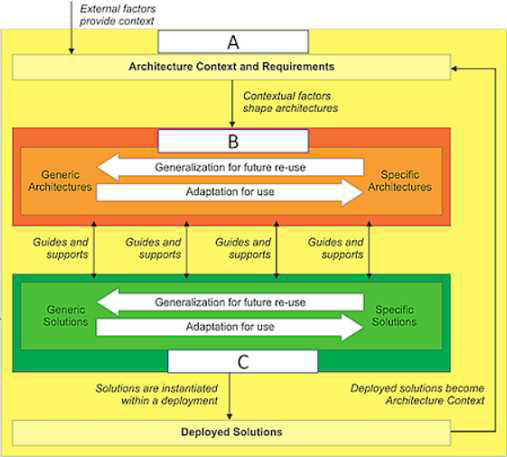
Consider the illustration.

What are the items labelled A, B and C?
- A . A-Enterprise Continuum, B-Architecture Continuum, C-Solutions Continuum
- B . A-Enterprise Architecture, B-Architecture Building Blocks, C-Solutions Building Blocks
- C . A-Architecture Vision, B-Business Architecture, C-Information Systems Architecture
- D . A-Enterprise Strategic Architecture, B-Segment Architecture, C-Solutions Architecture
A
Explanation:
The illustration shows the relationship between the Enterprise Continuum, the Architecture Continuum, and the Solutions Continuum, which are key concepts in the TOGAF framework. The Enterprise Continuum is a view of the Architecture Repository that shows how generic foundation architectures can be leveraged and specialized to support the requirements of an individual organization. The Architecture Continuum specifies a structured classification for architectural artifacts, such as models, patterns, and descriptions, that can be reused and adapted across different domains and levels of abstraction. The Solutions Continuum identifies implemented solutions that support various stages of business and IT capability evolution, such as common systems, industry solutions, and organization-specific solutions. The illustration also shows how the architecture context and requirements are influenced by external factors, such as business drivers, stakeholders, and standards, and how they shape the generic and specific architectures and solutions. The illustration also shows how the deployed solutions become part of the architecture context for future iterations of the architecture development cycle.
Reference:
• TOGAF Standard, 10th Edition, Part II: Architecture Development Method, Chapter 6: Architecture Repository, Section 6.2 Enterprise Continuum.
• TOGAF Standard, 10th Edition, Part IV: Architecture Content Framework, Chapter 35: Enterprise Continuum and Tools, Section 35.1 Introduction.
Which of the following describes a purpose of Architecture Principles?
- A . To describe likely impacts resulting from successful deployment of the target architecture.
- B . To establish a common understanding of how to control the business in pursuit of strategic objectives
- C . To provide a better understanding about the enterprise’s culture and values
- D . To form a contract between sponsoring organization and the enterprise architects
B
Explanation:
Architecture Principles are general rules and guidelines that inform and support the way in which an organization sets about fulfilling its mission. They reflect a level of consensus among the various elements of the enterprise, and form the basis for making future IT decisions. One of the purposes of Architecture Principles is to establish a common understanding of how to control the business in pursuit of strategic objectives, by providing a framework for evaluating and agreeing on the changes that affect the enterprise’s architecture3
Reference: 3: The TOGAF Standard, Version 9.2, Part III: ADM Guidelines and Techniques, Chapter 23: Architecture Principles: The TOGAF Standard, Version 9.2, Part IV: Architecture Content Framework, Chapter 31: Architecture Principles
Full Scenario
You are employed as an Enterprise Architect in an Enterprise Architecture (EA) team at a food production and distribution company. The main goal of the company is to increase profit while meeting the needs of consumers for its products. Its customers want food that is produced sustainably, safely, and transparently, while reducing environmental impact.
The company has an Enterprise Architecture practice based on the TOGAF standard, using it as the method and guiding framework. The Chief Information Officer (CIO) is the sponsor of EA practice.
The business is a highly mechanized agricultural operation where business capabilities, including planting, harvesting, processing, packaging, and distribution, rely heavily on technology and machinery. The use of EA has enabled the decision makers to have valuable insights into the different aspects of the business.
The warmer climate has led to less successful farming, and the company is growing fewer crops than before. Also, prices for energy, feed, fuel, and fertilizer have gone up. This has caused a big drop in earnings. Due to the rising costs and lower profits, the company has been unable to do as much to help the environment. It especially has struggled to reduce its carbon emissions.
In response to the situation, the Chief Executive Officer (CEO) has decided that big changes are needed, that will lead both to improved crop production and profitability. They must look to all aspects of the business. This includes looking at the mix of crops to mitigate for the change in climate. The company will also cease to process its own crops and will sell off its processing facilities. Thus, the target market will change, and the end-products will be different and more varied. A formal request for architecture change has been approved. At this stage there is no fixed scope, shared
vision, or objectives.
What is the best approach for architecture development to realize the CEO’s change in direction for the company?
Based on the TOGAF standard which of the following is the best answer?
- A . The team should use the Architecture Definition Document and work on architecture development starting simultaneously phases B, C and
- B . This is because the CEO has identified the need to change. This will ensure that the change can be defined in a structured manner and address the requirements needed to realize the change.
- C . The team should define the baseline Technology Architecture first in order to assess the current infrastructure capacity and capability for the company. Next, the team should concentrate on transition planning and incremental architecture deployment. This will identify requirements to ensure that the projects are sequenced in an optimal fashion to realize the change.
- D . The team should produce a new Request for Architecture Work leading to development of a new Architecture Vision. The trade-off method should be applied to identify and select an architecture satisfying the stakeholders. For an efficient change the EA team should be aligned with the organization’s planning, budgeting, operational, and change processes.
- E . The team should work on architecture definition including development of business models, with emphasis on defining the change parameters to support this new business strategy that the CEO has identified. Once understood, the team will be in the best position to identify the requirements, drivers, issues, and constraints for the change.
C
Explanation:
In TOGAF, when an enterprise undergoes a significant strategic shift―particularly one initiated by executive leadership without a clearly defined scope, vision, or objectives―the correct starting point is always Phase A: Architecture Vision, and only after a formal Request for Architecture Work is created or updated. The scenario explicitly states that the CEO has approved a request for architecture change but has not defined scope, constraints, or direction. This aligns precisely with TOGAF guidance that Phase A must establish the high-level vision, stakeholder concerns, business drivers, and initial requirements before moving into the detailed architecture development phases (B, C, D).
Answer choice C reflects this: it requires producing a new Request for Architecture Work and developing a new Architecture Vision, which is the foundational step for any enterprise-wide transformational effort. TOGAF also requires application of the trade-off method to balance
stakeholder needs in the Vision phase before detailed architectures are designed.
Choices A and D incorrectly assume architecture definition can begin without a clear approved vision.
Choice B focuses solely on Technology Architecture, which contradicts TOGAF’s requirement that
Business Architecture must lead the effort during major transformation.
Thus, the only answer compliant with TOGAF ADM is C.