
Practice Free OGEA-103 Exam Online Questions
Complete the sentence When considering agile development Architecture to Support Project will identify what products the Enterprise needs the boundary of the products and what constraints a product owner has. this defines the Enterprise’s___________.
- A . operations
- B . backlog
- C . workflow management
- D . lifecycle economics
B
Explanation:
When considering agile development, Architecture to Support Project will identify what products the enterprise needs, the boundary of the products, and what constraints a product owner has. This defines the enterprise’s backlog. A backlog is a list of features or tasks that need to be done to deliver a product or service. It is prioritized by the product owner based on the value and urgency of each item.
Reference: The TOGAF® Standard | The Open Group Website, Section 3.3.5 Architecture to Support Project.
The_________________ensures that a project transitioning into implementation also smoothly transitions into appropriate Architecture Governance.
- A . Migration Plan
- B . Transition Plan
- C . Implementation Governance Model
- D . Implementation Strategy
C
Explanation:
The Implementation Governance Model is a framework that defines the roles, responsibilities, processes, and standards for governing the implementation of the target architecture. It ensures that a project transitioning into implementation also smoothly transitions into appropriate Architecture Governance, which is the practice of ensuring compliance with the enterprise architecture and its principles, standards, and goals. The Implementation Governance Model is part of the Implementation and Migration Plan, which is the output of Phase F: Migration Planning of the Architecture Development Method (ADM)12
Reference: 1: The TOGAF Standard, Version 9.2, Part II: Architecture Development Method (ADM), Chapter 21: Phase F: Migration Planning 2: The TOGAF Standard, Version 9.2, Part VI: Architecture Capability Framework, Chapter 50: Architecture Governance
Consider the diagram showing a classification model for Architecture Landscapes.
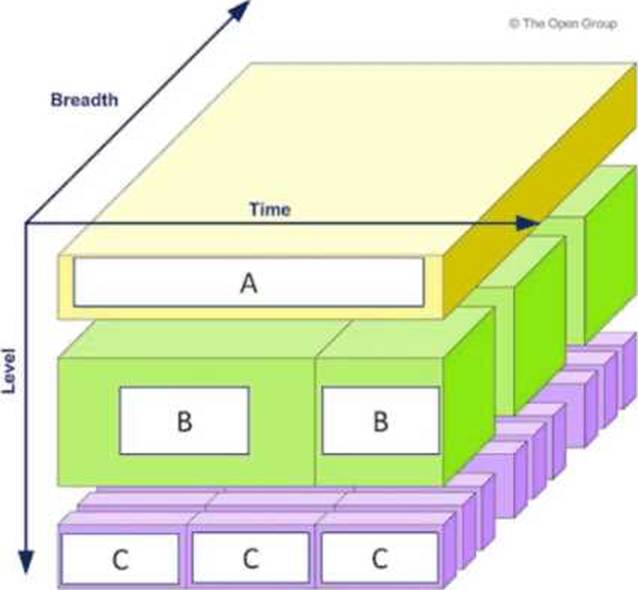
What are the items labelled A, B and C?
- A . A-Strategy Architecture. B-Tactic Architecture, C-Operational Architecture
- B . A-Architecture Vision. B-Business Architecture. C-Architecture Development
- C . A-Corporate Capability. B-Portfolio Capability. C-Project Capability
- D . A-Enterprise Strategic Architecture. B-Segment Architecture. C-Capability Architecture
Complete the sentence The Enterprise Continuum provides methods for classifying architecture artifacts as they evolve from________________________.
- A . Solutions Architectures to Solution Building Blocks
- B . generic architectures to reusable Solution Building Blocks
- C . Foundation Architectures to re-usable architecture assets
- D . generic architectures to Organization-Specific Architectures
D
Explanation:
The Enterprise Continuum provides methods for classifying architecture artifacts as they evolve from generic architectures to Organization-Specific Architectures. Generic architectures are architectures that have been developed for use across a wide range of enterprises with similar characteristics. They provide common models, functions, and services that can be reused and adapted for specific purposes. Organization-Specific Architectures are architectures that have been tailored to meet the needs and requirements of a particular enterprise or a major organizational unit within an enterprise. They reflect the unique vision, goals, culture, structure, processes, systems, and technologies of that enterprise or unit.
Reference: The TOGAF® Standard | The Open Group Website, Section 2.3 Enterprise Continuum.
Full Scenario
You are employed as an Enterprise Architect in an Enterprise Architecture (EA) team at a food production and distribution company. The main goal of the company is to increase profit while meeting the needs of consumers for its products. Its customers want food that is produced sustainably, safely, and transparently, while reducing environmental impact.
The company has an Enterprise Architecture practice based on the TOGAF standard, using it as the method and guiding framework. The Chief Information Officer (CIO) is the sponsor of EA practice.
The business is a highly mechanized agricultural operation where business capabilities, including planting, harvesting, processing, packaging, and distribution, rely heavily on technology and machinery. The use of EA has enabled the decision makers to have valuable insights into the different aspects of the business.
The warmer climate has led to less successful farming, and the company is growing fewer crops than before. Also, prices for energy, feed, fuel, and fertilizer have gone up. This has caused a big drop in earnings. Due to the rising costs and lower profits, the company has been unable to do as much to help the environment. It especially has struggled to reduce its carbon emissions.
In response to the situation, the Chief Executive Officer (CEO) has decided that big changes are needed, that will lead both to improved crop production and profitability. They must look to all aspects of the business. This includes looking at the mix of crops to mitigate for the change in climate. The company will also cease to process its own crops and will sell off its processing facilities. Thus, the target market will change, and the end-products will be different and more varied. A formal request for architecture change has been approved. At this stage there is no fixed scope, shared vision, or objectives.
What is the best approach for architecture development to realize the CEO’s change in direction for the company?
Based on the TOGAF standard which of the following is the best answer?
- A . The team should use the Architecture Definition Document and work on architecture development starting simultaneously phases B, C and D. This is because the CEO has identified the need to change. This will ensure that the change can be defined in a structured manner and address the requirements needed to realize the change.
- B . The team should define the baseline Technology Architecture first in order to assess the current infrastructure capacity and capability for the company. Next, the team should concentrate on transition planning and incremental architecture deployment. This will identify requirements to ensure that the projects are sequenced in an optimal fashion to realize the change.
- C . The team should produce a new Request for Architecture Work leading to development of a new Architecture Vision. The trade-off method should be applied to identify and select an architecture satisfying the stakeholders. For an efficient change the EA team should be aligned with the organization’s planning, budgeting, operational, and change processes.
- D . The team should work on architecture definition including development of business models, with emphasis on defining the change parameters to support this new business strategy that the CEO has identified. Once understood, the team will be in the best position to identify the requirements, drivers, issues, and constraints for the change.
C
Explanation:
In TOGAF, when an enterprise undergoes a significant strategic shift―particularly one initiated by executive leadership without a clearly defined scope, vision, or objectives―the correct starting point is always Phase A: Architecture Vision, and only after a formal Request for Architecture Work is created or updated. The scenario explicitly states that the CEO has approved a request for architecture change but has not defined scope, constraints, or direction. This aligns precisely with TOGAF guidance that Phase A must establish the high-level vision, stakeholder concerns, business drivers, and initial requirements before moving into the detailed architecture development phases (B, C, D).
Answer choice C reflects this: it requires producing a new Request for Architecture Work and developing a new Architecture Vision, which is the foundational step for any enterprise-wide transformational effort. TOGAF also requires application of the trade-off method to balance stakeholder needs in the Vision phase before detailed architectures are designed.
Choices A and D incorrectly assume architecture definition can begin without a clear approved vision.
Choice B focuses solely on Technology Architecture, which contradicts TOGAF’s requirement that Business Architecture must lead the effort during major transformation.
Thus, the only answer compliant with TOGAF ADM is C.
Consider the following statement:
According to the TOGAF Standard a governed approach of a particular deliverable will ensure a system of continuous monitoring to check integrity changes decision-making and audit of all architecture-related activities
Which deliverable is being referred to?
- A . An Architecture Contract
- B . The Architecture Definition Document
- C . The Architecture Vision
- D . The Statement of Architecture Work
A
Explanation:
An Architecture Contract is a deliverable that specifies the responsibilities and obligations of the parties involved in the implementation and governance of an architecture. It ensures a system of continuous monitoring to check integrity changes decision-making and audit of all architecture-related activities.
Reference: The TOGAF® Standard | The Open Group Website, Section 3.3.4 Architecture Contracts.
Consider the following statement:
According to the TOGAF Standard a governed approach of a particular deliverable will ensure a system of continuous monitoring to check integrity changes decision-making and audit of all architecture-related activities
Which deliverable is being referred to?
- A . An Architecture Contract
- B . The Architecture Definition Document
- C . The Architecture Vision
- D . The Statement of Architecture Work
A
Explanation:
An Architecture Contract is a deliverable that specifies the responsibilities and obligations of the parties involved in the implementation and governance of an architecture. It ensures a system of continuous monitoring to check integrity changes decision-making and audit of all architecture-related activities.
Reference: The TOGAF® Standard | The Open Group Website, Section 3.3.4 Architecture Contracts.
Complete the sentence A business scenario describes______________
- A . shortfalls between the Baseline and Target Architectures
- B . business domain gaps such as cross-training requirements
- C . business and technology environment in which those problems occur
- D . general rules and guidelines tor the architecture being developed
C
Explanation:
A business scenario describes business and technology environment in which those problems occur. It provides a realistic context for identifying and addressing business problems and opportunities, as well as their impact on the enterprise’s architecture.
Reference: The TOGAF® Standard | The Open Group Website, Section 3.3.1 Business Scenarios.
Which of the following describes the concept of an Enterprise Architecture Capability?
- A . The ability to distinguish between different types of architectural assets that exist at different levels of abstraction in the enterprise.
- B . The ability to follow general rules and guidelines that relate to Enterprise Architecture work and that enable decision-making.
- C . The ability to develop, use, and sustain the architecture of a particular enterprise using architecture to govern change.
- D . The ability to strike a balance between positive and negative outcomes resulting from the realization of opportunities.
C
Explanation:
Comprehensive and Detailed In-Depth Explanation from Expert in Enterprise Architecture, guiding in TOGAF and ArchiMate:
In TOGAF, an Enterprise Architecture Capability represents the organizational ability to effectively perform architecture work on an ongoing basis. It encompasses people, processes, governance, tools, and skills required to create and use architecture to guide enterprise change.
This capability enables the enterprise to:
Develop architectures across domains and scopes
Apply architecture consistently to guide strategy and execution
Govern change through architecture principles, standards, and compliance
Sustain architecture practices over time
Why Option C is correct:
Option C accurately reflects TOGAF’s definition: the ability to develop, use, and sustain architecture as a means of governing enterprise change.
Why the other options are incorrect:
A describes the Enterprise Continuum, not capability.
B describes Architecture Principles, not the overall capability.
D describes risk management, not architecture capability.
Authoritative TOGAF
Reference: TOGAF Architecture Capability Framework
TOGAF Enterprise Architecture Definition
TOGAF Architecture Governance
What is an objective of the ADM Implementation Governance Phase?
- A . To provide continual monitoring of the governance framework
- B . To ensure conformance for the target architecture
- C . To finalize the Implementation and Migration Plan
- D . To establish the resources for architecture governance
B
Explanation:
The objective of the ADM Implementation Governance Phase is to provide an architectural oversight of the implementation and to ensure conformance for the target architecture. This phase involves establishing procedures and processes to monitor and control the implementation projects and to verify that they comply with the defined architecture.
Reference: The TOGAF® Standard | The Open Group Website, Section 3.2.7 Phase G: Implementation Governance.