
Practice Free MB-335 Exam Online Questions
DRAG DROP
A company uses Process manufacturing.
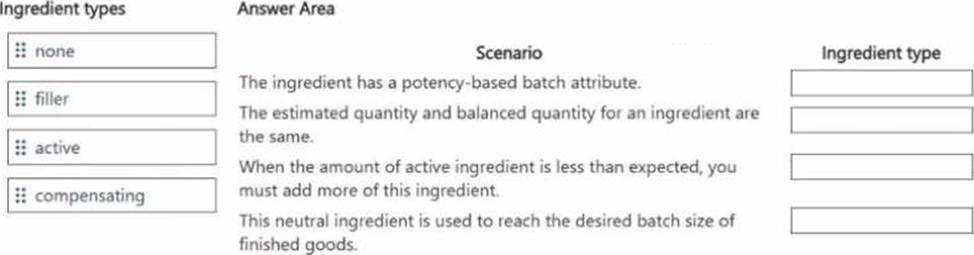
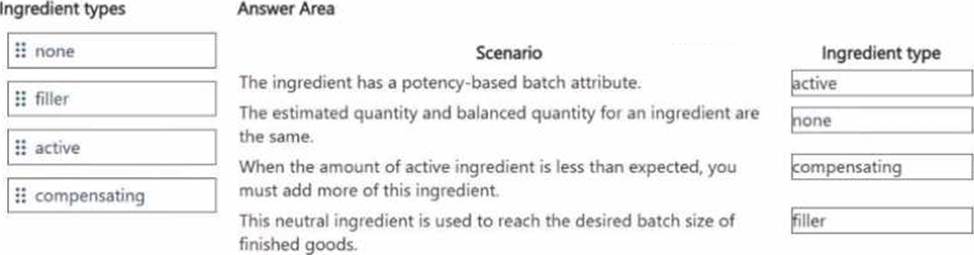
You need to review formulas and how the different ingredient types impact the batch balancing process
Which ingredient types should you use? To answer, drag the appropriate ingredient types to the correct scenarios. Each ingredient type may be used once, more than once, or not at all. You may need to drag the split bar between panes or scroll to view content. NOTE: Each correct selection is worth one point.
Note: This question is part of a series of questions that present the same scenario. Each question in the series contains a unique solution that might meet the stated goals. Some question sets might have more than one correct solution, while others might not have a correct solution.
After you answer a question in this section, you will NOT be able to return to it. As a result, these questions will not appear on the review screen.
A manufacturing company produces electronic components and devices.
The company has scheduling issues related to using working time calendars in manufacturing.
You need to ensure that the working time calendar is used when manufacturing jobs are scheduled.
Solution: Enable route groups for a process job type.
Does the solution meet the goal?
- A . Yes
- B . No
You are building the Bill of materials (BOM) for a new production item. The new item has a subcomponent.
Sub production orders for the subcomponent must be created when estimating production orders.
You need to configure the BOM line to generate sub production orders.
Which BOM line type should you use?
- A . Vendor
- B . Item
- C . Phantom
- D . Pegged supply
D
Explanation:
The BOM line type determines how the line is handled during master planning and batch order production1. The Item line type indicates that the item is a material or service that is directly consumed, and that doesn’t require further explosion or pegged supply1. When you estimate a production order for an item that has a BOM line with the Item line type, a sub production order is created for the item2.
The other options are not correct, because they do not generate sub production orders. The Vendor
line type indicates that the item is purchased from a vendor and not produced internally1. The Phantom line type indicates that the item is an intermediate product that is used to simplify the design process and group complex products into engineering modules1. The Pegged supply line type indicates that the item is supplied by another production order or transfer order, and that the supply must be reserved before it can be consumed1.
DRAG DROP
A manufacturing company is implementing Dynamics 365 Supply Chain Management.
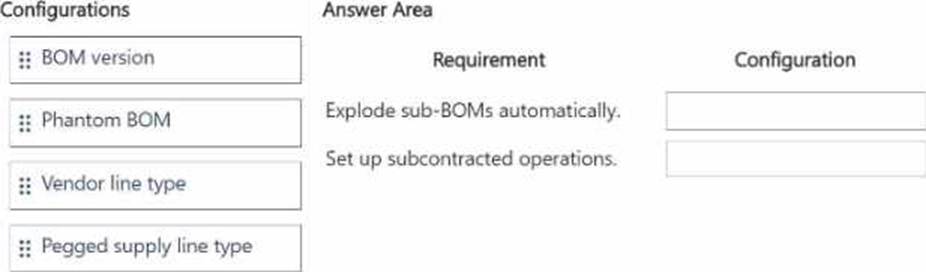
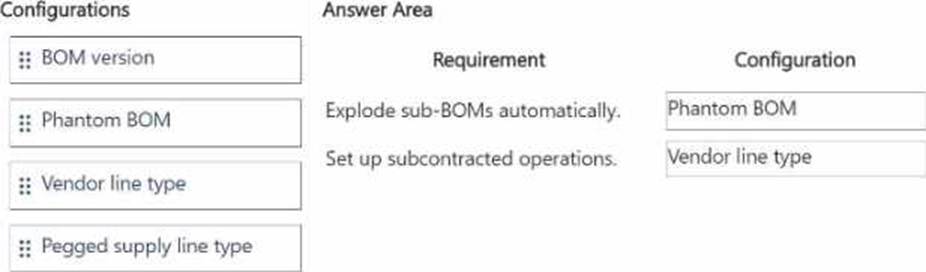
You have a bill of materials (BOM) for each finished good. Finished goods may have subcontracted operation steps.
When a user views a BOM for a finished good, the finished good must be exploded automatically.
You need to configure the BOM lines.
What should you configure? To answer, drag the appropriate configurations to the correct requirements. Each configuration may be used once, more than once, or not at all. You may need to drag the split bar between panes or scroll to view content. NOTE: Each correct selection is worth one point.
HOTSPOT
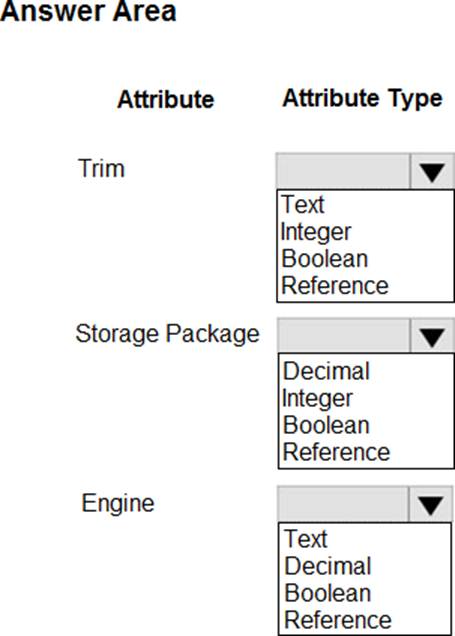
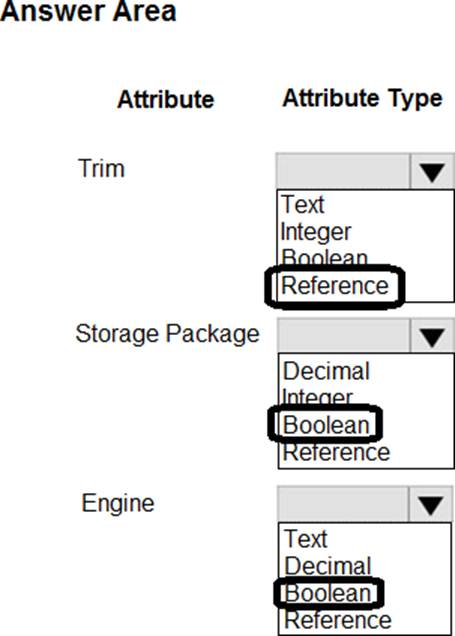
You need to configure system attributes.
Which attribute types should you use? To answer, select the appropriate options in the answer area. NOTE: Each correct selection is worth one point.
HOTSPOT
A manufacturer uses Dynamics 365 Supply Chain Management to create bicycle parts as a configure-to-order configuration. All bicycle parts are sourced from external sources and assembled in the manufacturing facility.
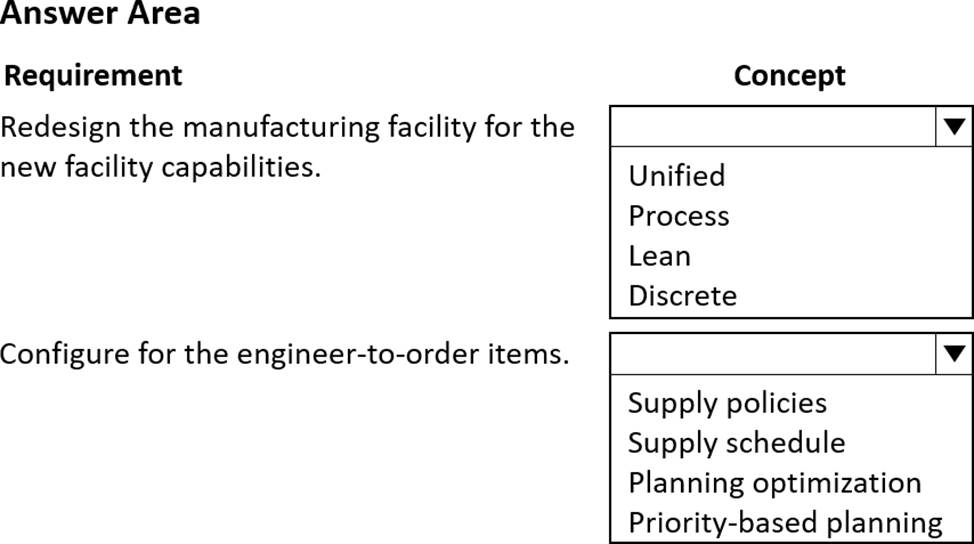
The manufacturer plans to expand its capabilities to create custom bicycles parts in an engineer-to-order model. All bicycle parts will be created in the manufacturing facility. The custom bicycle parts must be omitted from any master planning process. You need to describe the concepts for the requirements.
Which concepts should you use? To answer, select the appropriate options in the answer area. NOTE: Each correct selection is worth one point.
Explanation:
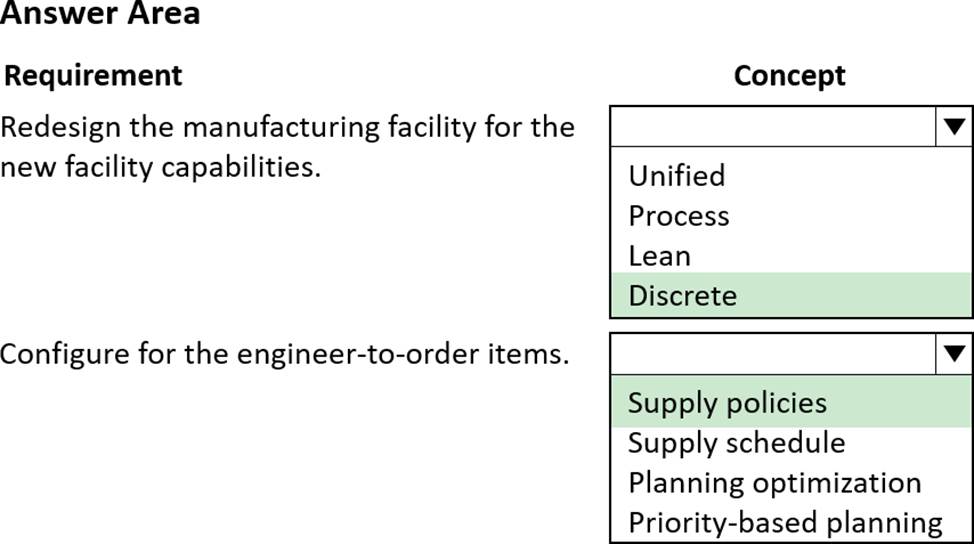
To describe the concepts for the requirements, you should use the following:
Redesign the manufacturing facility for the new facility capabilities: You should use the Discrete concept. Discrete manufacturing is a type of manufacturing that produces distinct items that can be easily counted, touched, or seen1. Discrete manufacturing is suitable for producing custom bicycle parts in an engineer-to-order model, because it allows you to create unique products based on customer specifications and engineering drawings2. Discrete manufacturing also supports complex production processes that involve multiple steps, resources, and materials2.
Configure for the engineer-to-order items: You should use the Supply policies concept.
Supply policies are rules that determine how supply is generated for a product based on its demand3. Supply policies can be configured at the product level, the product master level, or the coverage group level3. For engineer-to-order items, you can configure a supply policy that omits them from any master planning process. For example, you can set the coverage code to None, which means that no planned orders are generated for the product. You can also set the replenishment system to None, which means that no replenishment orders are generated for the product.
1: What is discrete manufacturing? 2: Discrete manufacturing overview 3: Supply policies: [Coverage codes]: [Replenishment systems]
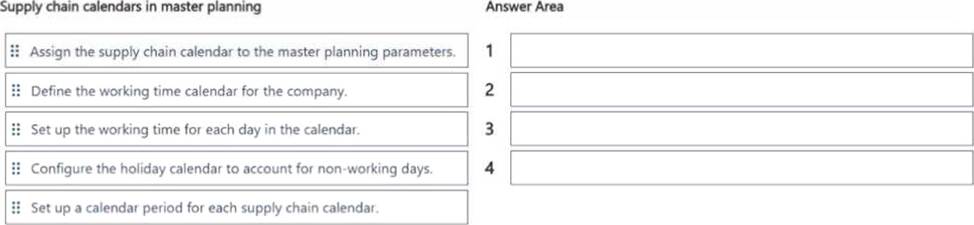
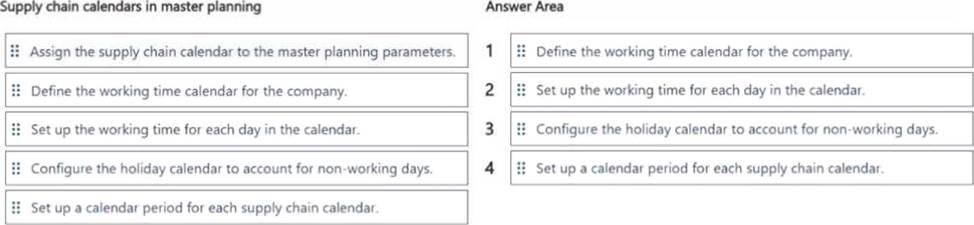
DRAG DROP
A company uses Dynamics 365 Supply Chain Management for master planning.
The company requires planning processes that are based on workers’ working times for production, transportation, and inventory management.
You need to configure the system to use the correct supply chain calendars
Which four actions should you perform in sequence? To answer, move the appropriate actions from the list of actions to the answer area and arrange them in the correct order.
You need to create the production orders for standard model bicycles.
Which method should you use?
- A . Sales order line
- B . Master planning execution
- C . Supply schedule form
- D . Released item
- E . All production orders form
Note: This question is part of a series of questions that present the same scenario. Each question in the series contains a unique solution that might meet the stated goals. Some question sets might have more than one correct solution, while others might not have a correct solution.
After you answer a question in this section, you will NOT be able to return to it. As a result, these questions will not appear in the review screen.
A manufacturing plant uses Lean processes. You plan to outsource a painting operation to a subcontracting vendor. You create a service item named SP 01 to represent the painting service. You need to create a subcontracting activity for the painting service.
Solution:
• Create a vendor warehouse for the subcontracting vendor.
• Create a vendor resource and add it to a new work cell for outsource painting.
• Create a production flow transfer activity and specify the vendor warehouse as The target warehouse.
Does the solution meet the goal?
- A . Yes
- B . No
B
Explanation:
The solution does not meet the goal. Here is the explanation:
To create a subcontracting activity for the painting service, you should use the following steps1: Create a vendor warehouse for the subcontracting vendor. This step is correct, because you need to create a warehouse that is assigned to the vendor account and set it as vendor-managed1. This way, you can track the inventory that is located at the vendor’s site.
Create a vendor resource and add it to a new work cell for outsource painting. This step is correct, because you need to create a resource that is assigned to the vendor account and add it to a resource group that represents the subcontracting work cell1. This way, you can assign the subcontracting activity to the vendor resource.
Create a production flow transfer activity and specify the vendor warehouse as the target warehouse. This step is incorrect, because you need to create a production flow process activity, not a transfer activity, for the subcontracting service1. A process activity represents an operation that transforms material into products or semi-finished goods2. A transfer activity represents a movement of material or products from one location to another2. You also need to specify the service item (SP 01) as the product of the process activity, and select the Generate license plate option on the mobile device menu item that is used for reporting as finished1.
A company uses Dynamics 365 Supply Chain Management for its rebate management process. The company must be able to generate calculated rebates for a deal that requires specific configurations.
The calculated rebate configuration must account for the order in which purchases are calculated and include the following details:
• Document notes = Prenotes not yet calculated
• Include credit notes = Yes
• Vendor rebate basis = Purchase order
• Price basis = FIFO
• Calculation method = Rolling
• Paid invoices only = No
You need to run the very first process to ensure generation of the correct rebates.
Which batch process should you run?
- A . Reimbursement
- B . Calculate FIFO purchase price
- C . Cost calculation details
- D . Create prenotes
- E . Rebate management