
Practice Free JN0-106 Exam Online Questions
You are asked to subnet the broadcast domains but need to support 50 hosts. In this scenario, which subnet mask would satisfy this requirement?
- A . /26
- B . /27
- C . /28
- D . /29
A
Explanation:
Determining the appropriate subnet mask for a specific host requirement is a core task in designing Junos-based network infrastructures. The number of usable hosts in an IPv4 subnet is calculated using the formula $2^n – 2$, where $n$ represents the number of host bits remaining after the network prefix. In this scenario, the requirement is to support 50 hosts within a single broadcast domain.
Evaluating the options:
A /29 mask provides 3 host bits ($2^3 – 2 = 6$ hosts), which is insufficient.
A /28 mask provides 4 host bits ($2^4 – 2 = 14$ hosts), which is insufficient.
A /27 mask provides 5 host bits ($2^5 – 2 = 30$ hosts), which still fails to meet the 50-host threshold.
A /26 mask provides 6 host bits. Applying the formula: $2^6 – 2 = 64 – 2 = 62$ usable host addresses.
Since a /26 mask provides 62 usable addresses, it is the smallest standard subnet mask that fully satisfies the requirement of 50 hosts. Using a /26 mask allows for the 50 required hosts while providing a small buffer for future growth (12 additional addresses) without wasting the excessive address space associated with a /25 or /24 mask. This efficient allocation of address space is a best practice for maintaining scalable and organized routing tables on Juniper devices.
You are asked to subnet the broadcast domains but need to support 50 hosts. In this scenario, which subnet mask would satisfy this requirement?
- A . /26
- B . /27
- C . /28
- D . /29
A
Explanation:
Determining the appropriate subnet mask for a specific host requirement is a core task in designing Junos-based network infrastructures. The number of usable hosts in an IPv4 subnet is calculated using the formula $2^n – 2$, where $n$ represents the number of host bits remaining after the network prefix. In this scenario, the requirement is to support 50 hosts within a single broadcast domain.
Evaluating the options:
A /29 mask provides 3 host bits ($2^3 – 2 = 6$ hosts), which is insufficient.
A /28 mask provides 4 host bits ($2^4 – 2 = 14$ hosts), which is insufficient.
A /27 mask provides 5 host bits ($2^5 – 2 = 30$ hosts), which still fails to meet the 50-host threshold.
A /26 mask provides 6 host bits. Applying the formula: $2^6 – 2 = 64 – 2 = 62$ usable host addresses.
Since a /26 mask provides 62 usable addresses, it is the smallest standard subnet mask that fully satisfies the requirement of 50 hosts. Using a /26 mask allows for the 50 required hosts while providing a small buffer for future growth (12 additional addresses) without wasting the excessive address space associated with a /25 or /24 mask. This efficient allocation of address space is a best practice for maintaining scalable and organized routing tables on Juniper devices.
A network administrator must set up the initial configuration of the out-of-band management interface on a new Juniper router to ensure management traffic is isolated from the default routing table (inet.0).
In this scenario, which configuration step is required to accomplish this task in Junos OS?
- A . Configure an IP address on interface ge-0/0/0.0 and enable ethernet-switching family.
- B . Configure the lo0.0 loopback interface with a management IP and apply it to the [edit system services] hierarchy.
- C . Assign an IP address to the me0.0 interface and set the routing-options to instance-type virtual-router.
- D . Assign an IP address to interface fxp0.0 or em0.0 and use the command set system management-instance to enable the management routing instance.
D
Explanation:
In modern Junos OS versions, the most efficient and standard way to isolate Out-of-Band (OOB) management traffic from transit traffic is by utilizing the management-instance. Historically, management interfaces like fxp0 (on M/MX/T series) or me0 (on EX/QFX series) shared the global routing table (inet.0), which could lead to routing conflicts if management subnets overlapped with production data.
To resolve this, Junos introduced the set system management-instance command. When this is enabled, the OS automatically creates a dedicated routing instance named mgmt_junos. The physical management interface (be it fxp0, em0, or me0) and its associated logical unit are moved into this private instance. This creates a complete separation: management protocols like SSH, SNMP, and NTP operate within mgmt_junos, while BGP, OSPF, and customer data remain in inet.0. This architecture ensures that even a massive routing loop or table exhaustion in the production plane will not prevent an administrator from accessing the device via the OOB port. Furthermore, it simplifies the configuration of default gateways for management traffic, as the mgmt_junos instance maintains its own independent routing table (mgmt_junos.inet.0), preventing management routes from ever being leaked into the provider core.
You manage a Junos device with 20 interfaces. Each interface requires the same description and MTU setting.
Which configuration approach would reduce repetitive commands and ensure consistency?
- A . Use the wildcard delete command to remove duplicate settings.
- B . Configure each interface individually.
- C . Use a configuration group.
- D . Use search and replace to apply settings across interfaces.
C
Explanation:
In the Junos OS architecture, configuration groups (defined under the [edit groups] hierarchy) provide a powerful mechanism for template-based management. This approach is specifically designed to handle scenarios where multiple configuration objects, such as twenty different Ethernet interfaces, require identical parameters like a specific description or MTU value. By defining these common settings once within a group, an administrator can then apply that group to multiple interfaces using the apply-groups statement.
This methodology drastically reduces the number of repetitive commands required and, more importantly, ensures strict consistency across the device. If the MTU needs to be adjusted in the future, the change is made in a single location―within the configuration group―and is automatically inherited by all interfaces to which the group is applied. This inheritance model prevents "configuration drift" where individual interfaces might otherwise end up with mismatched settings due to manual entry errors. Using configuration groups is considered a best practice for Senior Architects managing high-density platforms, as it simplifies the candidate configuration file and makes the management of bulk interface settings both scalable and error-resistant.
You are using the factory default configuration on a new Juniper router. You must successfully commit the configuration and activate the device.
Which component must be configured before Junos OS will allow you to accomplish this task?
- A . a system hostname
- B . a root-authentication password
- C . at least one logical interface with family inet enabled
- D . a management IP address on the fxp0 interface
B
Explanation:
When a Junos device is initialized for the first time or after a factory reset, it operates with a "factory-default" configuration. This configuration contains the minimum settings necessary for the device to boot, but it lacks essential security parameters. The Junos OS kernel enforces a strict security mechanism that prevents any administrator from successfully executing a commit command until a root-level password has been defined.
Specifically, the root-authentication object must be configured under the [edit system] hierarchy. This requirement ensures that no Junos device is deployed into a production environment with an open, unauthenticated root account. If an administrator attempts to commit changes without this setting, the configuration parser will return a "missing mandatory statement" error and the commit process will fail. While other settings―such as a system hostname, management IP address (on the fxp0 or me0 interfaces), or logical interface configurations―are critical for operational readiness, they are not strictly enforced by the system validation logic for the initial activation. Only the root-authentication (which can be a plain-text password or an encrypted key) is a hard prerequisite for transitioning the device from a default state to an active, running configuration.
Which statement accurately describes the Junos candidate configuration?
- A . It is a backup configuration stored in the rollback archive.
- B . It is the active configuration currently running on the device.
- C . It is a temporary configuration that becomes active only after a reboot.
- D . It is a configuration that stores proposed changes before they are committed.
D
Explanation:
In the Junos OS architecture, the configuration environment is strictly bifurcated to ensure system stability and integrity. The candidate configuration is a specific database that serves as a staging area, storing all proposed changes made by an administrator during a configuration session before they are finalized. Unlike other network operating systems where changes might take effect immediately upon entry, Junos utilizes this "sandbox" approach where modifications reside only in the candidate database until a commit command is explicitly executed.
Once the commit process is initiated, the Junos OS kernel validates the candidate configuration for syntax errors and logical consistency. If the validation check is successful, the candidate configuration is promoted and becomes the active configuration―the operational state currently running on the device hardware. This separation allows multiple administrators to work on complex changes without impacting live transit traffic or device stability prematurely. If a mistake is identified during the editing process, the candidate configuration can be easily discarded or compared against the active state to identify discrepancies. This workflow is a cornerstone of Junos OS, facilitating a "check-before-apply" methodology that is essential for carrier-grade reliability and minimizing the risk of accidental outages during critical maintenance windows. Junos OS Fundamentals, Configuration Databases, Candidate vs. Active.
What is the maximum number of IP addresses that would be assigned to hosts in the 192.168.1.0/24 network?
- A . 24
- B . 32
- C . 128
- D . 254
D
Explanation:
In the IPv4 addressing scheme used within Junos OS, the /24 prefix length (representing a subnet mask of 255.255.255.0) allocates 24 bits for the network portion and 8 bits for the host portion of the 32-bit address. To determine the total number of addresses in this block, the formula $2^n$ is applied, where $n$ is the number of host bits. With 8 bits available ($2^8$), there are a total of 256 possible IP addresses.
However, the architecture of standard IP networking requires the reservation of two specific addresses within any subnet, making them unavailable for assignment to individual host interfaces. The first address (192.168.1.0) is the network address, which identifies the subnet itself. The last address (192.168.1.255) is the directed broadcast address, used to send traffic to all hosts on the segment simultaneously. Consequently, the maximum number of addresses that can be assigned to actual hosts―such as router interfaces, servers, or workstations―is calculated as $2^n – 2$. In this specific scenario, $256 – 2 = 254$. This calculation is a fundamental requirement for network architects when defining address pools and ensuring the Packet Forwarding Engine (PFE) is correctly configured with valid host-layer identifiers.
Refer to the exhibit.
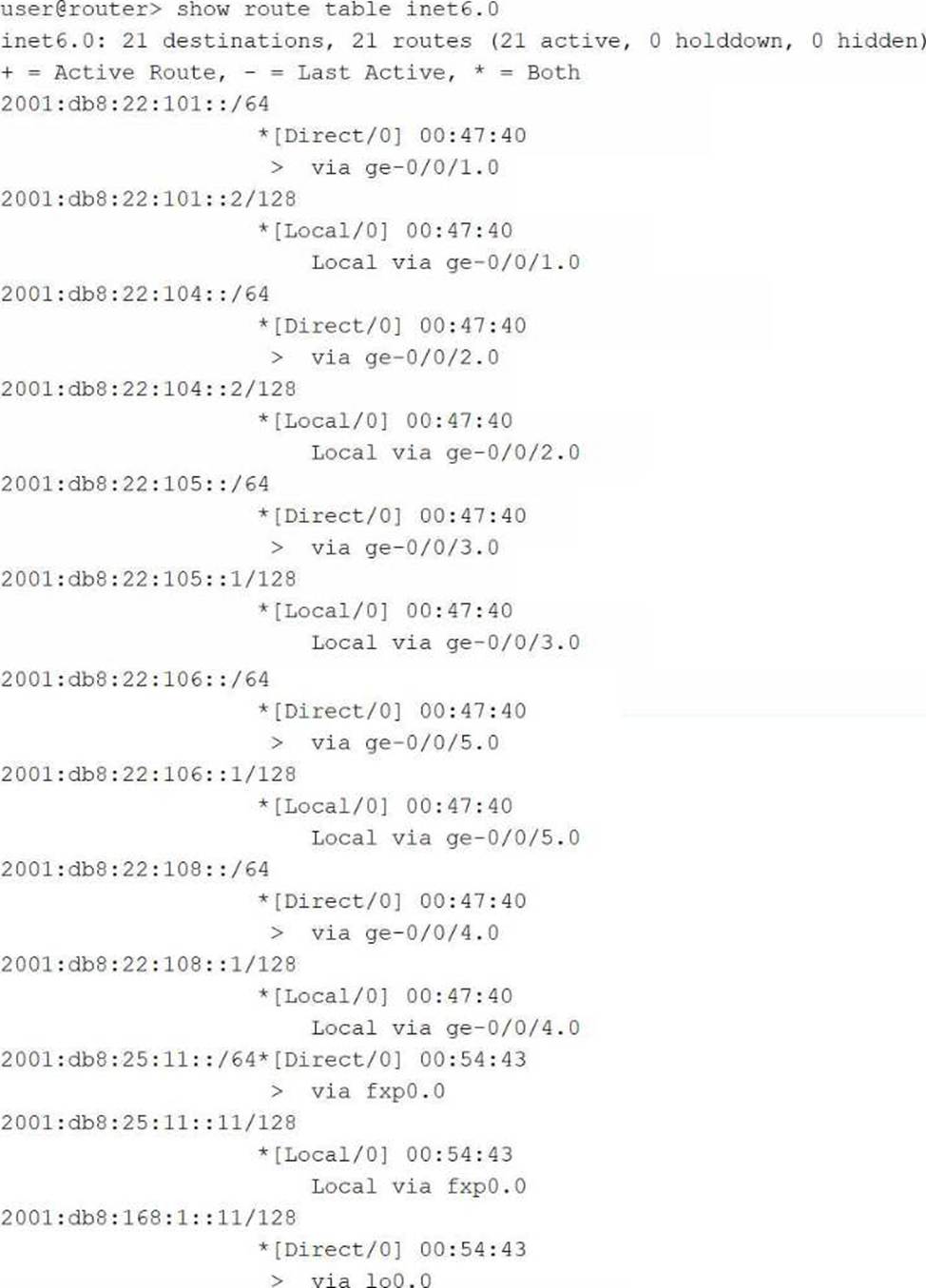
Referring to the exhibit, which two statements about IPv6 routing are correct? (Choose two.)
- A . The router is not learning IPv6 routes from peers.
- B . The router cannot forward traffic to remote IPv6 networks.
- C . Traffic destined for the 2001:db8:22:108::/64 network is forwarded using the ge-0/0/5.0 interface.
- D . The router is connected to the 2001:db8:22:107::/64 network.
A, B
Explanation:
The provided exhibit displays the output of the show route table inet6.0 command, which represents the master routing table for IPv6 unicast traffic in Junos OS. Analysis of the specific route entries reveals that all listed destinations are categorized as either [Direct/0] or [Local/0]. These route types indicate that the table only contains networks physically connected to the router’s interfaces and the specific IP addresses assigned to those interfaces.
Because there are no routes identified by dynamic protocols (such as OSPFv3, IS-IS, or BGP) or static entries, it is verified that the router is not learning IPv6 routes from any neighbors or peers. Consequently, the routing table lacks reachability information for any non-local or remote IPv6 segments. Without these routes or a configured default gateway (::/0), the router is unable to forward traffic to remote IPv6 networks. Statements C and D are factually incorrect based on the exhibit: the 2001:db8:22:108::/64 network is associated with interface ge-0/0/4.0 (not ge-0/0/5.0), and the 2001:db8:22:107::/64 network is entirely absent from the displayed routing table.
Click the Exhibit button.
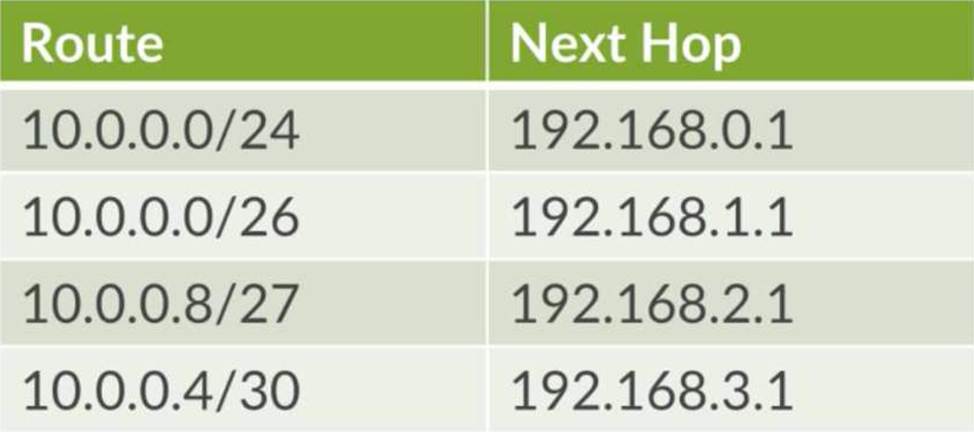
Referring to the exhibit, what is the next hop for IP address 10.0.0.9?
- A . 192.168.2.1
- B . 192.168.1.1
- C . 192.168.3.1
- D . 192.168.0.1
A
Explanation:
In Junos OS, the Packet Forwarding Engine (PFE) determines the next hop for a packet by performing a lookup in the forwarding table and identifying all valid matches for the destination IP address. When multiple routes encompass the same destination, the router strictly follows the Longest Prefix Match (LPM) rule to select the most specific entry.
For the destination address 10.0.0.9, the following evaluation occurs based on the exhibit:
Which two characteristics apply to TCP? (Choose two.)
- A . TCP guarantees fixed latency for application flows.
- B . TCP broadcasts datagrams by default on Ethernet.
- C . TCP uses a three-way handshake to establish a connection.
- D . TCP provides reliable, ordered delivery using sequence numbers.
C, D
Explanation:
Comprehensive and Detailed 150 to 250 words of Explanation From: The Transmission Control Protocol (TCP) is a core transport-layer protocol within the TCP/IP suite designed to provide a highly reliable, connection-oriented service. Unlike the User Datagram Protocol (UDP), which is connectionless and best-effort, TCP ensures that data is delivered accurately and in the correct order. A defining characteristic of TCP is its use of a three-way handshake to establish a session. This process involves the exchange of SYN, SYN-ACK, and ACK segments, which synchronizes sequence numbers between the two endpoints and ensures both hosts are ready for data transfer.
Furthermore, TCP provides reliable, ordered delivery by utilizing sequence numbers and acknowledgments. Each data segment is assigned a sequence number; the receiving host uses these numbers to reassemble the data in its original order, even if segments arrive out of sequence due to network jitter or multiple paths. If a segment is lost, the lack of a timely acknowledgment triggers a retransmission, guaranteeing that the application receives all data. TCP does not provide fixed latency guarantees, as its error-recovery mechanisms can introduce delays. Additionally, TCP is a unicast-only protocol and does not support broadcasting on Ethernet. Networking Fundamentals, Transport Layer Protocols, TCP vs. UDP.