
Practice Free H12-811_V2.0-ENU Exam Online Questions
In the WLAN networking, multiple APs can broadcast the same SSID and belong to the same BSSID, allowing STAs to stay connected to the same wireless network wherever they move.
- A . TRUE
- B . FALSE
Both SNMP Trap and Inform Request are used by managed devices to send alarms to the NMS. Inform Request requires an acknowledgment from the NMS, whereas Trap does not.
- A . TRUE
- B . FALSE
The following command output is displayed on R1:
[R1] display aaa configuration
Domain Name Delimiter: @
Domainname parse direction: Left to right
Domainname location: After-delimiter
Administrator user default domain: default_admin
Normal user default domain: default
Domain: total: 256 used: 3
Authentication-scheme: total: 32 used: 2
Accounting-scheme: total: 32 used: 1
Authorization-scheme: total: 32 used: 2
Service-scheme: total: 256 used: 0
Recording-scheme: total: 32 used: 0
Local-user: total: 512 used: 2
Remote-admin-user block retry-interval: 5 Min(s)
Remote-admin-user block retry-time: 3
Remote-admin-user block time: 5 Min(s)
Session timeout invalid enable: No
Which of the following statements is false?
- A . The maximum number of consecutive authentication failures of the local account is 3.
- B . The local account lockout duration is 30 minutes.
- C . The domain name delimiter is at sign (@).
- D . A maximum of 512 local users can be created. Two local users have been created.
Radio waves are a type of electromagnetic waves with relatively high frequencies and short wavelengths in the electromagnetic spectrum.
- A . TRUE
- B . FALSE
On an enterprise network, SW1 and SW2 are connected through an Eth-Trunk in LACP mode. The administrator sets the minimum number of active links to 3 on SW1. However, there are only two physical links between the two switches and the links are normal.

Which of the following statements are true about this scenario? (Choose all that apply.)
- A . The Eth-Trunk interface is Up.
- B . The Eth-Trunk interface is Down.
- C . The two physical interfaces are Down.
- D . The two physical interfaces are Up.
Which of the following statements are true about the Python code shown below? (Select all that apply)
import paramiko
import time
ssh = paramiko.SSHClient()
ssh.set_missing_host_key_policy(paramiko.AutoAddPolicy())
ssh.connect(‘192.168.1.254′, username=’python’, password=’Huawei@123′)
channel = ssh.invoke_shell()
channel.send(‘screen-length 0 temporaryn’)
time.sleep(1)
output = channel.recv(65535). decode(‘utf-8’)
print(output)
ssh.close()
- A . ssh.close() is used to terminate the SSH connection.
- B . ssh.connect(‘192.168.1.254′, username=’python’, password=’Huawei@123′) is used to set up a connection with the device whose IP address is 192.168.1.254.
- C . import paramiko and import time are used to import the modules required by the code.
- D . channel = ssh.invoke_shell() is used to create an interactive shell session.
On the network shown in the figure, all switches run STP. All links have a path cost of 20, and SW1 is the root bridge.
What is the root path cost (RPC) of SW4?
- A . 20
- B . 40
- C . 60
- D . 80
An enterprise has deployed a Huawei WLAN, but some STAs cannot associate with wireless signals. To troubleshoot this issue, you log in to the WAC and run related commands. The command output is as follows.
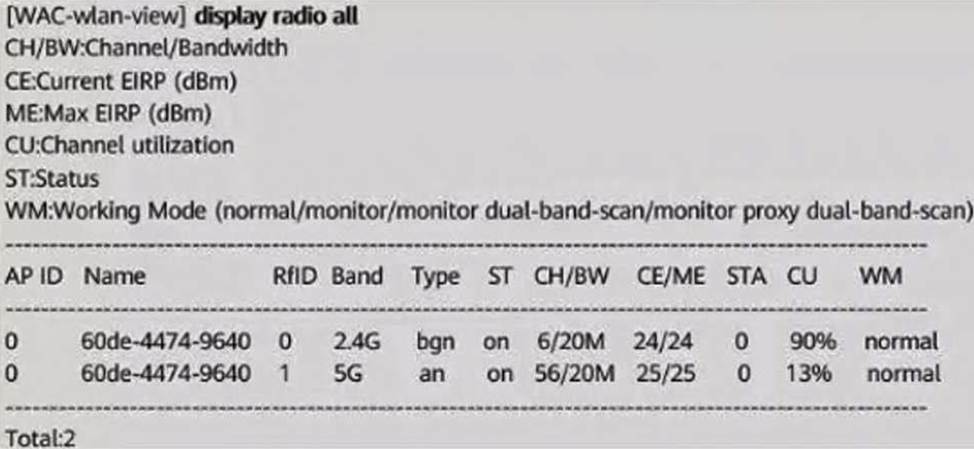
According to the command output, which of the following is the possible cause of the STA association failure?
- A . The STAs are not in the VAP’s whitelist.
- B . The AP’s radios are not enabled.
- C . The channel utilization of the AP’s radios is too high, and the air interface is busy.
- D . The STAs are in the global blacklist.
Which of the following IPv6 addresses is a link-local address?
- A . FD00::FA63:DBFF:FE9E:10
- B . FC00::FA63:DBFF:FE9E:10
- C . FE80::FA63:DBFF:FE9E:10
- D . 2001::FA63:DBFF:FE9E:10
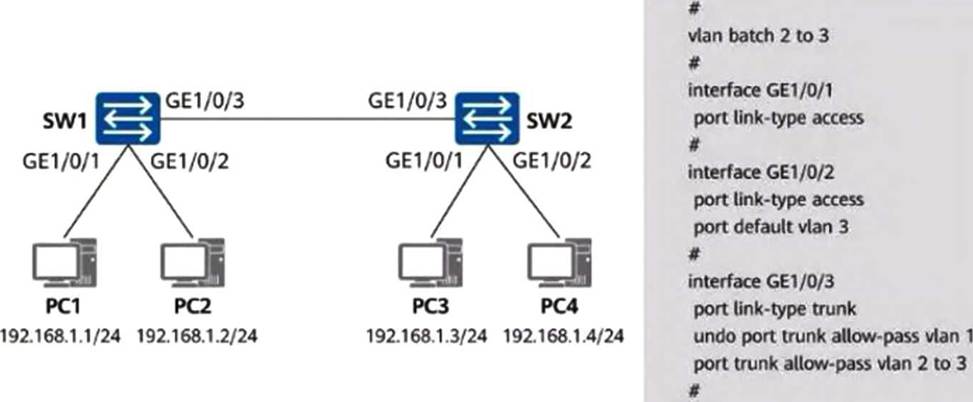
The network administrator performs the configuration shown in the figure on SW1 and SW2.
Which of the following statements are false about this scenario? (Choose all that apply.)
- A . PC1 and PC2 can communicate with each other at Layer 2.
- B . PC1 and PC3 can communicate with each oilier at Layer 2.
- C . PC2 and PC3 can communicate with each other at Layer 2.
- D . PC2 and PC4 can communicate with each other at Layer 2.