
Practice Free H12-811_V2.0-ENU Exam Online Questions
In Layer 3 in-path WLAN networking, the WAC and Fit APs are connected at Layer 3. APs can obtain the WAC’s address through broadcast or DHCP.
- A . TRUE
- B . FALSE
After the root bridge is elected on an STP network, which of the following parameters may be compared by ports on non-root bridge nodes to elect the root port? (Select all that apply)
- A . PID of a port on the local device
- B . Root path cost (RPC)
- C . BID of the device that sends BPDUs
- D . PID of a port on the device that sends BPDUs
On the network shown in the figure, S2 serves as a DHCP server and has four address pools, R1 functions as a DHCP relay agent, and S1 is a DHCP client.
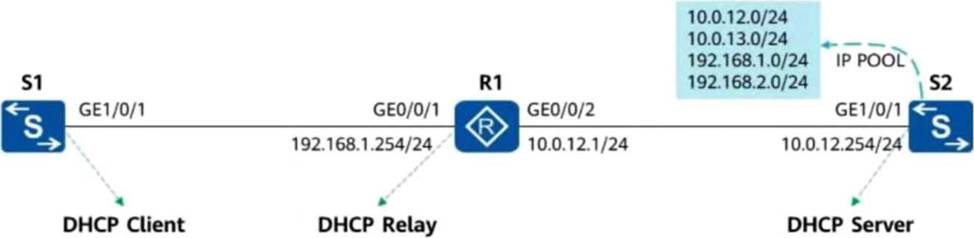
Which of the following IPv4 addresses can be assigned to S1 through DHCP?
- A . 10.0.12.253/24
- B . 192.168.2.2/24
- C . 192.168.1.108/24
- D . 10.0.13.13/24
When a Huawei device functions as an SSH client to log in to another network device for the first time, the ssh client first-time enable command must be run to enable the first-time login function of the SSH client. Otherwise, the login fails.
- A . TRUE
- B . FALSE
If the neighbor relationship between R1 and R2 has reached the Full state in OSPF, which of the following statements are true? (Select all that apply)
- A . R1 and R2 have different router IDs.
- B . R1 and R2 belong to the same area.
- C . R1 and R2 use the same process ID.
- D . R1 and R2 have the same LSDB in the same area.
A small enterprise’s switches do not support LACP. Therefore, the administrator manually binds two links between two switches into an Eth-Trunk.
Which of the following statements are false about this scenario? (Choose all that apply.)
- A . If the peer interface of one link is incorrectly connected to another device, the local device detects the fault and stops forwarding service traffic through the link.
- B . If one of the links fails, the switches automatically add another normal link to the Eth-Trunk.
- C . If one of the links falls, the switches automatically removes the link from the link aggregation configuration.
- D . The two links in the Eth-Trunk work in active/standby mode, and only the active link forwards data.
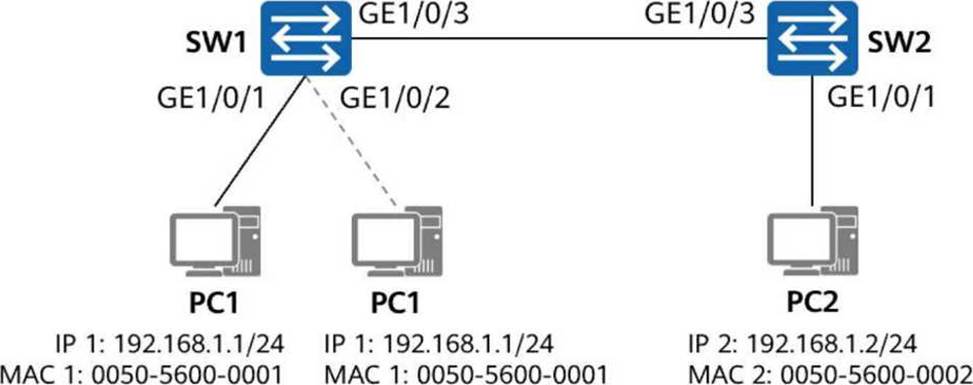
The figure shows the simplified topology of an enterprise campus network. On this network, the aging time of dynamic MAC address entries on switches is 300 seconds.
The administrator connects PC1 to GE1/0/1 of SW1 and successfully pings the IP address of PC2 from PC1. Then, the administrator disconnects the Ethernet cable of PC1 from GE1/0/1 of SW1, immediately connects the cable to GE1/0/2 of SW1, and pings the IP address of PC2 from PC1.
Which of the following operations does SW1
perform after receiving a data frame from PC1 when PC1 is connected to GE1/0/2 of SW1?
- A . SW1 saves the mapping between the MAC address of PC1 and GE1/0/1, and also keeps the mapping between the MAC address of PC1 and GE1/0/2.
- B . SW1 saves the mapping between the MAC address of PC1 and GE1/0/2 and deletes the mapping between the MAC address of PC1 and GE1/0/1.
- C . SW1 deletes all MAC address entries and relearns them from all ports.
- D . SW1 does not update the MAC address table until the original entry ages out.
During WLAN deployment, a Fit AP fails to go online on the WAC. You log in to the WAC and run the display ap all command to check the AP status. The command output shows that the AP status is unauth, indicating that the AP fails the authentication. You therefore need to confirm this AP on the WAC to allow the AP to go online.
- A . TRUE
- B . FALSE
In the WLAN networking, multiple APs can broadcast the same SSID and belong to the same BSSID, allowing STAs to stay connected to the same wireless network wherever they move.
- A . TRUE
- B . FALSE
In the WLAN networking, multiple APs can broadcast the same SSID and belong to the same BSSID, allowing STAs to stay connected to the same wireless network wherever they move.
- A . TRUE
- B . FALSE