Practice Free DP-700 Exam Online Questions
You have a Fabric workspace that contains a warehouse named Warehouse1. Data is loaded daily into Warehouse1 by using data pipelines and stored procedures.
You discover that the daily data load takes longer than expected.
You need to monitor Warehouse1 to identify the names of users that are actively running queries.
Which view should you use?
- A . sys.dm_exec_connections
- B . sys.dm_exec_requests
- C . queryinsights.long_running_queries
- D . queryinsights.frequently_run_queries
- E . sys.dm_exec_sessions
You need to schedule the population of the medallion layers to meet the technical requirements.
What should you do?
- A . Schedule a data pipeline that calls other data pipelines.
- B . Schedule a notebook.
- C . Schedule an Apache Spark job.
- D . Schedule multiple data pipelines.
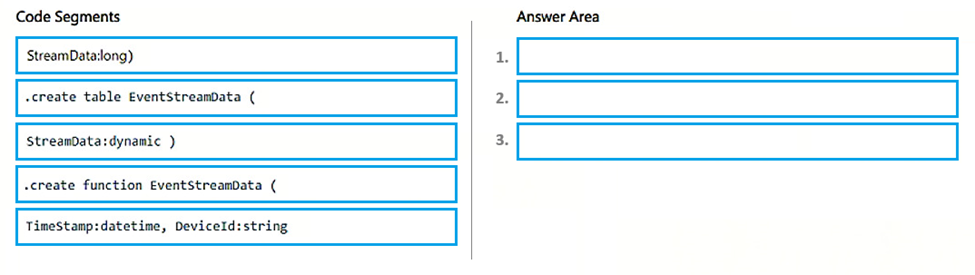
DRAG DROP
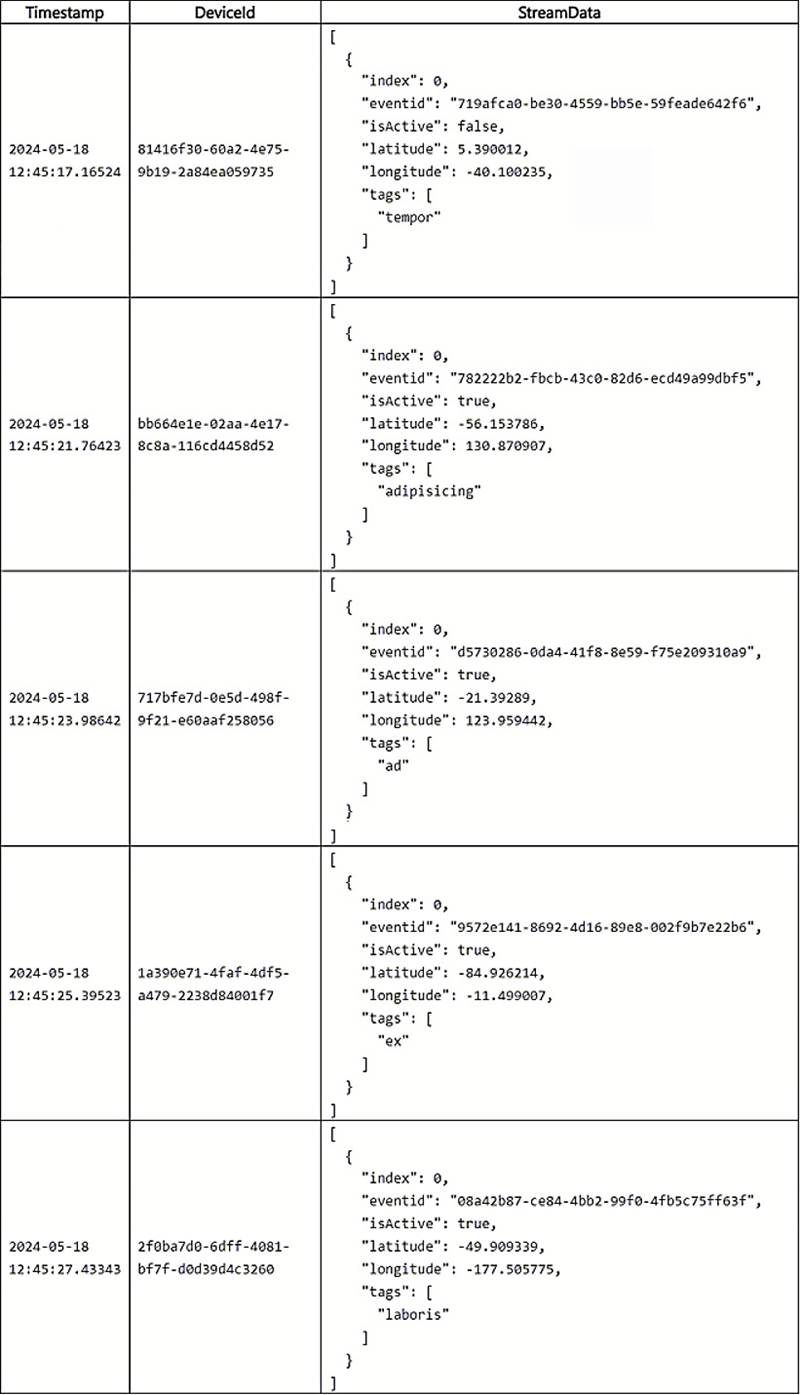
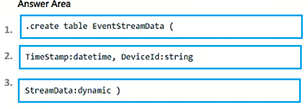
You have a Fabric workspace that contains an eventhouse named Eventhouse1.
In Eventhouse1, you plan to create a table named DeviceStreamData in a KQL database. The table will contain data based on the following sample.
HOTSPOT
You have a Fabric workspace that contains a lakehouse named Lakehousel.
Lakehousel contains a table named Status_Target that has the following columns:
• Key
• Status
• LastModified
The data source contains a table named Status.Source that has the same columns as Status_Target.
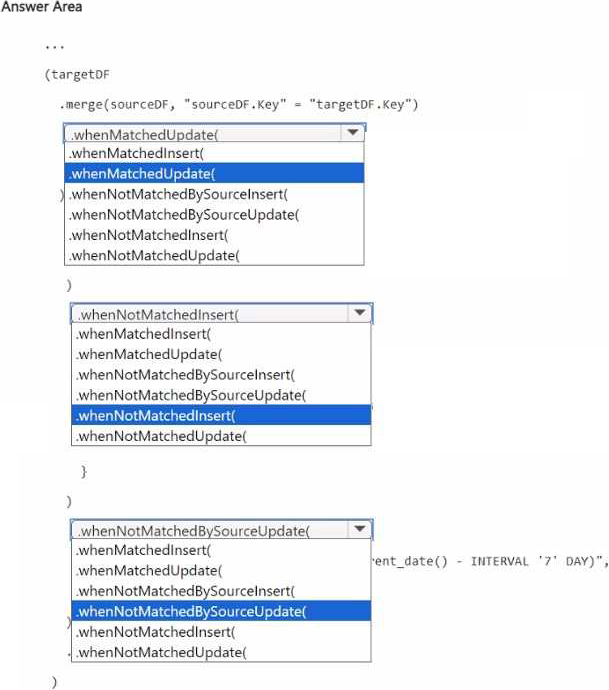
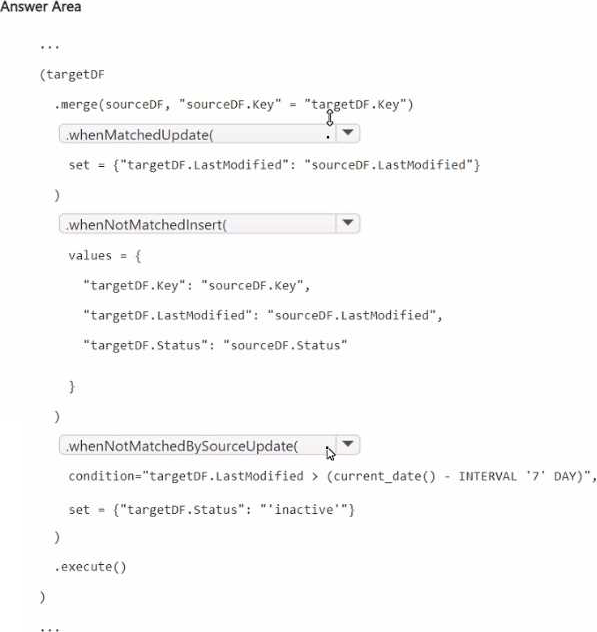
Status.Source is used to populate Status_Target. In a notebook name Notebook!, you load Status_Source to a DataFrame named sourceDF and Status_Target to a DataFrame named targetDF.
You need to implement an incremental loading pattern by using Notebook-!. The solution must meet
the following requirements:
• For all the matching records that have the same value of key, update the value of LastModified in Status_Target to the value of LastModified in Status_Source.
• Insert all the records that exist in Status_Source that do NOT exist in Status_Target.
• Set the value of Status in Status_Target to inactive for all the records that were last modified more than seven days ago and that do NOT exist in Status.Source.
How should you complete the statement? To answer, select the appropriate options in the answer area. NOTE: Each correct selection is worth one point.
You need to ensure that usage of the data in the Amazon S3 bucket meets the technical requirements.
What should you do?
- A . Create a workspace identity and enable high concurrency for the notebooks.
- B . Create a shortcut and ensure that caching is disabled for the workspace.
- C . Create a workspace identity and use the identity in a data pipeline.
- D . Create a shortcut and ensure that caching is enabled for the workspace.
You have a Fabric workspace named Workspace1.
You plan to integrate Workspace1 with Azure DevOps.
You will use a Fabric deployment pipeline named deployPipeline1 to deploy items from Workspace1 to higher environment workspaces as part of a medallion architecture. You will run deployPipeline1 by using an API call from an Azure DevOps pipeline.
You need to configure API authentication between Azure DevOps and Fabric.
Which type of authentication should you use?
- A . service principal
- B . Microsoft Entra username and password
- C . managed private endpoint
- D . workspace identity
You have a Fabric data warehouse that contains the following tables.
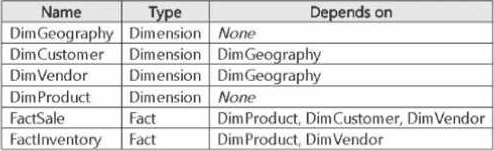
You need to refresh the tables by using an automated pipeline. The solution must ensure that table updates occur in the correct order to maintain referential integrity.
Which two tables should you refresh first? Each correct answer presents part of the solution. NOTE: Each correct selection is worth one point.
- A . FactSale
- B . Dim Product
- C . Factlnventory
- D . DimCustomer
- E . DimGeography
You have a Fabric workspace that contains a lakehouse named Lakehousel.
You plan to create a data pipeline named Pipeline! to ingest data into Lakehousel. You will use a parameter named paraml to pass an external value into Pipeline1!. The paraml parameter has a data
type of int
You need to ensure that the pipeline expression returns param1 as an int value.
How should you specify the parameter value?
- A . "@pipeline(). parameters. paraml"
- B . "@{pipeline().parameters.paraml}"
- C . "@{pipeline().parameters.[paraml]}"
- D . "@{pipeline().parameters.paraml}-
You have a Fabric lakehouse that contains the resources shown in the following table.

You need to use a notebook to query for customers in the United States and load the filtered data into US Customers. The solution must minimize the number of scripts used.
Which statement should you use?
- A . customers.write.format("parquet").mode("append").saveAsTable("USCustomers")
- B . customers.write.format("delta").mode("overwrite").save("Tables/USCustomers")
- C . customers.write.format("delta").mode("overwrite").saveAsTable("USCustomers")
- D . customers.write.format("parquet").mode("append").save("Tables/USCustomers")
HOTSPOT
You have a Fabric workspace named Workspace1 that contains a warehouse named Warehouse2. A team of data analysts has Viewer role access to Workspace1.
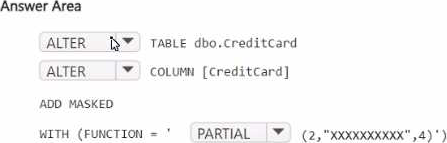
You create a table by running the following statement.
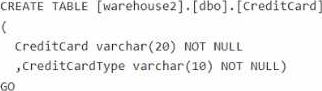
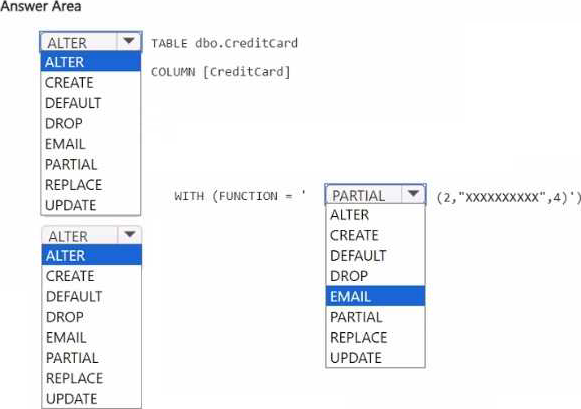
You need to ensure that the team can view only the first two characters and the last four characters of the Creditcard attribute.
How should you complete the statement? To answer, select the appropriate options in the answer area. NOTE: Each correct selection is worth one point.