Practice Free H12-811_V2.0-ENU Exam Online Questions
If the neighbor relationship between R1 and R2 has reached the Full state in OSPF, which of the following statements are true? (Select all that apply)
- A . R1 and R2 have different router IDs.
- B . R1 and R2 belong to the same area.
- C . R1 and R2 use the same process ID.
- D . R1 and R2 have the same LSDB in the same area.
A, B, D
Explanation:
When two OSPF routers reach the Full state, it means that adjacency establishment has been successfully completed and the routers have synchronized the necessary link-state information for that area. For this to happen, the two routers must have different router IDs, so option A is correct. They must also belong to the same OSPF area on the interfaces used to form the adjacency, making option B correct. Once adjacency reaches Full state, the routers have synchronized their link-state databases for that area, so option D is also correct.
Option C is incorrect because the OSPF process ID is only locally significant on a device. Two neighboring routers do not need to use the same process ID to establish adjacency. HCIA-Datacom teaches that OSPF neighbor formation depends on matching parameters such as area ID, network type, hello/dead timers, authentication settings, and subnet consistency, but not on the locally configured process number. This question is important because many learners mistakenly believe the process ID must match between devices, while in fact OSPF uses protocol parameters exchanged in packets rather than local process labels to form neighbor relationships.
With the release of Wi-Fi 7, wireless networks are now faster, more stable, and more latency-tolerant than ever.
Which of the following frequency bands are supported by Wi-Fi 7? (Select all that apply)
- A . 5 GHz
- B . 9.6 GHz
- C . 6 GHz
- D . 2.4 GHz
A, C, D
Explanation:
Wi-Fi 7 supports operation in the 2.4 GHz, 5 GHz, and 6 GHz frequency bands, so options A, C, and D are correct. These three bands together provide flexible coverage and capacity options. The 2.4 GHz band offers better propagation and wider coverage, while the 5 GHz and 6 GHz bands provide more channels, higher capacity, and better support for high-speed, low-latency services.
Option B, 9.6 GHz, is incorrect because it is not a Wi-Fi 7 operating band. HCIA-Datacom WLAN content highlights Wi-Fi 7 as a major advancement in wireless performance, bringing improvements in throughput, channel usage, spectrum efficiency, and latency characteristics. The addition and use of the 6 GHz band is especially important because it expands available spectrum resources and helps reduce contention in dense wireless environments. In practical enterprise WLAN design, understanding supported frequency bands is essential for channel planning, interference control, device compatibility assessment, and service optimization. This question checks whether the learner can correctly identify the standard operating bands used by modern Wi-Fi 7 networks.
Which of the following configurations can enable connectivity between interfaces on R1 and R3? (Select all that apply)

- A . [R1] ip route-static 20.1.1.0 24 10.0.0.2
- B . [R1] ip route-static 20.1.1.0 24 20.1.1.2
- C . [R3] ip route-static 10.0.0.0 24 20.1.1.2
- D . [R3] ip route-static 10.0.0.0 24 20.1.1.1
A, D
Explanation:
For two directly connected edge networks to communicate through intermediate routing, each end router must have a route to the remote destination network pointing to the correct next hop on the transit link. Since 10.0.0.0/24 is directly connected to R1 and 20.1.1.0/24 is directly connected to R3, R1 needs a route to 20.1.1.0/24, and R3 needs a route to 10.0.0.0/24.
Option A is correct because it configures on R1 a static route to the remote network 20.1.1.0/24 using next hop 10.0.0.2, which is the neighbor toward the transit path.
Option D is correct because it configures on R3 a static route to the remote network 10.0.0.0/24 using next hop 20.1.1.1, which is the proper adjacent forwarding address in that direction.
Option B is incorrect because a router cannot use a next hop that belongs to the remote destination network but is not directly reachable as a valid immediate forwarding address in this topology.
Option C is also incorrect because the specified next hop is not the correct adjacent next-hop address for R3. HCIA-Datacom stresses that static routes must always point to a reachable next hop or outbound interface.
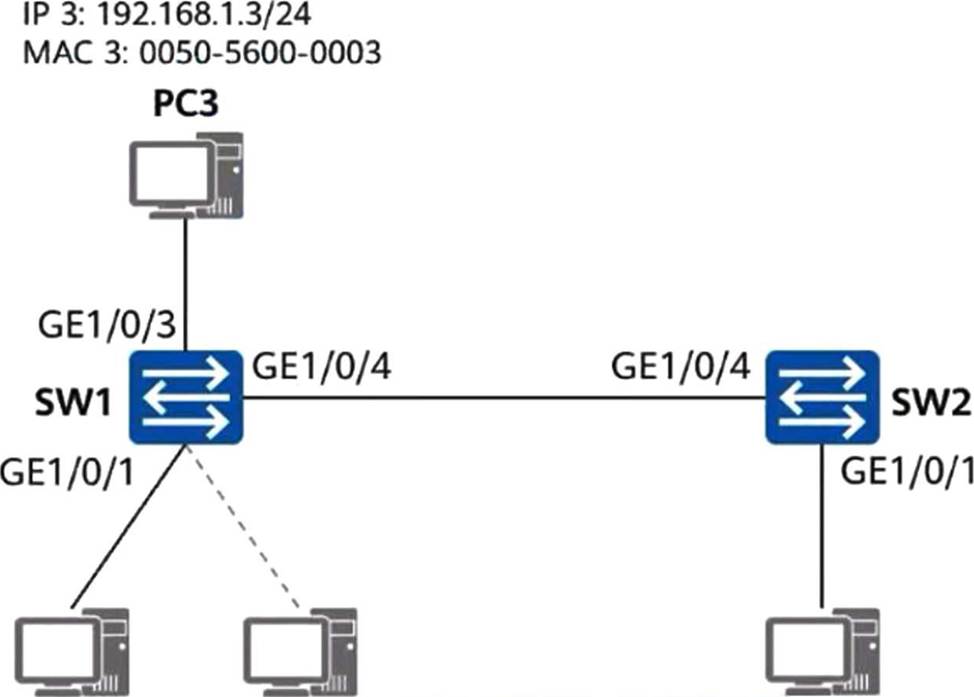
On the network shown in the figure, GE1/0/1 and GE1/0/2 of SW1 are access interfaces, and their PVIDs are VLAN 2 and VLAN 3 respectively. GE1/0/1 of SW2 is also an access interface, and its PVID is VLAN 4.

Which of the following configurations on SW1 and SW2 can ensure that data packets sent from PC1 and PC2 can reach PC3?
- A . Configure GE1/0/3 of SW2 as a hybrid interface, add it to VLAN 4 in untagged mode, and retain the default PVID.
- B . Configure GE1/0/3 of SW1 as a hybrid interface, add it to VLAN 2 and VLAN 3 in untagged mode, and set its PVID to VLAN 4.
- C . Configure GE1/0/3 of SW2 as a trunk interface, configure it to allow packets from VLAN 4 to pass through, and set its PVID to VLAN 4.
- D . Configure GE1/0/3 of SW1 as a trunk interface, configure it to allow packets from VLAN 2 and VLAN 3 to pass through, and set its PVID to VLAN 4.
B, C
Explanation:
PC1 and PC2 are in different VLANs on SW1, while PC3 is in VLAN 4 on SW2. To allow traffic from VLAN 2 and VLAN 3 users to reach PC3 through the inter-switch link, SW1 must be able to send frames from PC1 and PC2 toward SW2 in a form that SW2 can place into VLAN 4.
Option B is valid because a hybrid interface on SW1 can send frames from VLAN 2 and VLAN 3 untagged, and setting the PVID to VLAN 4 allows untagged inbound frames on the peer side to be associated appropriately when matched with the SW2 configuration.
Option C is also valid because configuring SW2’s GE1/0/3 as a trunk allowing VLAN 4 and setting its PVID to VLAN 4 means untagged frames arriving from SW1 are treated as belonging to VLAN 4 and can then be forwarded to PC3 through its access interface.
Option A is incomplete because only configuring SW2 does not solve the VLAN handling on SW1.
Option D is incorrect because a trunk on SW1 would send VLAN 2 and VLAN 3 frames tagged, which would not match the VLAN 4-only expectation on SW2 in this scenario.
OSPF supports the division of a network into areas, each identified by an area ID that ranges from 0 to 255. Area 0 is designated as the backbone area.
- A . TRUE
- B . FALSE
B
Explanation:
This statement is false because although Area 0 is indeed the backbone area, the statement about the area ID range is incorrect. In OSPF, the area ID is a 32-bit value, which can be represented either in decimal format or in IPv4 address format such as 0.0.0.0. It is not limited to the numeric range 0 to 255.
For example, an area can be configured as 0, 1, 100, or in dotted-decimal form such as 0.0.0.1 or 0.0.0.10, depending on implementation and configuration style. HCIA-Datacom teaches that OSPF uses hierarchical area design to improve scalability, reduce SPF calculation scope, and optimize LSA flooding. The backbone area, which is Area 0, serves as the transit area connecting all non-backbone areas in a standard OSPF design. Therefore, the second part of the statement is correct, but the first part is wrong, making the entire statement false. This question tests whether the learner understands both the function of Area 0 and the actual format of OSPF area identifiers.
OSPF supports the division of a network into areas, each identified by an area ID that ranges from 0 to 255. Area 0 is designated as the backbone area.
- A . TRUE
- B . FALSE
B
Explanation:
This statement is false because although Area 0 is indeed the backbone area, the statement about the area ID range is incorrect. In OSPF, the area ID is a 32-bit value, which can be represented either in decimal format or in IPv4 address format such as 0.0.0.0. It is not limited to the numeric range 0 to 255.
For example, an area can be configured as 0, 1, 100, or in dotted-decimal form such as 0.0.0.1 or 0.0.0.10, depending on implementation and configuration style. HCIA-Datacom teaches that OSPF uses hierarchical area design to improve scalability, reduce SPF calculation scope, and optimize LSA flooding. The backbone area, which is Area 0, serves as the transit area connecting all non-backbone areas in a standard OSPF design. Therefore, the second part of the statement is correct, but the first part is wrong, making the entire statement false. This question tests whether the learner understands both the function of Area 0 and the actual format of OSPF area identifiers.
In the figure, a web client sends an HTTP request to a web server, and the router in between performs operations on the HTTP request.
Which of the following statements are false about the router’s operations? (Select all that apply)

- A . The router encapsulates a new destination IP address before sending the data.
- B . The router removes the data frame header and checks the destination IP address.
- C . The router searches the IP routing table based on the port number in the transport layer header.
- D . The router checks the content of the application-layer data and determines the port from which to send the data.
A, C, D
Explanation:
A router works mainly at the network layer. When it receives a frame, it removes the Layer 2 header and trailer, examines the destination IP address in the Layer 3 header, consults the routing table, selects the outgoing interface, and then re-encapsulates the packet into a new Layer 2 frame for the next hop. Therefore, statement B is true and is not part of the answer.
Statement A is false because the router does not create a new destination IP address during normal forwarding. The source and destination IP addresses remain unchanged end to end unless special functions such as NAT are used.
Statement C is false because routing-table lookup is based on the destination IP address, not on TCP or UDP port numbers.
Statement D is also false because normal IP routing does not inspect application-layer content to determine the outgoing interface. That decision is made from the network-layer destination address and the routing table. This question tests the layered forwarding logic of routers in TCP/IP networks.
In the figure, a TCP connection has been established between PC1 and PC2.

After PC1 sends a data segment to PC2, which of the following is the acknowledgment number in the packet returned by PC2?
- A . b+23
- B . a+44
- C . b+1
- D . a+22
B
Explanation:
In TCP, the acknowledgment number indicates the next byte that the receiver expects to receive. In the figure, PC1 sends a TCP segment to PC2 with sequence number = a+22 and payload length = 22 bytes. Since TCP sequence numbers count bytes, the last byte carried in this segment corresponds to sequence number a+43. Therefore, after PC2 successfully receives this data, it sends back an ACK indicating that the next expected byte is a+44.
That is why option B is correct. This is a standard TCP reliability mechanism. TCP does not acknowledge “packets” as units; it acknowledges the byte stream. The ACK number always points to the next byte expected from the peer. The source and destination port numbers identify the session, but the sequence and acknowledgment numbers track ordered delivery. HCIA-Datacom uses this mechanism to explain connection-oriented transport, reliable delivery, retransmission, and traffic control. Understanding how the payload length affects sequence progression is essential when analyzing packet captures and troubleshooting TCP communication problems in enterprise networks.
If a network device has both a static route and a direct route to network 10.1.1.0/24, it uses the direct route preferentially.
- A . TRUE
- B . FALSE
A
Explanation:
This statement is true. When a device has multiple routes to the same destination prefix, route selection is based first on the longest prefix match, and when prefix length is the same, the device compares the route preference or administrative priority associated with each routing source. On Huawei devices, a direct route has a better preference than a static route, so the direct route is selected first when both routes have the same destination and mask.
A direct route is generated automatically when an IP address is configured on an interface and that interface is Up. Because the destination network is directly connected, this route is considered more trustworthy and efficient than a manually configured static route pointing to the same prefix. HCIA-Datacom uses this principle to explain route selection, routing-table generation, and troubleshooting cases where a configured static route does not appear as the active route because a direct or dynamic route has higher priority. This is a basic but important concept in IP forwarding and helps engineers correctly interpret routing tables on Huawei routers and Layer 3 switches.
R1 has the following configurations:
[R1] radius-server template 1
[R1-radius-1] radius-server authentication 10.1.6.6 1812
[R1-radius-1] radius-server accounting 10.1.6.6 1813
[R1-radius-1] radius-server shared-key cipher YsHsjx_202206139
[R1-radius-1] quit
[R1] aaa
[R1-aaa] authentication-scheme auth1
[R1-aaa-authen-auth1] authentication-mode radius
[R1-aaa-authen-auth1] quit
[R1-aaa] accounting-scheme acc1
[R1-aaa-accounting-acc1] accounting-mode radius
[R1-aaa-accounting-acc1] quit
[R1-aaa] domain huawei.com
[R1-aaa-domain-huawei.com] authentication-scheme auth1
[R1-aaa-domain-huawei.com] accounting-scheme acc1
[R1-aaa-domain-huawei.com] radius-server 1
[R1-aaa-domain-huawei.com] quit
[R1-aaa] quit
Which of the following statements is true?
- A . RADIUS does not support accounting. Even if an accounting server is specified in the RADIUS server template, accounting cannot be performed when terminals access the network.
- B . The user cannot obtain authorization information after being authenticated because the IP address of the authorization server is not configured in the RADIUS server template.
- C . When a terminal initiates an authentication request, R1 needs to first establish a TCP connection with the server whose IP address is 10.1.6.6.
- D . When a terminal uses the user name [email protected] to initiate authentication, RADIUS authentication is used.
D
Explanation:
Option D is correct. The AAA configuration binds the domain huawei.com to the authentication scheme auth1, which uses RADIUS as the authentication mode, and to the accounting scheme acc1, which also uses RADIUS. Therefore, when a user logs in with a user name in the format [email protected], the device parses the suffix @huawei.com, matches the domain, and applies the configured RADIUS authentication method.
Option A is false because RADIUS does support accounting, and UDP port 1813 is commonly used for that purpose.
Option B is false because a separate authorization server IP is not strictly required in this context; RADIUS can carry authorization attributes together with authentication/accounting processing depending on server behavior and device configuration.
Option C is false because standard RADIUS communication uses UDP, not TCP, with authentication typically on port 1812 and accounting on 1813. HCIA-Datacom teaches domain-based AAA processing as a key concept, where the user name suffix determines which authentication, authorization, and accounting policies are applied on the NAS device.