
Practice Free Workday Pro Integrations Exam Online Questions
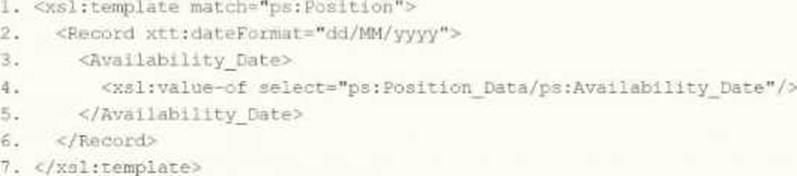
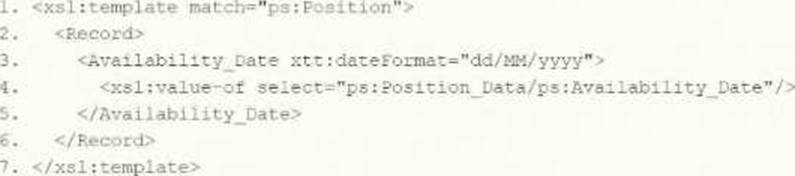
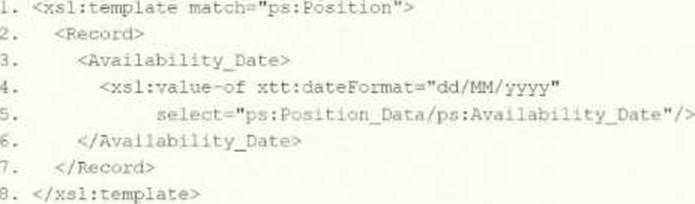
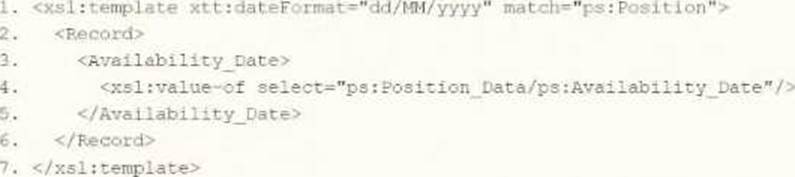
You need the integration file to generate the date format in the form of "31/07/2025" format
• The first segment is day of the month represented by two characters.
• The second segment is month of the year represented by two characters.
• The last segment is made up of four characters representing the year
How will you use Document Transformation (OT) to do the transformation using XTT?
A)
B)
C)
D)
- A . Option A
- B . Option B
- C . Option C
- D . Option D
A calculated field used as a field override in a Connector is not appearing in the output .
Assuming the field has a value, what could cause this to occur?
- A . Access not provided to calculated field data source.
- B . Access not provided to all fields in the calculated field.
- C . Access not provided to Connector calculated field web service.
- D . Access not provided to all instances of calculated field.
How many integration systems can an ISU be assigned to concurrently?
- A . One
- B . Three
- C . Five
- D . Unlimited
Refer to the scenario. You are configuring a Core Connector: Worker integration with the Data Initialization Service (DIS) enabled that runs once daily. The integration must extract only active worker records with changes to compensation, home address, or business title since the last run 24 hours ago, using Workday’s change detection to avoid full extracts.
During testing, an employee’s home address is updated, but the integration does not detect the change in the output. The employee is eligible, the connector uses the correct integration field attributes, and the launch parameters are properly configured for a Full-Diff extract.
What configuration task must you modify from the integration system to ensure the expected change is included in the output?
- A . Configure Integration Field Overrides
- B . Maintain Integration Attributes
- C . Edit Subscriptions
- D . Configure Integration Transaction Log
You need to create a report that includes data from multiple business objects. For a supervisory organization specified at run time, the report must output one row per worker, their active benefit plans, and the names and ages of all related dependents. The Worker business object contains the Employee, Benefit Plans, and Dependents fields. The Dependent business object contains the employee’s dependent’s Name and Age fields.
How would you select the primary business object (PBO) and related business objects (RBO) for the report?
- A . PBO: Dependent, RBO: Worker
- B . PBO: Worker, RBO: Dependent
- C . PBO: Dependent, no RBOs
- D . PBO: Worker; no RBOs
What is the relationship between the Integration System User (ISU), Integration System Security Group (ISSG), and domain security policies?
- A . Assign domain security policies to the ISSG, and then assign the ISSG to the ISU.
- B . Assign domain security policies to the ISU, and then assign the ISU to the ISSG.
- C . Assign the ISU to the ISSG, and then assign the ISSG to domain security policies.
- D . Assign the ISSG to the ISU, and then assign the ISU to domain security policies.
Refer to the following scenario to answer the question below.
An external system needs a file containing data for recent worker job changes. They would like to receive a file routinely at 5:00 PM Eastern Standard Time, every 48 hours. The file should show job changes since the last integration run.
What is the recurrence type of the integration schedule?
- A . Recurs every 2 day(s)
- B . Custom Recurrence
- C . Recurs every 48 hours
- D . Dependent Recurrence
Refer to the following scenario to answer the question below.
You have configured a Core Connector: Worker integration, which utilizes the following basic configuration:
• Integration field attributes are configured to output the Position Title and Business Title fields from the Position Data section.
• Integration Population Eligibility uses the field Is Manager which returns true if the worker holds a manager role.
• Transaction Log service has been configured to Subscribe to specific Transaction Types: Position Edit Event.
You launch your integration with the following date launch parameters (Date format of
MM/DD/YYYY):
• As of Entry Moment: 05/25/2024 12:00:00 AM
• Effective Date: 05/25/2024
• Last Successful As of Entry Moment: 05/23/2024 12:00:00 AM
• Last Successful Effective Date: 05/23/2024
To test your integration, you made a change to a worker named Jeff Gordon who is not assigned to the manager role. You perform an Edit Position on Jeff Gordon and update their business title to a new value. Jeff Gordon’s worker history shows the Edit Position Event as being successfully completed with an effective date of 05/24/2024 and an Entry Moment of 05/24/2024 07:58:53 AM however Jeff Gordon does not show up in your output.
What configuration element would have to be modified for the integration to include Jeff Gordon in the output?
- A . Transaction log subscription
- B . Integration Population Eligibility
- C . Date launch parameters
- D . Integration Field Attributes
What is the limitation when assigning ISUs to integration systems?
- A . An ISU can be assigned to five integration systems.
- B . An ISU can be assigned to an unlimited number of integration systems.
- C . An ISU can be assigned to only one integration system.
- D . An ISU can only be assigned to an ISSG and not an integration system.
You are configuring a Core Connector integration that will send data to an external vendor. The vendor requires that the integration output file includes a unique Batch ID in its filename.
This ID must follow the format VNDR_YEARMONTH_seq.xml, where YEAR is the four-digit year, MONTH is the two-digit month, and seq is a five-digit sequence number that must reset to 00001 at the beginning of each new month.
Which settings must you configure on the integration Filename Sequence Generator to produce this Batch ID filename?
- A . Sequence ID Format Restart Frequency
- B . Sequence ID Format Restart Frequency
- C . Sequence ID Format Restart Frequency
- D . Sequence ID Format Restart Frequency