
Practice Free Plat-Dev-201 Exam Online Questions
Question #61
A company’s engineering department is conducting a month-long test on the scalability of an in-house-developed software that requires a cluster of 100 or more servers.
Which of the following models is the best to use?
- A . PaaS
- B . SaaS
- C . BaaS
- D . laaS
Correct Answer: D
D
Explanation:
Infrastructure as a Service (IaaS) is the best model for the scenario described because it provides on-demand access to compute, storage, and networking resources that are ideal for a scalable server cluster. IaaS allows the engineering team to rent infrastructure resources without having to invest in physical hardware, making it perfect for temporary or fluctuating workloads, such as scalability testing.
Key Characteristics of IaaS:
Full control over the operating systems and applications running on the servers.
Flexible resource allocation to support high scalability.
Ideal for custom software testing where specific server configurations may be needed.
Why not the other options?
PaaS (Platform as a Service): While PaaS is excellent for application development and deployment, it abstracts the infrastructure layer, which would limit the engineering team’s control over the cluster’s
configuration.
SaaS (Software as a Service): SaaS delivers fully managed applications, not infrastructure or testing environments. It’s irrelevant for this use case.
BaaS (Backend as a Service): BaaS is tailored to mobile or web application backend development, providing APIs and pre-built services, not infrastructure for a server cluster.
Platform Developer
Reference: While this question is broader than Salesforce-specific concepts, understandingIaaS vs. PaaSis relevant when working with Salesforce development.
For example:
Salesforce operates as aPaaS (e.g., Force.com platform), allowing developers to build and deploy applications without managing underlying servers.
Testing scalability and performance at an infrastructure level (as in the question) would fall underIaaSconcepts, which Salesforce developers might encounter when integrating external services or infrastructure like AWS, Azure, or Google Cloud.
This foundational knowledge complements your understanding of cloud services in the Salesforce ecosystem.
D
Explanation:
Infrastructure as a Service (IaaS) is the best model for the scenario described because it provides on-demand access to compute, storage, and networking resources that are ideal for a scalable server cluster. IaaS allows the engineering team to rent infrastructure resources without having to invest in physical hardware, making it perfect for temporary or fluctuating workloads, such as scalability testing.
Key Characteristics of IaaS:
Full control over the operating systems and applications running on the servers.
Flexible resource allocation to support high scalability.
Ideal for custom software testing where specific server configurations may be needed.
Why not the other options?
PaaS (Platform as a Service): While PaaS is excellent for application development and deployment, it abstracts the infrastructure layer, which would limit the engineering team’s control over the cluster’s
configuration.
SaaS (Software as a Service): SaaS delivers fully managed applications, not infrastructure or testing environments. It’s irrelevant for this use case.
BaaS (Backend as a Service): BaaS is tailored to mobile or web application backend development, providing APIs and pre-built services, not infrastructure for a server cluster.
Platform Developer
Reference: While this question is broader than Salesforce-specific concepts, understandingIaaS vs. PaaSis relevant when working with Salesforce development.
For example:
Salesforce operates as aPaaS (e.g., Force.com platform), allowing developers to build and deploy applications without managing underlying servers.
Testing scalability and performance at an infrastructure level (as in the question) would fall underIaaSconcepts, which Salesforce developers might encounter when integrating external services or infrastructure like AWS, Azure, or Google Cloud.
This foundational knowledge complements your understanding of cloud services in the Salesforce ecosystem.
Question #62
A Developer Edition org has five existing accounts. A developer wants to add 10 more accounts for testing purposes.
The following code is executed in the Developer Console using the Execute Anonymous window:
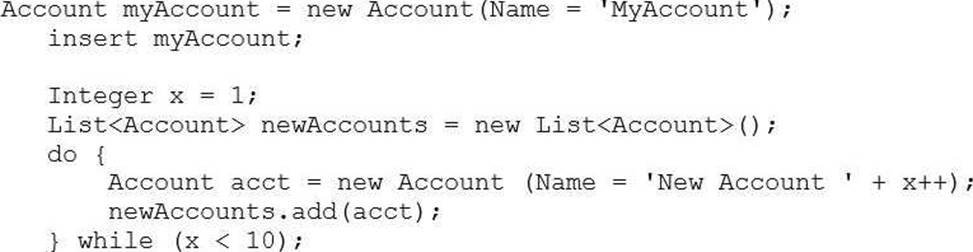
How many total accounts will be in the org after this code is executed?
- A . 5
- B . 6
- C . 10
- D . 15
Correct Answer: D
D
Explanation:
The code snippet in question creates and inserts an account namedMyAccountand then initializes a loop to add additional accounts.
The loop runs fromx = 1and continues adding accounts untilx < 10.
Since the conditionx++is post-increment, the loop runs exactly 10 times, creating and adding 10 new accounts to thenewAccountslist.
At the end, theinsertDML statement persists these 10 new accounts, along with the already existing account (MyAccount).
Total accounts in the org:
Existing accounts = 5
New accounts added = 10
Total = 15
: Salesforce Apex Developer Guide
Salesforce SOQL & SOSL Reference
D
Explanation:
The code snippet in question creates and inserts an account namedMyAccountand then initializes a loop to add additional accounts.
The loop runs fromx = 1and continues adding accounts untilx < 10.
Since the conditionx++is post-increment, the loop runs exactly 10 times, creating and adding 10 new accounts to thenewAccountslist.
At the end, theinsertDML statement persists these 10 new accounts, along with the already existing account (MyAccount).
Total accounts in the org:
Existing accounts = 5
New accounts added = 10
Total = 15
: Salesforce Apex Developer Guide
Salesforce SOQL & SOSL Reference