
Practice Free JN0-232 Exam Online Questions
Which two statements about user-defined security zones are correct? (Choose two.)
- A . Users cannot share security zones between routing instances.
- B . Users can configure multiple security zones.
- C . Users can share security zones between routing instances.
- D . User-defined security zones do not apply to transit traffic.
B, C
Explanation:
User-defined security zones allow users to configure multiple security zones and share them between routing instances. This allows users to easily manage multiple security zones and their associated policies. For example, a user can create a security zone for corporate traffic, a security zone for guest traffic, and a security zone for public traffic, and then configure policies to control the flow of traffic between each of these security zones. Transit traffic can also be managed using user-defined security zones, as the policies applied to these zones will be applied to the transit traffic as well.
What information does the show chassis routing-engine command provide?
- A . chassis serial number
- B . resource utilization
- C . system version
- D . routing tables
By default, revenue interfaces are placed into which system-defined security zone on an SRX Series device?
- A . trust
- B . null
- C . untrust
- D . junos-trust
Click the Exhibit button.
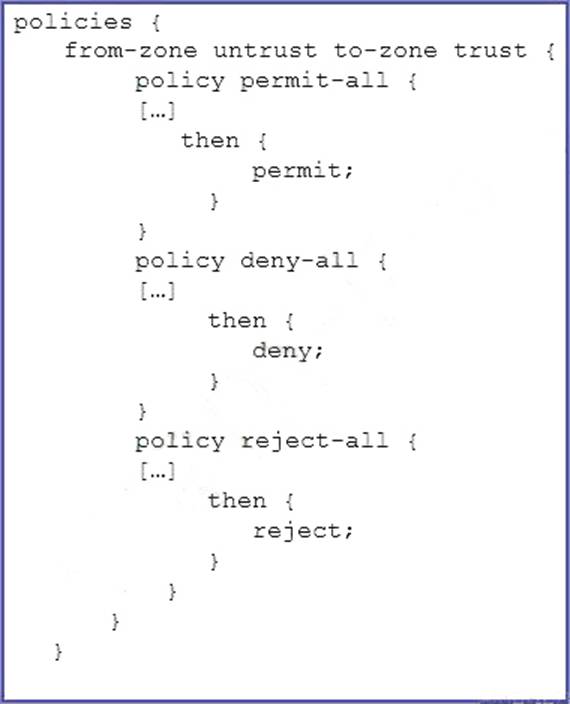
Which two statements are correct about the partial policies shown in the exhibit? (Choose two.)
- A . UDP traffic matched by the deny-all policy will be silently dropped.
- B . TCP traffic matched by the reject-all policy will have a TCP RST sent.
- C . TCP traffic matched from the zone trust is allowed by the permit-all policy.
- D . UDP traffic matched by the reject-all policy will be silently dropped.
Click the Exhibit button.
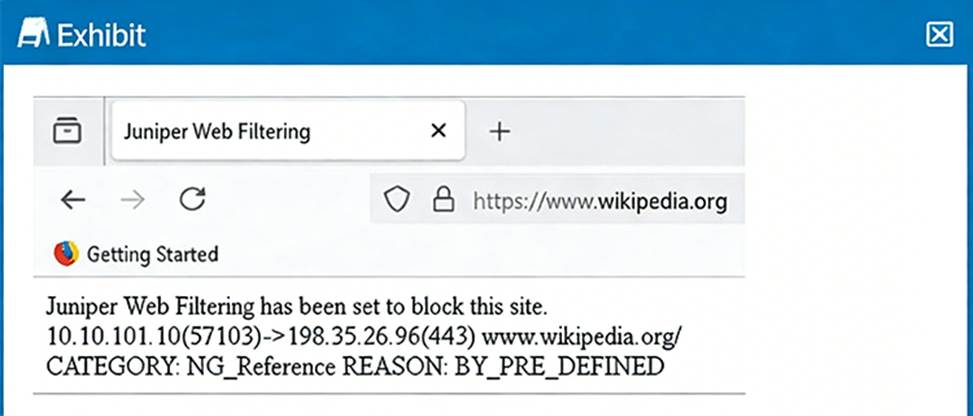
Referring to the exhibit, which two statements are correct? (Choose two.)
- A . The URL matches a predefined Web filtering category.
- B . The NextGen Web Filtering type is being used.
- C . The SRX firewall does not have an SSL proxy configuration.
- D . This is a custom Web filtering block message.
A B
Explanation:
From the exhibit:
The user attempted to access https: //www.wikipedia.org.
The block page indicates:
CATEGORY: NG_Reference
REASON: BY_PRE_DEFINED
The header states: “Juniper Web Filtering has been set to block this site.”
Analysis of options:
Option A: Correct. The log shows “REASON: BY_PRE_DEFINED,” which means the site was blocked because it matched apredefined category in the Web filtering database.
Option B: Correct. The category “NG_Reference” indicates that the NextGen (Enhanced/Cloud-based) Web Filtering type is being used.
Option C: Incorrect. The exhibit does not provide any information about SSL proxy configuration; it only shows that the HTTPS site was blocked.
Option D: Incorrect. The block page shown is the standard Juniper default block page, not a custom message.
Correct Statements: The URL matches a predefined Web filtering category, and the NextGen Web Filtering type is being used.
Reference: Juniper Networks CWeb Filtering (SurfControl, Enhanced, and NextGen Web Filtering), Junos OS Security Fundamentals.
Which two statements describe what Port Address Translation (PAT) does? (Choose two.)
- A . It maps an external IP address to an internal IP address.
- B . It enables multiple external clients to initiate a connection with multiple internal devices.
- C . It enables multiple internal devices to share a single external IP address.
- D . It maps an internal IP address to an external IP address and port number.
C D
Explanation:
PAT (Port Address Translation), also called NAT overload, allows many devices to share a single public IP:
Option C: Correct. Multiple internal hosts share a single external IP.
Option D: Correct. Each internal host is mapped to the same public IP but differentiated by unique port numbers.
Option A: This describes basic static NAT (1-to-1 mapping).
Option B: Incorrect, this describes general NAT behavior but not specific to PAT.
Correct Statements: PAT enables multiple internal devices to share one external IP, and it maps internal IPs to external IP + port.
Reference: Juniper Networks CSource NAT and PAT Operations, Junos OS Security Fundamentals.
Which statement is correct about packet mode processing?
- A . Packet mode enables session-based processing of incoming packets.
- B . Packet mode works with NAT, VPNs, UTM, IDP, and other advanced security services.
- C . Packet mode bypasses the flow module.
- D . Packet mode is the basis for stateful processing.
You are asked to create a security policy that controls traffic allowed to pass between the Internet and private security zones. You must ensure that this policy is evaluated before all other policy types on your SRX Series device.
In this scenario, which type of security policy should you create?
- A . routing policy
- B . default policy
- C . zone policy
- D . global policy
D
Explanation:
Global policies (Option D): Evaluated before zone-based policies. They allow centralized control and can apply across all zones. Perfect for Internet-to-private traffic that must be enforced before other rules.
Routing policy (Option A): Controls routing decisions, not traffic forwarding/security.
Default policy (Option B): Denies all traffic by default, but cannot be customized for early evaluation.
Zone policy (Option C): Zone-based policies apply after global policies and are limited to specific zone pairs.
Correct Policy Type: Global policy
Reference: Juniper Networks CGlobal Security Policies vs Zone-Based Policies, Junos OS Security Fundamentals.
You want to enable NextGen Web Filtering in SRX Series devices.
In this scenario, which two actions will accomplish this task? (Choose two.)
- A . Generate a CA-signed certificate.
- B . Generate a self-signed certificate.
- C . Configure an SSL initiation profile.
- D . Configure an SSL proxy profile.
B D
Explanation:
NextGen Web Filtering (NGWF) requires SSL proxy functionality to inspect HTTPS traffic. To enable
NGWF:
Option B: You can generate a self-signed certificate for SSL proxy functionality (or import a CA-signed certificate, but the course emphasizes self-signed for lab/demo purposes).
Option D: You must configure an SSL proxy profile so that HTTPS traffic can be decrypted and inspected.
Option A: A CA-signed certificate may be used in production but is not strictly required to enable NGWF.
Option C: SSL initiation profiles are used for outbound SSL inspection initiated by the SRX, not for NGWF traffic interception.
Correct Actions: Generate a self-signed certificate, Configure an SSL proxy profile
Reference: Juniper Networks CNextGen Web Filtering Configuration with SSL Proxy, Junos OS Security Fundamentals.
Click the Exhibit button.
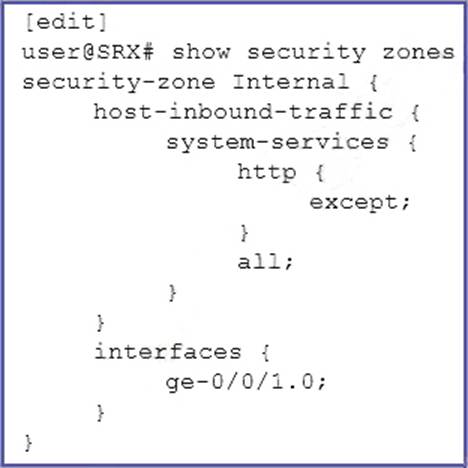
What is the purpose of the host-inbound-traffic configuration shown in the exhibit?
- A . to permit host inbound HTTP traffic and deny all other traffic on the internal security zone
- B . to deny and log all host inbound traffic on the internal security zone, except for HTTP traffic
- C . to permit all host inbound traffic on the internal security zone, but deny HTTP traffic
- D . to permit host inbound HTTP traffic on the internal security zone