
Practice Free JN0-232 Exam Online Questions
Which two statements about security zones are correct? (Choose two.)
- A . A security zone includes interfaces assigned to different routing instances.
- B . You add a network interface to a security zone before it can send or receive traffic.
- C . Interfaces in the same security zone can use different routing instances.
- D . Security zones control the type of exception traffic accepted by a network interface.
Which two products will allow security policy management on SRX Series devices? (Choose two.)
- A . Juniper Mist
- B . Security Director
- C . JIMS
- D . JSA
Which two statements are correct about unified security policies? (Choose two.)
- A . Dynamic applications in unified security policies analyze traffic based on Layer 4 information.
- B . Traffic that matches a unified policy will not be evaluated by traditional security policy.
- C . Dynamic applications in unified security policies analyze traffic based on Layer 7 information.
- D . Traffic that matches a traditional policy will not be evaluated by unified security policy.
Which two characteristics of destination NAT and static NAT are correct? (Choose two.)
- A . Destination NAT requires address range sizes that match the devices being translated.
- B . Destination NAT supports port forwarding.
- C . Static NAT automatically creates a matching rule for the opposite direction.
- D . Static NAT uses Port Address Translation.
Which two statements about SRX Series zones are correct? (Choose two.)
- A . The Junos-host zone allows the use of security policies to control access to the SRX Series Firewall.
- B . The null zone allows the use of security policies to log dropped control plane traffic.
- C . The functional zone is used to define the management interface on smaller SRX Series Firewalls.
- D . A security zone processes intra-zone traffic without a security policy.
You plan to use unified security policies to identify and control nested HTTP applications.
In this scenario, which two actions must you perform on your SRX Series Firewall? (Choose two.)
- A . Install the application identification (AppID) feature license on the SRX Series Firewall.
- B . Include dynamic application objects in your security policies.
- C . Create all the unified security policies in the global zone.
- D . Disable the default security policy.
What is a purpose for creating multiple routing instances on an SRX Series Firewall device?
- A . to manage routing protocols and updates
- B . to simplify the configuration of network interfaces
- C . to maintain separation of routing information for security purposes
- D . to enable network monitoring through SNMP
You want to enable NextGen Web Filtering (NGWF) on your SRX Series Firewall
Which two actions must you perform in this scenario? (Choose two.)
- A . Install a NextGen Web Filtering feature license.
- B . Enable NextGen Web Filtering as the default Web Altering type.
- C . Assign a public IP address to the loopback interface.
- D . Enable SSL host Inbound traffic on the untrust security zone.
Referring to the exhibit, which statement is correct?
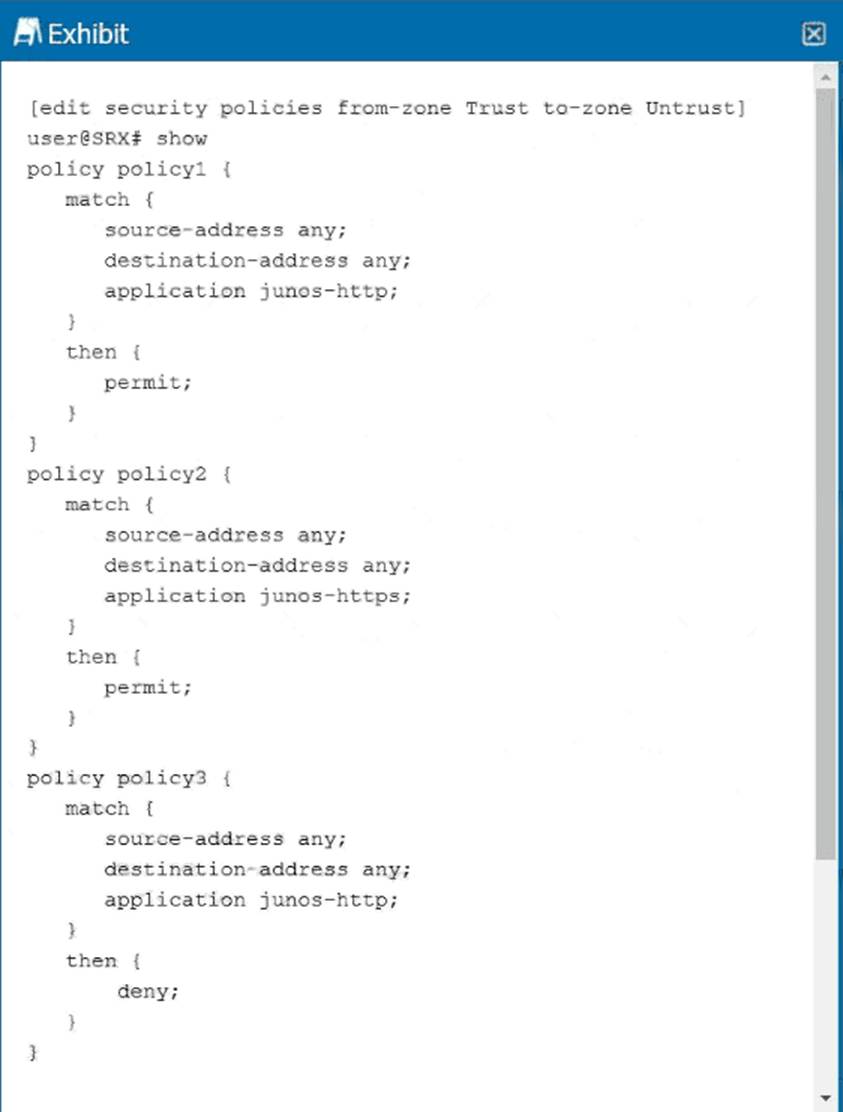
- A . policy2 will be shadowed because it matches the same application as policy1.
- B . policy3 will be shadowed because it matches the same application as policy1.
- C . policy1 will be shadowed because it matches the same application as policy3.
- D . None of the policies will be shadowed.
Which two statements are true about the NextGen Web Filtering (NGWF) feature on an SRX Series device? (Choose two.)
- A . The NGWF feature consults your local lists before consulting the Juniper cloud.
- B . The NGWF feature does not require a license.
- C . The NGWF feature consults the Juniper cloud before consulting your local lists.
- D . The NGWF features requires a license.