
Practice Free JN0-223 Exam Online Questions
You want to use a Python package or module.
In this scenario, which statement would accomplish this task?
- A . reap
- B . dir
- C . input
- D . Import
D
Explanation:
In Python, to use a package or module, you use the import statement. This statement allows you to load a module into your script so that you can use its functions, classes, and variables. For example, if you wanted to use the math module, you would write import math. This makes all the functions and constants in the math module available for use in your program.
Option A (reap), B (dir), and C (input) do not serve the purpose of importing modules. dir is used to list the attributes of an object, input is used to get user input, and reap is not a valid Python command related to importing modules.
Supporting
Reference: Python Documentation on Imports: The Python documentation provides clear guidelines on how to use the import statement to include modules in your Python scripts.
Exhibit.
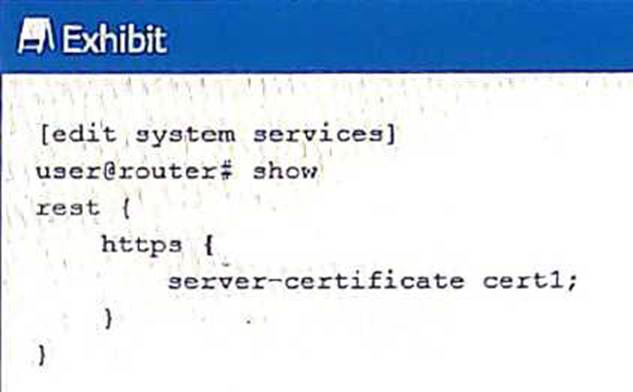
Referring to the exhibit, which statement about REST is correct?
- A . The device is configured to allow only two simultaneous REST connections.
- B . The device is configured to allow connections from the REST API Explorer
- C . The device is configured to allow HTTP connections on port 3030.
- D . The device is configured to allow HTTPS connections on port 3443.
Why is a REST API considered stateless?
- A . The client requests to the server do not include state information.
- B . The REST API is an international API.
- C . No client context is stored on the server between requests.
- D . The state of the server is not important when making requests.
Your organization is developing an application to automate management of Junos network appliances. You want to use the existing PyEZ libraries to improve the development process.
Which API would satisfy this requirement?
- A . REST API
- B . JETAPI
- C . RPC API
- D . XML API
What is the difference between a list and a tuple in Python?
- A . Lists are immutable objects that use square brackets, and tuples are mutable objects that use parentheses.
- B . Lists are mutable objects that use square brackets, and tuples are immutable objects that use parentheses.
- C . Lists are immutable objects that use parentheses, and tuples are immutable objects that use square brackets.
- D . Lists are mutable objects that use parentheses, and tuples are immutable objects that use square brackets.
B
Explanation:
In Python, the distinction between lists and tuples is essential for efficient programming:
Lists:
Mutable (B): This means that once a list is created, its elements can be changed, added, or removed.
Lists are versatile and commonly used when the data is expected to change.
Square Brackets: Lists are defined using square brackets [].
Example:
my_list = [1, 2, 3]
my_list[0] = 10 # Modifying the first element
Tuples:
Immutable (B): Once a tuple is created, it cannot be altered. Tuples are used when a fixed collection of items is needed, providing more integrity to the data.
Parentheses: Tuples are defined using parentheses ().
Example:
my_tuple = (1, 2, 3)
# my_tuple[0] = 10 # This would raise an error because tuples are immutable
Reference: Python Official Documentation: The Python Language Reference provides detailed information on data types like lists and tuples, including their mutability and syntax.
Automation Scripts: In the context of automation, understanding when to use mutable or immutable data structures can significantly impact script performance and reliability.
What is the correct sequence for Python script execution?
- A . The code is translated to byte code, the byte code is executed in runtime, and then the code is interpreted.
- B . The code is interpreted, the code is translated to byte code, and then the byte code is executed in runtime.
- C . The code is translated to byte code, the code is interpreted, and then the byte code is executed in runtime.
- D . The byte code is executed in runtime, the code is interpreted, and then the code is translated to byte code.
B
Explanation:
Python follows a specific execution flow when a script is run:
The code is interpreted:
Python is an interpreted language, meaning that the Python interpreter reads the code line by line.
When a Python script is executed, the interpreter first reads the source code.
The code is translated to bytecode:
After interpreting the source code, Python translates it into bytecode. Bytecode is an intermediate representation of the source code that is portable and efficient for execution by the Python Virtual Machine (PVM).
The bytecode is executed in runtime:
Finally, the Python Virtual Machine (PVM) executes the bytecode. The PVM is a part of the Python
runtime environment, responsible for interpreting the bytecode into machine-specific instructions for execution.
Hence, the correct sequence is: interpreted → translated to bytecode → bytecode executed in runtime.
Why the Other Options Are Incorrect:
Options A, C, and D present an incorrect order of the script execution process, especially in how bytecode is generated and executed.
Reference: Python’s documentation on the interpreter and its execution model explains this standard process.
A REST API client uses which two HTTP methods to execute RPC requests on the server? (Choose two.)
- A . POST
- B . HEAD
- C . GET
- D . CONNECT
A, C
Explanation:
REST APIs use HTTP methods to perform different operations on resources. In the context of RPC (Remote Procedure Call) requests:
GET: This method is used to retrieve data from the server. In a REST API, it is commonly used to fetch information about resources, such as the current configuration or operational state.
POST: This method is used to send data to the server to create or update a resource. In the context of RPC, POST is often used to execute a procedure on the server that may result in the modification of a resource or triggering of an action.
Options B (HEAD) and D (CONNECT) are not typically used for executing RPC requests:
HEAD is similar to GET but only retrieves the headers, not the body of the response.
CONNECT is used to establish a tunnel to the server, primarily for SSL-encrypted communication, and is not commonly associated with RESTful RPC operations.
Supporting
Reference: Juniper Networks REST API Documentation: The documentation provides detailed information about the use of HTTP methods in Juniper’s RESTful services.
"RESTful Web Services" by Leonard Richardson and Sam Ruby: This book explains the principles of REST and how different HTTP methods, particularly GET and POST, are used to interact with RESTful APIs.
What is the default port for NETCONF connections over SSH?
- A . 22
- B . 8080
- C . 830
- D . 433
C
Explanation:
https://www.juniper.net/documentation/us/en/software/junos/netconf/topics/topic-map/netconf-ssh-connection.html
The IANA-assigned port for NETCONF-over-SSH sessions is 830.
You are asked to write an on-box script that will be triggered when a specific interface on a Junos device goes down.
Which type of on-box script should you use to accomplish this task?
- A . commit
- B . event
- C . operation
- D . SNMP
B
Explanation:
An event script is used to automate responses to system events in Junos, such as an interface going down. These scripts are triggered automatically when a specified event occurs, making them suitable for tasks like monitoring interface status and executing actions when the status changes.
Option B (event) is correct because event scripts are designed for reacting to system events like an interface going down.
Option A (commit) is used for configuration changes, Option C (operation) is used for operational tasks, and Option D (SNMP) is not applicable in this context.
Supporting
Reference: Juniper Networks Event Scripts Documentation: Details how event scripts are used to automate responses to specific system events in Junos
Which two statements about NETCONF are true? (Choose two.)
- A . It uses the operations layer to lock the configuration of a Junos device.
- B . It uses the messages layer to commit the configuration of a Junos device.
- C . It uses the messages layer to lock the configuration of a Junos device.
- D . It uses the operations layer to commit the configuration of a Junos device.
A, D
Explanation:
NETCONF (Network Configuration Protocol) operates through different layers, with the operations layer being particularly important for managing configurations:
Operations Layer (A & D): This layer is responsible for actions like locking and committing the configuration on a Junos device. The lock operation prevents other sessions from modifying the configuration, and the commit operation applies the configuration changes to the device.
Options B and C are incorrect because the messages layer handles the communication aspects, such as exchanging data between the client and server, not performing configuration operations like locking and committing.
Reference: IETF RFC 6241 (NETCONF): Describes the protocol layers and their functions, with a focus on the operations layer.
Juniper Networks NETCONF Documentation: Provides insights into how NETCONF operations are managed in Junos