
Practice Free JN0-223 Exam Online Questions
Which HTTP status code indicates a response to a successful request?
- A . 500
- B . 302
- C . 200
- D . 400
C
Explanation:
Explanation
Reference: https://www.juniper.net/documentation/en_US/junos-space-sdk/13.1/apiref/com.juniper.junos_space.sdk.help/html/reference/Commonbehav.html
You must use Junos PyEZ to configure unique IP addresses on individual machines.
Which two features will permit this requirement? (Choose). Ian SCP module
- A . an SCP module
- B . a BSON data file
- C . a YAML data file
- D . a Jinja2 template
C, D
Explanation:
To configure unique IP addresses on individual machines using Junos PyEZ, you can use the following features:
YAML Data File (C): YAML files are used to store configuration data in a human-readable format. They are often used in combination with Jinja2 templates to provide the data necessary for template rendering.
Jinja2 Template (D): Jinja2 is a templating engine for Python that allows you to create dynamic templates. When used with Junos PyEZ, a Jinja2 template can be filled with data (such as IP addresses from a YAML file) to generate configuration snippets that are applied to different devices.
Options A (SCP module) and B (BSON data file) are not typically used with Junos PyEZ for this
purpose.
Reference: Junos PyEZ Documentation: Discusses the use of YAML files and Jinja2 templates for generating configurations.
Jinja2 Templating Documentation: Provides details on how to create and use templates in Python scripts.
You are using the curl tool to include multiple RPCs in a REST API request.
Which HTTP method must be used for this request?
- A . GET
- B . PUT
- C . POST
- D . HEAD
Which two statements about XML schema definition (XSD) files are correct? (Choose two.)
- A . XSD files define all the elements in an XML document and the document XML hierarchy.
- B . Every XML document must have an XSD file defined for it.
- C . An XSD file is not an XML document.
- D . XSD files ensure that everyone working with the XML document uses a common set of tags.
A, D
Explanation:
XML Schema Definition (XSD) files are used to define the structure and data types of an XML document. They ensure that the XML document adheres to a specific structure by defining the allowed elements, attributes, and their data types, thereby enforcing a consistent format.
Option A is correct because XSD files define the elements, attributes, and structure (hierarchy) of an XML document.
Option D is correct because XSD files provide a standardized format, ensuring that all parties working with the XML document use the same set of tags and structure.
Option B (Every XML document must have an XSD file defined for it) is incorrect; not every XML document requires an XSD file, although it’s beneficial for validation.
Option C (An XSD file is not an XML document) is incorrect because XSD files themselves are written in XML.
Supporting
Reference: W3C XML Schema Definition (XSD) Documentation: Explains the purpose and structure of XSD files, including their role in defining XML document schemas.
You are asked to develop an on-box Junos script that prevents deletion of the SNMP configuration.
Which type of script serves this purpose?
- A . commit script
- B . event script
- C . op script
- D . SNMP script
A
Explanation:
A commit script in Junos is used to enforce policies and configuration constraints on the device. These scripts are written in Extensible Stylesheet Language Transformations (XSLT) or Python and are executed automatically during the commit process of a configuration change.
In this context, to prevent the deletion of the SNMP configuration, a commit script is the appropriate choice. It can be designed to check the configuration changes being committed and reject any commit that attempts to delete or modify the SNMP configuration. This script essentially acts as a gatekeeper, ensuring that only allowable changes are committed to the device configuration.
Supporting
Reference: Juniper Networks Commit Scripts Documentation: The official Juniper documentation provides examples and use cases of commit scripts, including how they can be used to prevent unauthorized changes to the device configuration.
"Junos Automation Scripting" by Jonathan Looney: This resource gives practical examples and best practices for creating commit scripts to enforce configuration policies in Junos OS.
Junos supports which two APIs for on-box scripting? (Choose two.)
- A . JET
- B . Puppet
- C . XML
- D . Chef
A, C
Explanation:
Juniper Networks’ Junos operating system supports several APIs for on-box scripting, two of which are:
JET (Juniper Extension Toolkit): JET is a modern API framework that provides a programmable interface for interacting with Junos. It allows developers to create custom applications that run directly on Junos devices, enabling the automation of network operations. JET provides both a gRPC and a REST API interface, allowing for flexible integration with external systems.
XML API: The Junos XML API allows direct interaction with the Junos OS through XML-based requests. This API can be used to retrieve information, configure devices, and execute commands on Junos devices. The XML API is crucial for automation tasks as it provides a structured and consistent way to interact with the device’s configuration and operational data.
Detailed Explanation
JET (A) provides high-performance access to Junos routing, switching, and service elements via programmable interfaces. It is highly used for creating custom applications that require tight integration with the Junos OS.
XML (C), on the other hand, is a well-established method for interacting with Junos, especially for legacy systems or when working within environments where XML is the standard data format.
Other options like Puppet (B) and Chef (D) are not APIs provided by Junos for on-box scripting but are configuration management tools used externally to manage Junos devices.
Reference: Juniper Networks JET Documentation: Provides details on how to leverage JET APIs for automation.
Junos XML Management Protocol Guide: Describes how to use XML for scripting and automating tasks in Junos.
These APIs are key components of Juniper’s automation strategy, allowing for scalable, flexible, and efficient network operations.
You are asked to use the REST API to retrieve interface configuration information from your Junos device. You decide to use a cURL HTTP GET command to retrieve this information.
In this scenario, which statement is correct?
- A . The request is handled by the mod process running on the Junos device.
- B . The request is handled by the isrpd process running on the Junos device.
- C . The request is handled by the rpd process running on the Junos device.
- D . The request is handled by the isd process running on the Junos device
B
Explanation:
When using the REST API on a Junos device, the isrpd (Integrated Service Routing Process Daemon) process is responsible for handling REST API requests. This process listens for incoming HTTP
requests and processes them accordingly, including retrieving interface configuration information when a GET request is made.
Option B is correct because the isrpd process handles the REST API requests on a Junos device.
Options A (mod process), C (rpd process), and D (isd process) are incorrect in this context as they either do not exist or serve different purposes on a Junos device.
Supporting
Reference: Juniper Networks REST API Documentation: Provides insights into how REST API requests are managed and processed by the isrpd process on Junos devices.
What are two important aspects of the DevOps culture? (Choose two.)
- A . communication
- B . separation of duties
- C . use of specific tools
- D . people
A, D
Explanation:
Two important aspects of the DevOps culture are:
Communication (A): In a DevOps environment, continuous and effective communication between development, operations, and other stakeholders is crucial. It ensures that everyone is aligned, reduces misunderstandings, and facilitates faster and more efficient workflows.
People (D): DevOps is as much about the people as it is about the processes and tools. The culture emphasizes collaboration, shared responsibility, and a mindset focused on continuous improvement. Empowering people to work together across different disciplines is at the heart of DevOps.
Options B and C are not primary aspects of the DevOps culture. While tools are essential in implementing DevOps practices, the culture emphasizes communication and collaboration among people more than the use of specific tools or rigid separation of duties.
Reference: DevOps Handbook: Discusses the cultural aspects of DevOps, with a focus on communication and people.
DevOps Best Practices: Highlights the importance of fostering a culture that prioritizes collaboration and shared goals.
Exhibit.
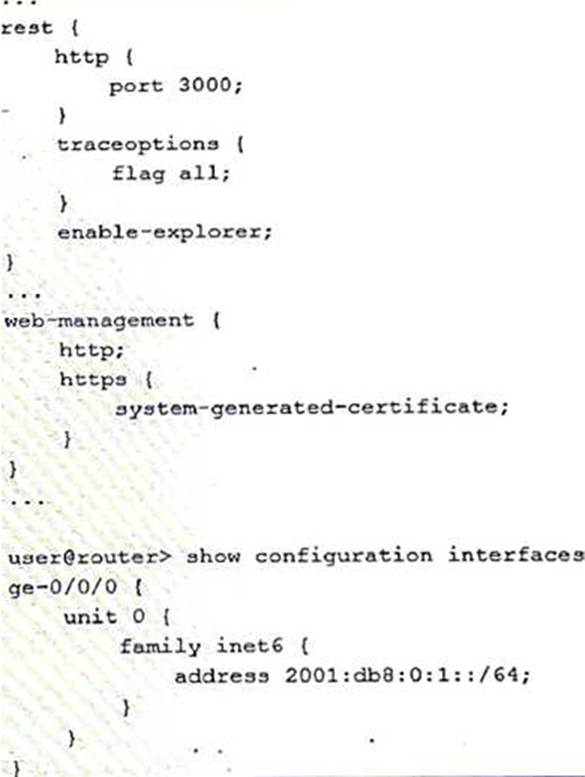
You have the configuration shown in the exhibit, but are unable to access the REST API Explorer.
Which configuration is necessary to solve this problem?
- A . Configure the rest service to be active on port 80.
- B . Configure an IPv4 address on ge-0/0/0 0.
- C . Configure a secondary IPv6 address on ge-0/0/0.0.
- D . Configure a firewall filter to explicitly permit SSH.
Which Junos configuration database is updated by PyEZ by default?
- A . shared
- B . dynamic
- C . private
- D . ephemeral
C
Explanation:
An event script is used to automate responses to system events in Junos, such as an interface going down. These scripts are triggered automatically when a specified event occurs, making them suitable for tasks like monitoring interface status and executing actions when the status changes.
Option B (event) is correct because event scripts are designed for reacting to system events like an interface going down.
Option A (commit) is used for configuration changes, Option C (operation) is used for operational tasks, and Option D (SNMP) is not applicable in this context.
Supporting
Reference: Juniper Networks Event Scripts Documentation: Details how event scripts are used to automate responses to specific system events in Junos