
Practice Free CCPSC Exam Online Questions
The Accident Pyramid indicates:
- A . That for every accident fatality there are many “near misses”
- B . How Murphy’s law operates
- C . That for every minor accident there are many accidents of greater consequences
- D . A graphical illustration of major incidents
For flashing liquids:
- A . the fraction flashed is always less than 10% of the total mass
- B . the fraction flashed is always more than 50% of the total mass
- C . the energy for the flashing comes from the enthalpy of the liquid
- D . flashing will never occur if the liquid is stored above its normal boiling point
A facility is selecting an inerting procedure for one of its large reactors.
Which inerting method would be expected to require the greatest nitrogen consumption?
- A . Vacuum purging
- B . Pressure purging
- C . Sweep through purging
- D . Vacuum/pressure purging
- E . Siphon purging
Which of the following statements is correct pertaining to Process Safety Audits? (Select all that apply)
- A . An audit is a systematic, independent review to verify conformance with established guidelines, standards, regulatory requirements, or self-imposed requirements of the organization.
- B . 2nd and 3rd party audit teams may include access to a representative of the facility being audited.
- C . Findings and recommendations usually are the same thing in a process safety audit.
- D . It is always appropriate for a facility to staff the audit team with only site personnel.
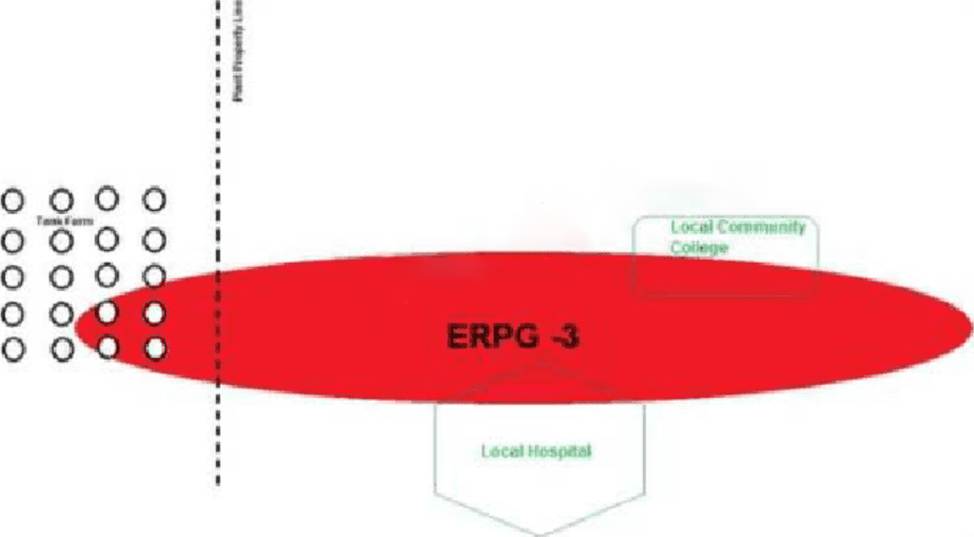
Consider the information shown on the diagram.
Which Risk Based Process Safety elements are most relevant to this situation? (select all that apply)
- A . Auditing
- B . Hazard Identification and Risk Analysis
- C . Emergency Management
- D . Contractor Management
- E . Stakeholder Outreach
- F . Safe Work Practices
The Risk Based Process Safety element which is designed to verify that a process is verified safe to start after a short term shutdown is Operational Readiness.
True or False?
- A . True
- B . False
Applicable codes and standards can be issued by (Select all that apply)
- A . The company
- B . Regulatory agencies
- C . The business unit or site
- D . National or international standards organizations
During a Risk Based Process Safety audit, one operator states that refresher training should be provided more frequently.
What actions should the auditor take? (Select all that apply)
- A . The auditor should classify this as a finding. No additional information is required
- B . The auditor should record this input, but not classify this as a finding based on a single observation
- C . The auditor should not classify this as a finding because the operator should not have been interviewed
- D . The auditor should interview additional operators before deciding whether to classify the observation as a finding
Which is the main objective for investigating process safety incidents?
- A . Optimize inspection and maintenance
- B . Reduce the number of incidents and improve plant performance
- C . Determine root causes and avoid recurrence
- D . Improve the Control of Work system
A line is provided for adding a chemical to a reactor to quench the reaction. The line has an automatic valve which is designed to open when reactor temperature exceeds the High-High limit.
Which of the items are key parts of the ITPM (Inspection, Testing, and Preventive Maintenance) requirements for the valve? (Select all that apply)
- A . Valve must be functionally tested to ensure that it opens quickly enough to quench the reaction
- B . Valve must be designed to open quickly enough to quench the reaction
- C . Valve and its control system must be inspected and tested with sufficient frequency to confirm that it will reliably open when required
- D . Valve must be designed to fail open