
Practice Free CCPSC Exam Online Questions
A company has done a statistical/metric study on root causes of incidents over the last dozen years. It shows a steady, marked increase in the number of incidents with root cause being insufficient operator knowledge of the process.
Which two of the following statements are most reasonable?
- A . The incident investigation element is clearly deficient
- B . The company’s training program might need improvement
- C . The company’s process safety competency could be deteriorating
- D . Facility audits are not detecting the issue
- E . Better writing of operating procedures will compensate for insufficient process knowledge by the operators
A chemical processor has a chlorine unloading facility shown in the sketch. The area has an ambient chlorine detector with audible alarm and a chemical operator is continually in attendance during the unloading operation. In the event of a leak, the action plan is to spray water on the leak and the contained spill to effect some dilution. Identify and discuss any negative consequences that might result from implementing this plan.
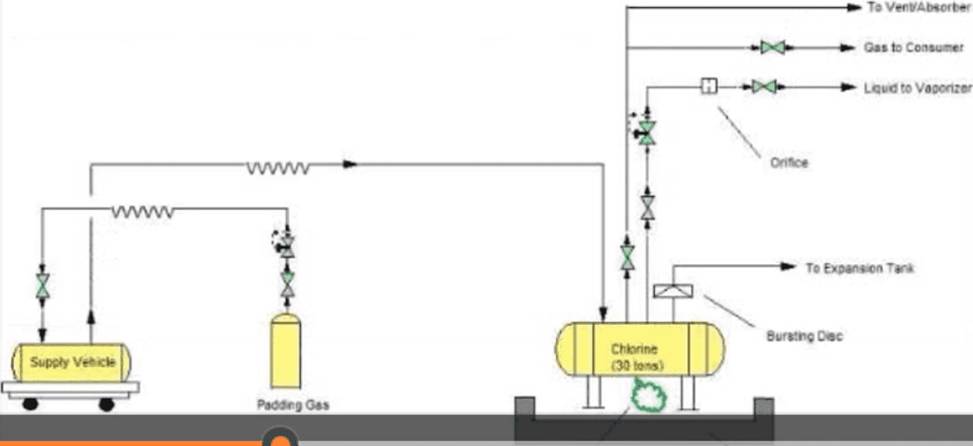
- A . Water spray always neutralizes chlorine safely with no risks
- B . Water spray may increase hazard by forming toxic/corrosive byproducts, spreading contamination, and increasing exposure risk
- C . The plan eliminates the need for detection systems
- D . There are no significant consequences if an operator is present
Which of the following can be considered applicable inspection methods as part of an Inspection/Testing/Preventive Maintenance program under the Asset Integrity and Reliability Element? (Select all that apply)
- A . Ultrasonic Thickness Measurements
- B . Work Orders
- C . Ultrasonic Leak Detection
- D . Positive Material Identification
Identifying potential change situations is characteristic of:
- A . Process Knowledge Management
- B . Operational Readiness
- C . Management Review and Continuous Improvement
- D . Management of Change
- E . Hazard Identification and Risk Analysis
A worker appears to be improvising instead of following procedures. A review indicates that the procedures provide the correct instructions. The worker says “I don’t understand the procedure, can you explain?” You explain the procedure, and then this worker performs consistently well. Then you give the worker a new procedure to follow and this worker begins to improvise on the new procedure. After a verbal explanation the performance improves.
What is the most likely explanation for this situation?
- A . Worker does not understand what can go wrong if procedures are not followed
- B . Worker did not study new procedures before using them
- C . Worker may have a reading disability
Which of the following are effective methods for verifying that an operator understood the training provided? (Select all that apply)
- A . The operator signing a form to indicate that they understood the training provided
- B . A written quiz or test that must be passed after the training has been completed
- C . An attendance sheet from the training course
- D . Documentation from the trainer that the operator demonstrated understanding of the training provided
What are the main objectives for conducting a Process Safety Management audit? (Select all that apply)
- A . Reduce process safety risks
- B . Verify effectiveness of Risk-Based Process Safety management systems
- C . Identify program improvement opportunities
- D . Prepare an emergency response plan
- E . Certify that all Operating Procedures are correct and up-to-date
This heater was severely damaged during startup as a result of a firebox explosion. The operator had difficulty with the instrumentation and decided to complete the startup by bypassing the interlocks. The main gas valve was opened and gas filled the heater while the pilots were off.
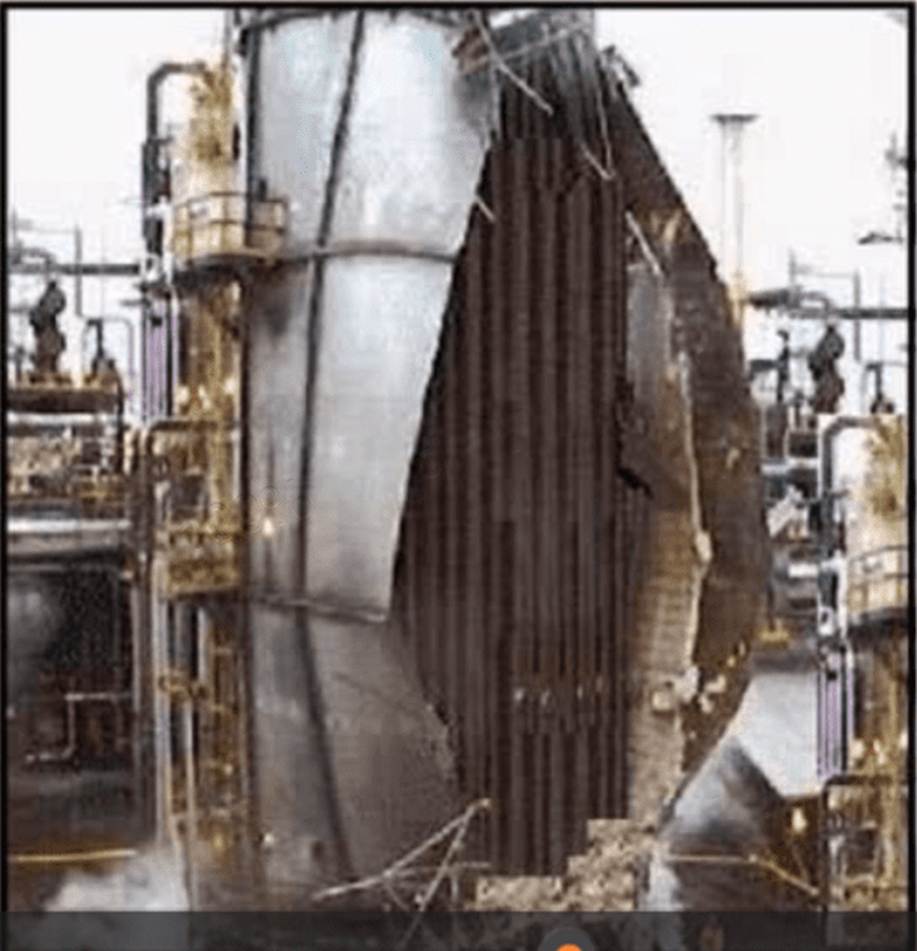
Upon lighting of the pilots, the heater exploded destroying the casing and damaging several tubes. Identify and discuss what elements of Risk-Based Process Safety, had they been implemented more effectively, could have reduced or eliminated the likelihood of this event occurring or reduced the consequences.
- A . Only Mechanical Integrity was involved
- B . Only Emergency Management was involved
- C . Multiple elements including Operating Procedures, Management of Change, Training, Asset Integrity, and Process Safety Culture were involved
- D . No RBPS elements could have prevented this incident
The control of the status of systems and equipment is part of:
- A . Incident Investigation
- B . Operational Readiness
- C . Conduct of Operations
- D . Hazard Identification and Risk Analysis
A 3000 gallon, stainless steel, insulated vessel rated for 30 psig is equipped with a rupture disc set for 30 psig for emergency relief.
Assuming each of the following scenarios has been deemed possible, which would require the smallest sized relief?
- A . A pool fire from the leak of a common solvent beneath the vessel
- B . An internal ignition of the vessel’s vapor space, the vessel containing a solvent
- C . A runaway reaction of the vessel’s contents, in solvent service, where testing has determined a temperature rise rate of 500°C/min at disc relief setting