
Practice Free AI-901 Exam Online Questions
HOTSPOT
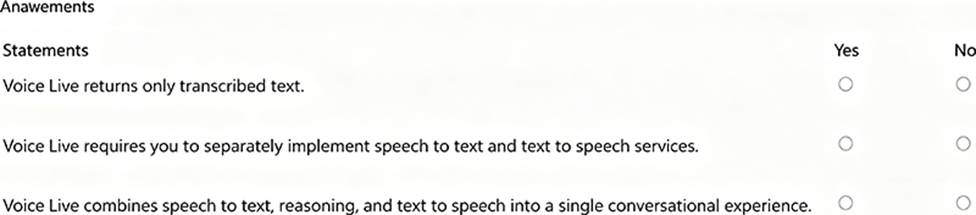
For each of the following statements, select Yes if the statement is true. Otherwise, select No. NOTE: Each correct selection is worth one point.
Explanation:
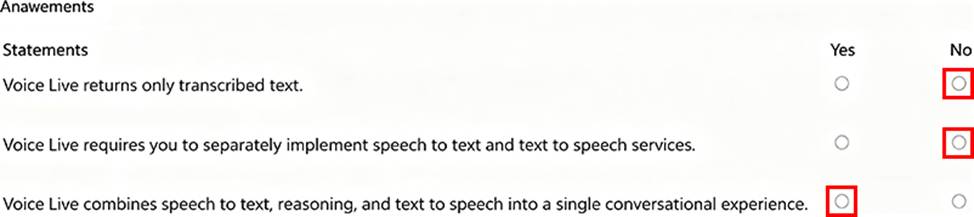
Statement 1: Voice Live returns only transcribed text. = No
Voice Live is not limited to transcription. Microsoft documentation states that the Voice Live API supports real-time bidirectional voice applications, including speech recognition, text-to-speech synthesis, avatar streaming, animation data, and audio processing.
Statement 2: Voice Live requires you to separately implement speech to text and text to speech services. = No
Voice Live provides a single real-time voice API experience rather than requiring separate STT and
TTS implementations for the conversational loop. Microsoft describes live AI voice conversations as combining speech capabilities for real-time interaction, and the Voice Live API includes speech recognition and text-to-speech synthesis features.
Statement 3: Voice Live combines speech to text, reasoning, and text to speech into a single conversational experience. = Yes
This is correct. Microsoft’s guidance explains that Azure OpenAI audio/realtime capabilities are for scenarios that combine audio with language understanding, reasoning, or generation in a single model call, and Voice Live supports real-time voice-enabled applications over WebSocket connections.
HOTSPOT
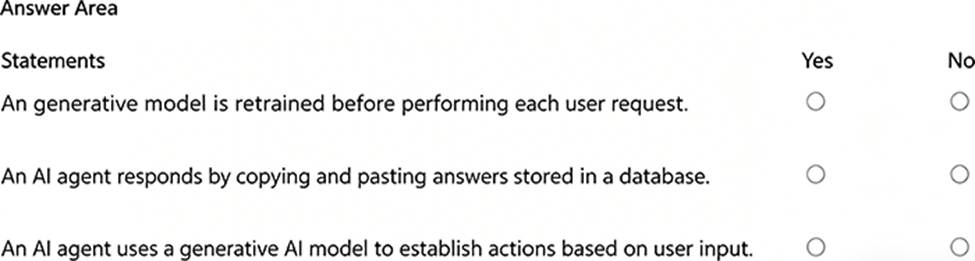
For each of the following statements, select Yes if the statement is true. Otherwise, select No. NOTE: Each correct selection is worth one point.
Explanation:
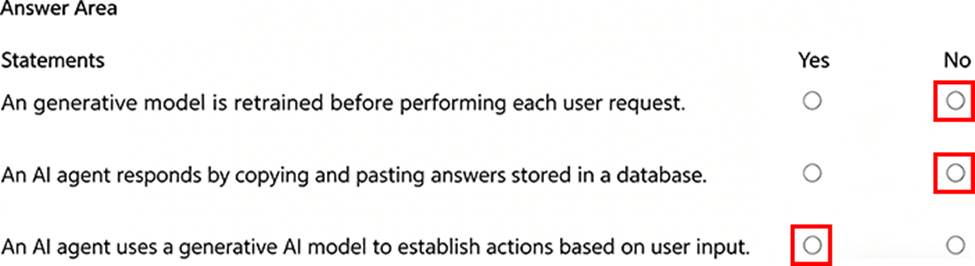
Statement 1: An AI generative model is retrained before performing each user request. = No A generative AI model is not retrained for every user request. During normal use, the model performs inference: it receives input, processes the prompt, and generates a response based on the deployed model.
Statement 2: An AI agent responds by copying and pasting answers stored in a database. = No An AI agent does not simply copy and paste stored answers. Agents use generative AI models, instructions, context, and optionally tools or connected data sources to reason over user input and produce responses or actions.
Statement 3: An AI agent uses a generative AI model to establish actions based on user input. = Yes This is correct. An AI agent uses a generative AI model together with instructions and available tools to interpret user input, determine the next action, and generate a response.
HOTSPOT
Select the answer that correctly completes the sentence.
Explanation:
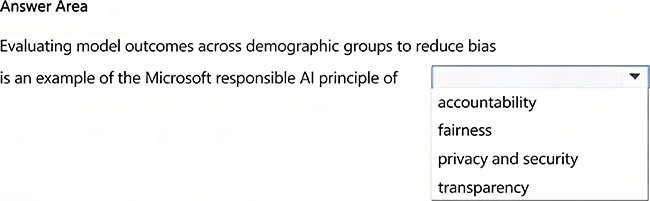
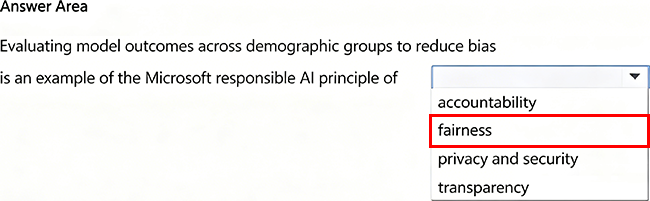
Evaluating model outcomes across demographic groups to reduce bias is an example of the Microsoft responsible AI principle of fairness.
The Microsoft responsible AI principle of fairness means AI systems should treat all people fairly and avoid unfair bias or discrimination across groups.
The other options are incorrect:
accountability means people and organizations remain responsible for AI systems and their effects.
privacy and security focuses on protecting data and controlling access.
transparency means users should understand when and how AI is being used, including system capabilities and limitations.
You need to create an AI agent in Microsoft Foundry that follows a specific role and behavior when responding to users.
What should you configure?
- A . tokens per minute (TPM)
- B . system instructions
- C . temperature
- D . max completion tokens
B
Explanation:
To create an AI agent that follows a specific role and behavior, you configure system instructions. Microsoft Foundry Agent Service documentation states that agent instructions define goals, constraints, and behavior.
Option A. tokens per minute (TPM) controls throughput quota, not behavior.
Option C. temperature controls response randomness/creativity, not the agent’s role.
Option D. max completion tokens controls response length, not the agent’s role or behavioral rules.
Therefore, the correct answer is B. system instructions.
You are developing a web app that processes invoices to calculate expenses.
You need to extract structured fields, including nested values, from the invoices by using a defined schema.
What should you use?
- A . a transcription workflow in Azure Speech in Foundry Tools
- B . an optical character recognition (OCR)-only document processing pipeline
- C . an analyzer in Azure Content Understanding in Foundry Tools
- D . an Azure AI Search service
C
Explanation:
The requirement is to extract structured fields, including nested values, from invoices by using a defined schema. In Azure Content Understanding, an analyzer is the processing unit that defines how content is analyzed, what information is extracted, and how the output is structured, including JSON fields.
Microsoft’s Content Understanding document solutions documentation states that Content Understanding uses customizable analyzers to extract essential information, fields, and relationships from documents and forms. Microsoft’s quickstart also shows invoice processing with the prebuilt-invoice analyzer to extract structured data from an invoice document.
Why the other options are incorrect: